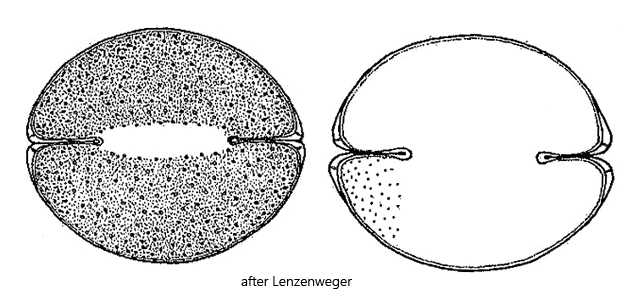
hyaline thickening of cell wall at basal corners of semi-cells
hyaline thickenings with large pore
two pyrenoids per semi-cell
Cosmarium obsoletum
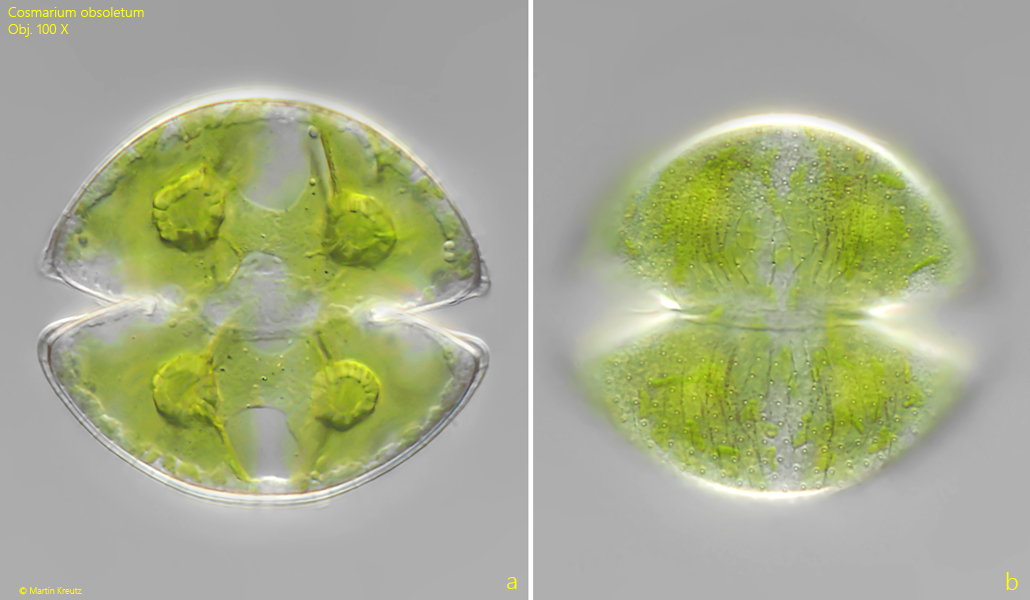
I found only very few specimens of Cosmarium obsoletum in samples from the Schwemm Moor in Austria in June 2025. This species is characterized by hyaline thickenings at the basal corners of the semi-cells, making it easy to identify. An enlarged pore canal runs through the hyaline thickenings, but is not easy to discern (s. fig 1 a). The sinus of the specimen shown below is somewhat atypically open outwards due to the slight coverslip pressure I applied.
Fig. 1 a-b:Cosmarium obsoletum. L = 51 µm. Two focal planes of a slightly squashed specimen in DIC. Note the hyaline thickenings of the basal corners of the semi-cells. Obj. 100 X.
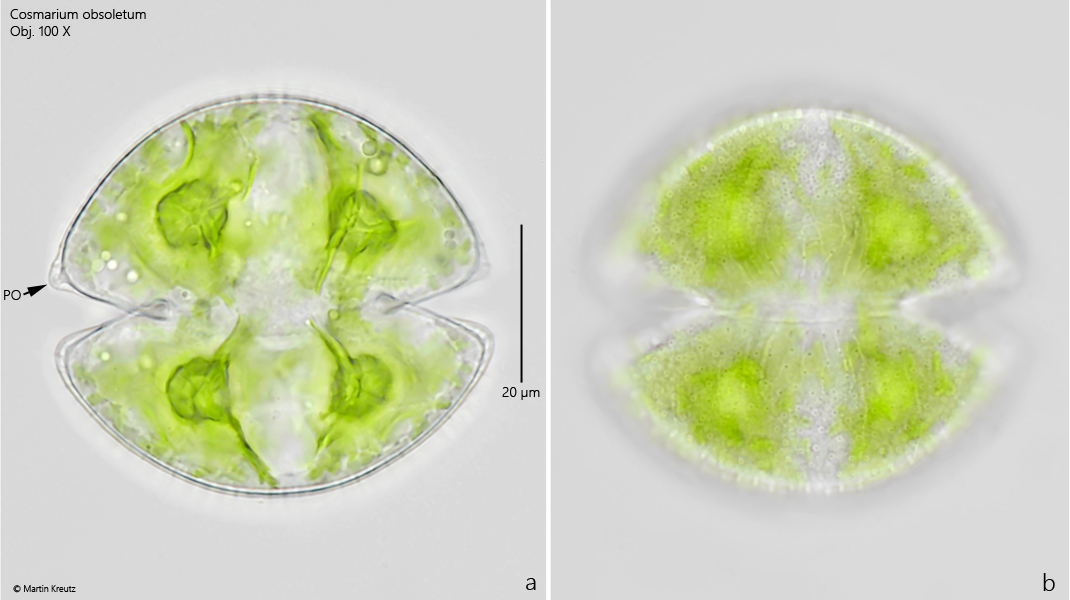
Fig. 2 a-b:Cosmarium obsoletum. L = 51 µm. The same specimen as shown in fig. 1 a-b in brightfield illumination. In the hyaline thickening of the upper semi-cell one of the large pores (PO) is visible. Obj. 100 X.