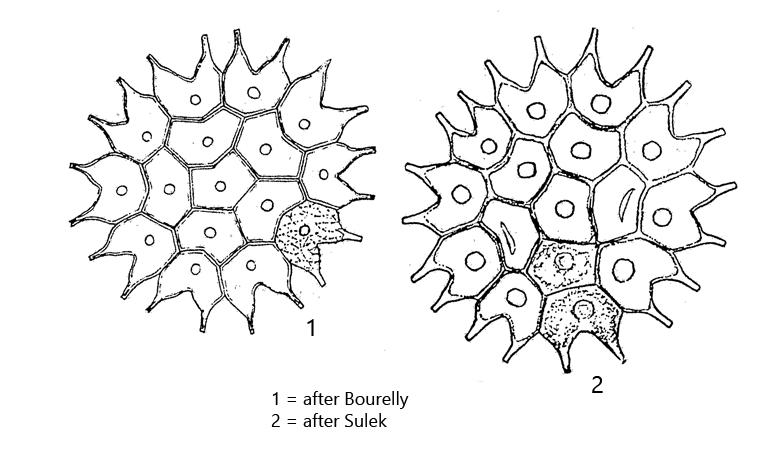
marginal cells 8–30 X 9–21 µm, cell wall smooth or finely granulated
inner cells concentrically arranged without intercelluar spaces
marginal cells bilobed with a V-shaped notch
marginal cells occasionally bearing tufts of mucilaginous spines at tips of lobes
chloroplast parietal
single pyrenoid
Pseudopediastrum boryanum
The species Pediastrum boryanum was transferred to Pseudopediastrum boryanum by Hegewald in 2005. I found Pseudopediastrum boryanum in the plankton of the strongly eutrophic pond of the waste disposal company Constance. This pond is fed by the purified water of the sewage plant, which is still very rich in nutrients.
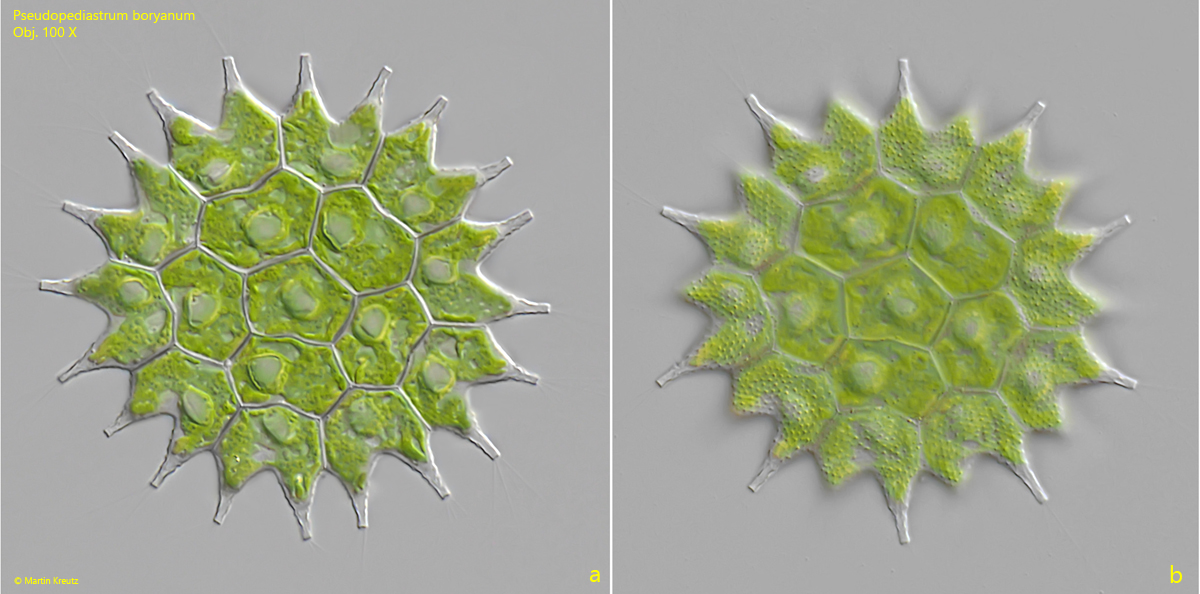
Pseudopediastrum boryanum can be easily recognized by the lack of any intercellular spaces in the coenobium. The inner cells have a hexagonal shape and the marginal cells have a distinct V-shaped notch and two projections each. At the distal ends of the projections often tufts of thin fibers are visible, which I interpret as an adaptation to the planktonic habitat. The cell wall of Pseudopediastrum boryanum is finely granulated.
Fig. 1 a-b: Pseudopediastrum boryanum. D = 73 µm. Two focal planes of a slightly squashed 16 cell coenobium. The cell wall is finely granulated. Obj. 100 X.