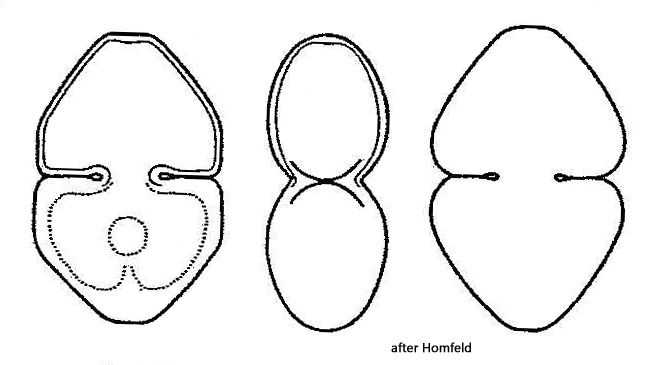
semi-cells trapezoidal or triangular with broadly rounded corners
basal part of the half cells sometimes with parallel sides
length 20–48 µm, width 13–31 µm
sinus narrow, slightly dilated to the istmus
cell wall finely granulated, thickened at apices
one pyrenoid per semi-cell
Cosmarium granatum
I first found Cosmarium granatum in December 1994 in a shallow pond in the Wollmatinger Ried. In May 1996 I found further specimens in samples from the Tettermoor (Austria) and in the Simmelried in May 2025.
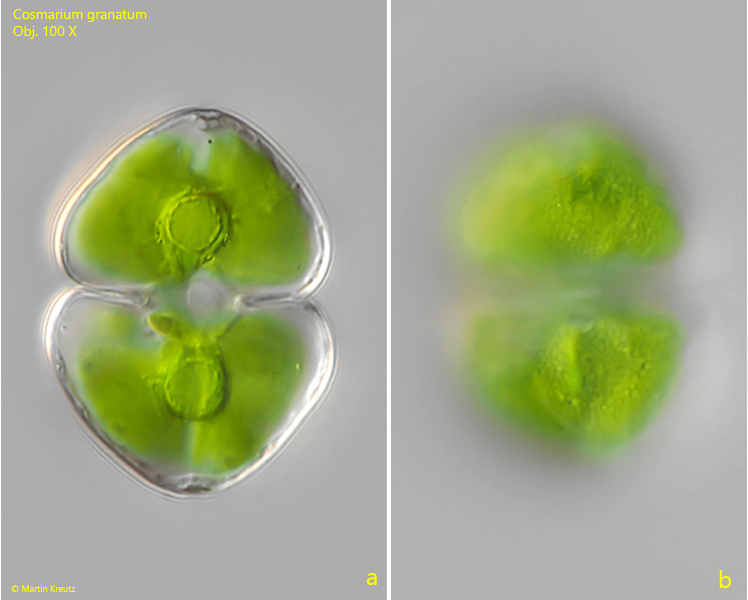
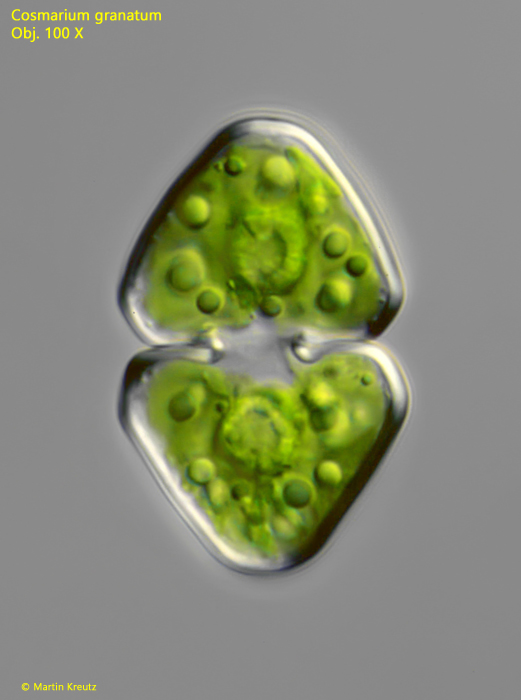
I recognize Cosmarium granatum by the almost triangular shape of the half-cells, whereby the corners are always broadly rounded. Sometimes the sides are angled again just above the sinus (s. figs. 1 a-b and 3). The cell wall of Cosmarium granatum is quite thick in relation to the cell size. It is finely granulated, without warts or tubercles.
Fig. 1 a-b:Cosmarium granatum. L = 42 µm. Two focal planes of a specimen found in May 2025 in the Simmelried. Obj. 100 X.
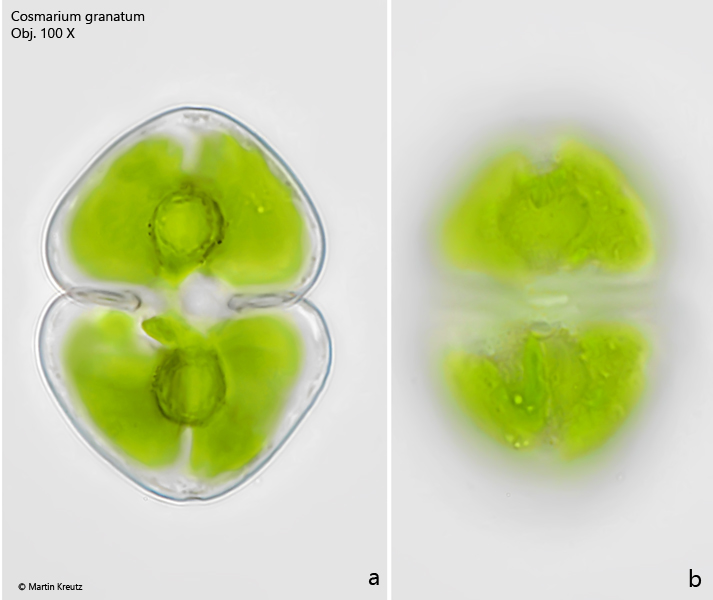
Fig. 2 a-b:Cosmarium granatum. L = 42 µm. The same specimen as shown in fig. 1 a-b in brightfield illumination. Obj. 100 X.
Fig. 3:Cosmarium granatum. L = 43 µm. A second specimen found in May 1996 in the Tettermoor (Austria). Obj. 100 X.