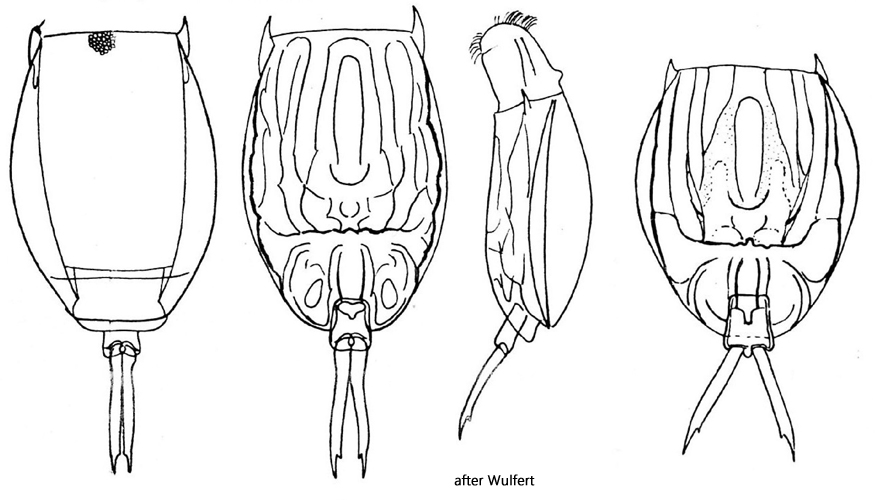
between dorsal and ventral plate of lorica a furrow
anterior ventral and dorsal margin of lorica straight truncated
two lateral small spines at anterior margin of lorica
the cuticle of the lorica strongly sculptured with ridges
length 85–105 µm (of lorica)
foot segments rectangular or pyramidal
toes slender, 24–36 µm long
base of toes slightly narrowed
claws short (5–7µm)
one eyespot
Lecane stichaea
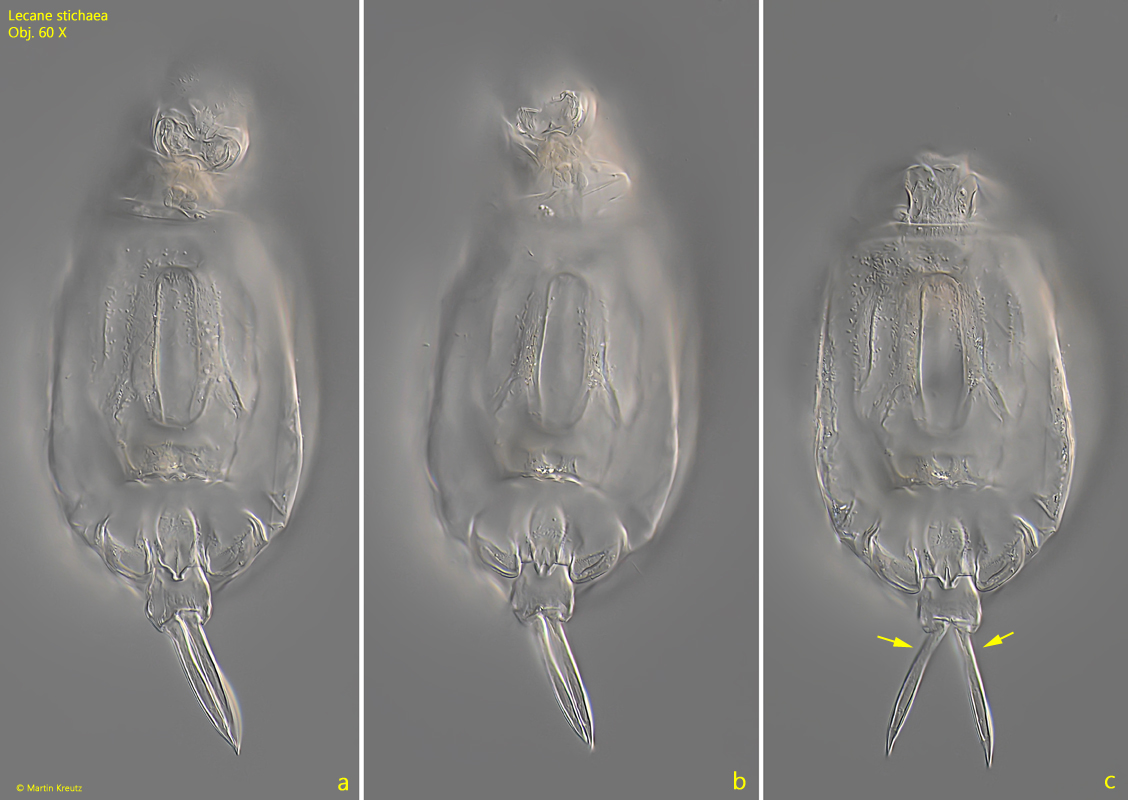
I have found only a few specimens of Lecane stichaea in samples from the Lauchsee Moor in Austria. Unfortunately, I was only able to examine the ventral side, which is heavily sculptured, while the dorsal side is smooth. The pattern of the ventral side is very characteristic (see also the drawings by Wulfert, above). Additionally, Lecane stichaea has two small lateral spines on the front edge of the lorica (s. fig. 2 b). These are even more clearly visible in a contracted specimen. Another feature is the slender toes, which taper somewhat basally (s. fig. 1 c).
Fig. 1 a-c:Lecane stichaea. L = 98 µm (of lorica). A slightly squashed specimen from ventral. Note the slight constriction at the base of the toes (c, arrows). Obj. 60 X.
Fig. 2 a-b:Lecane stichaea. L = 98 µm (of lorica). The stronger squashed specimen as shown in fig. 1 a-c). The ventral side is strongly sculptured with a characteric pattern. Note the two lateral spines (LS) at the anterior margin of the lorica. Obj. 60 X.
Fig. 3 a-b:Lecane stichaea. To focal planes of the trophi in a strongly squashed specimen. Obj. 100 X.