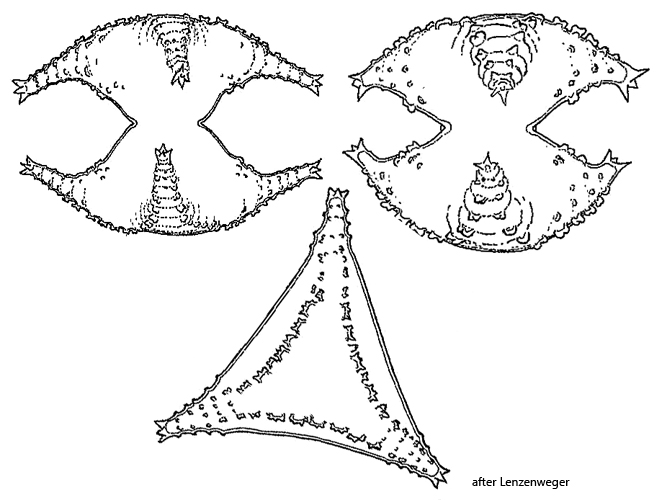
arms with concentric rows of granules, often pairs
intramarginal also pais of warts
Staurastrum traunsteineri
So far, I have found Staurastrum traunsteineri only once in June 2025 in the Schwemm Moor. However, only a few specimens were found in the samples. Lenzenweger (1997) lists the Egelsee near Abtenau as a location.
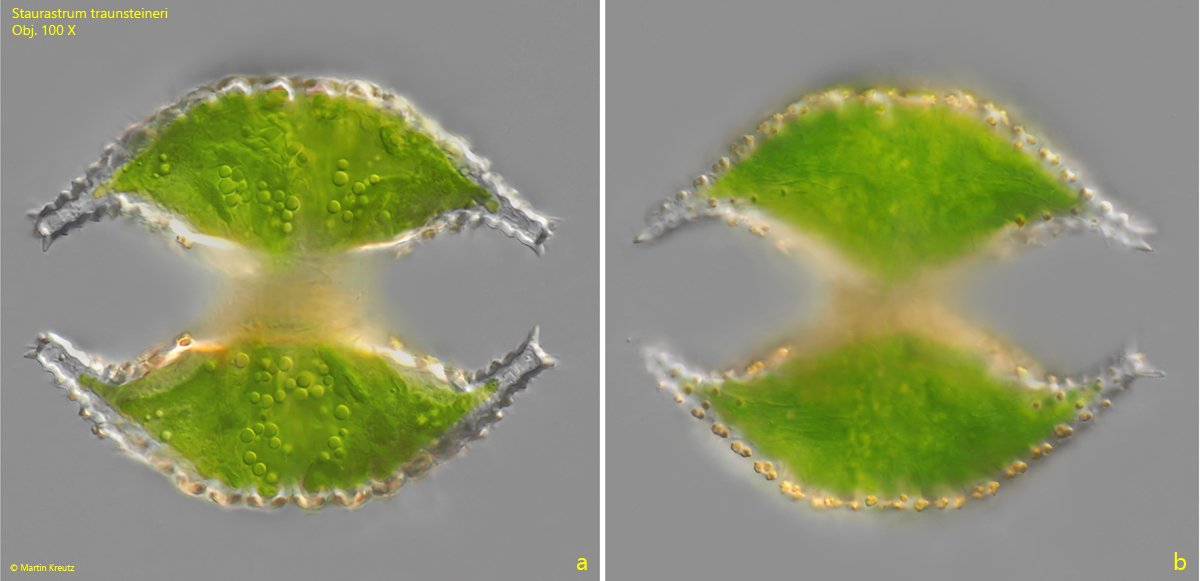
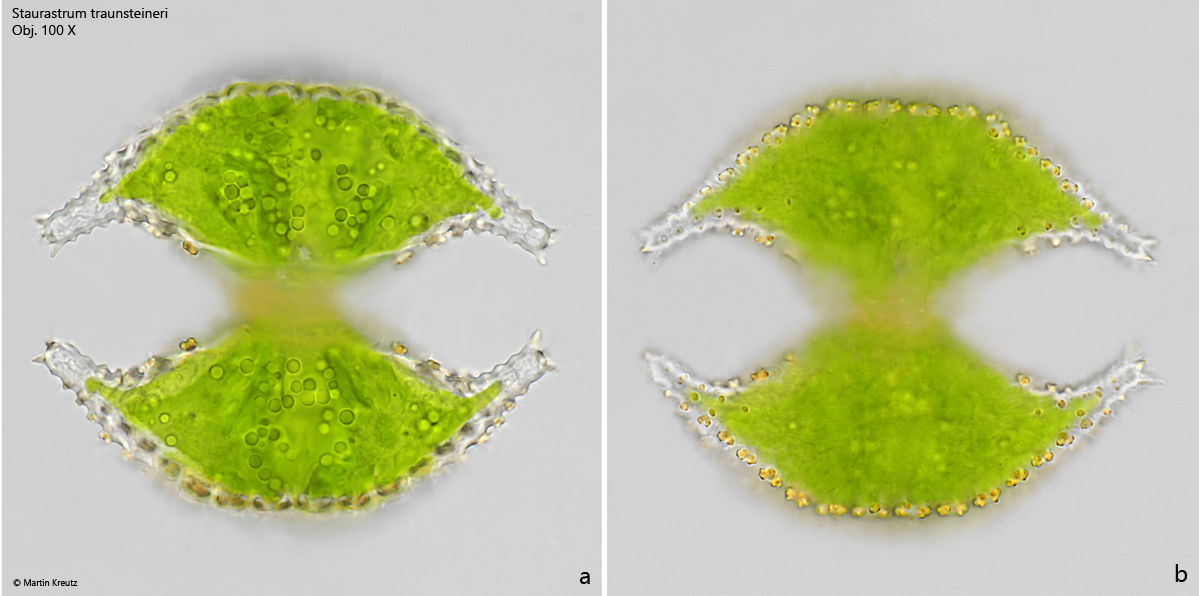
In the samples, Staurastrum traunsteineri stands out even at low magnifications due to its shape. The arms are clearly curved towards the cell equator, while the apices are almost flat. In extreme cases, the arms can even touch at the equator. Several spines sit at the ends of the arms, and rows of warts run from the apices to the ends of the arms, which are often paired and brownish in color.
Fig. 1 a-b:Staurastrum traunsteineri. L = 72 µm. Two focal planes in DIC of a specimen found in June 2025 in the Schwemm Moor. Obj. 100 X.
Fig. 2 a-b:Staurastrum traunsteineri. L = 72 µm. The same specimen as shown in fig. 1 a-b in brightfield illumination. Obj. 100 X.