Synonyms: Closterium obtusum var. pusillum, Arthrodia pusilla, Closterium naviculoides, Closterium pusillum var. monolithum, Closterium pusillum var. minus
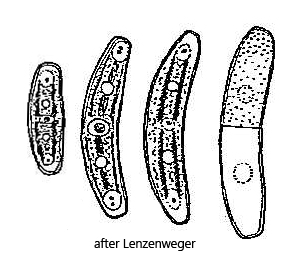
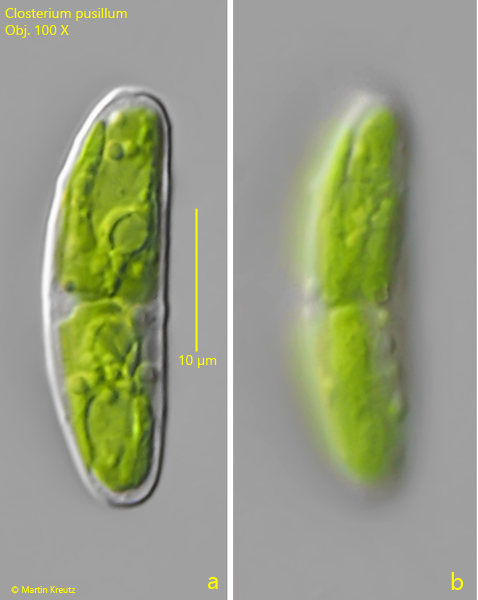
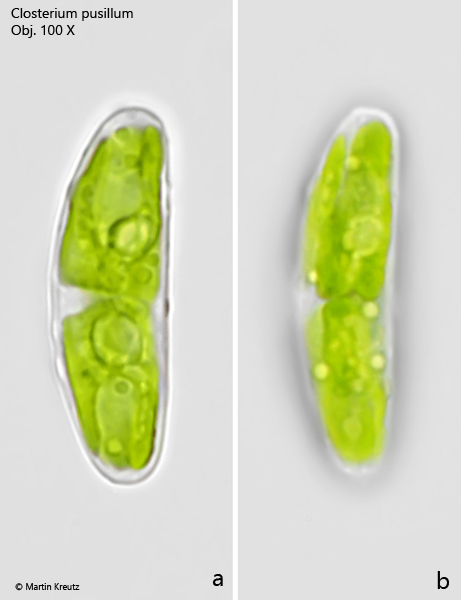
So far, I have found only a single specimen of Closterium pusillum in an old sample from the Schwemm Moor. This species is the smallest within the genus Closterium. The specimen was 28 µm in length, at the lower end of the range for Closterium pusillum. This form was designated by Lenzenweger (1996) as Closterium pusillum var. minus, but he also pointed out that the designation is taxonomically doubtful. In fact, the variant is listed as a synonym of Closterium pusillum (s. “Synonyms” above).
The cell wall of my specimen was smooth and colorless, but showed small irregularities that appeared as tiny bumps on the surface. Chloroplasts and pyrenoids corresponded to the description, but I could not detect any terminal vacuoles. Possibly these were obscured by the chloroplasts.
Fig. 1 a-b:Closterium pusillum. L = 28 µm. Two focal planes of a specimen in DIC. Obj. 100 X.
Fig. 2 a-b:Closterium pusillum. L = 28 µm. The same specimen as shown in fig. 1 a-b in brightfield illumination. Obj. 100 X.