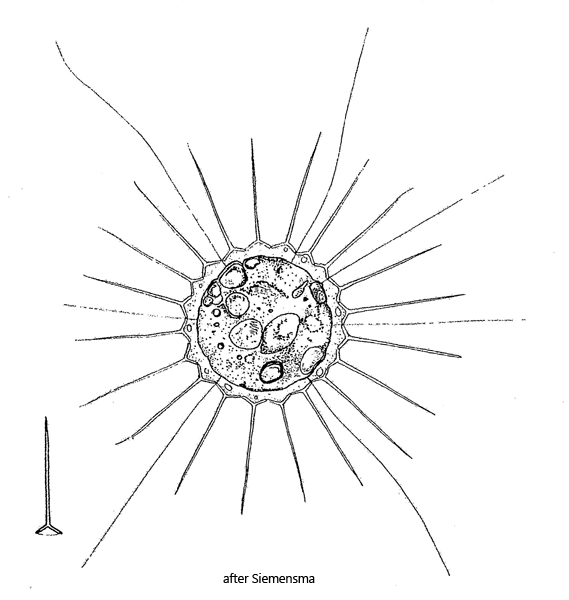
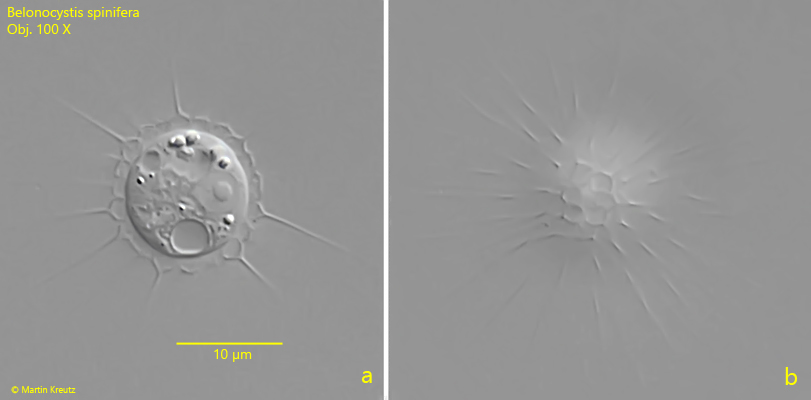
cells covered by hollow spines with a tent-shaped base
filopodia thread-like, wavy (hard to see)
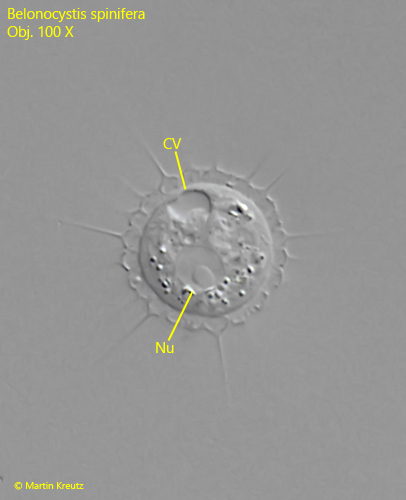
1–4 contractile vacuoles
nucleus eccentrically, with spherical nucleolus
Belonocystis spinifera
I usually find Belonocystis spinifera in acidic, peaty waters. Very rarely, I also find this species in the Simmelried. In fresh samples, the small specimens are usually difficult to find. In older samples, the specimens are more easily found in grown detritus flakes on the walls of the sample containers.
Although Belonocystis spinifera has the external appearance of a heliozoan, the species belongs to the amoebae. This is due to the fine, flexible filopodia with which Belonocystis spinifera can also move. These are not rigid axopodia with central, axonemal microtubules.
The scales of Belonocystis spinifera cover the entire body and leave no oral aperture. They consist of a hollow spine that broadens umbrella-like at the base. In optical section, this structure appears tent-shaped. The fine filopodia extend between these scales and are very difficult to see. I myself have not been able to observe them so far.