Cosmarium bicuneatum

(F.Gay) Nordstedt, 1889

Most likely ID: n.a.


Synonym: Euastrum bicuneatum, Ursinella bicuneata, Cosmarium arctoum var. tatricum


Sampling location: Sima Moor (Austria)


Phylogenetic tree: Cosmarium bicuneatum


Diagnosis: 

  • cells small, as long as wide
  • length 10–14 µm, width 8–13 µm
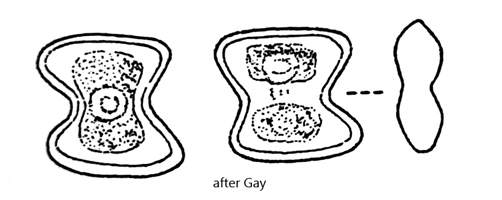
  • sinus blunt-winged, widely open
  • isthmus broad
  • apices slightly convex
  • cell wall smooth
  • elliptical to spindle-shaped in apical view
Cosmarium-bicuneatum
Cosmarium bicuneatum

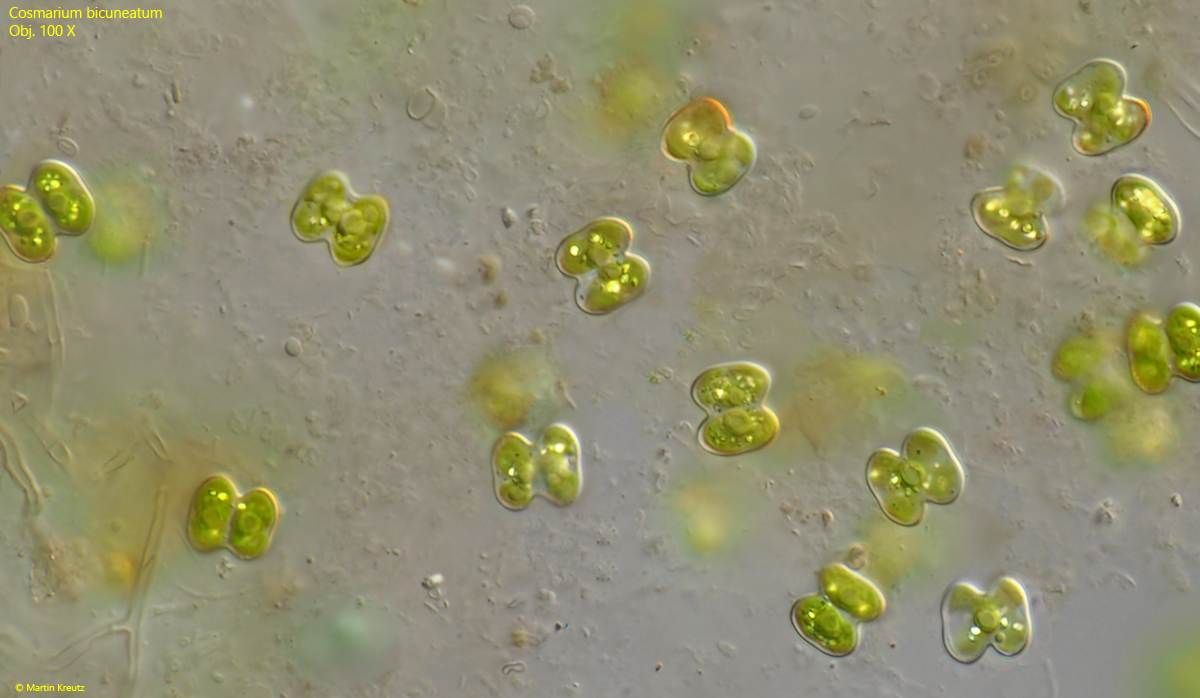
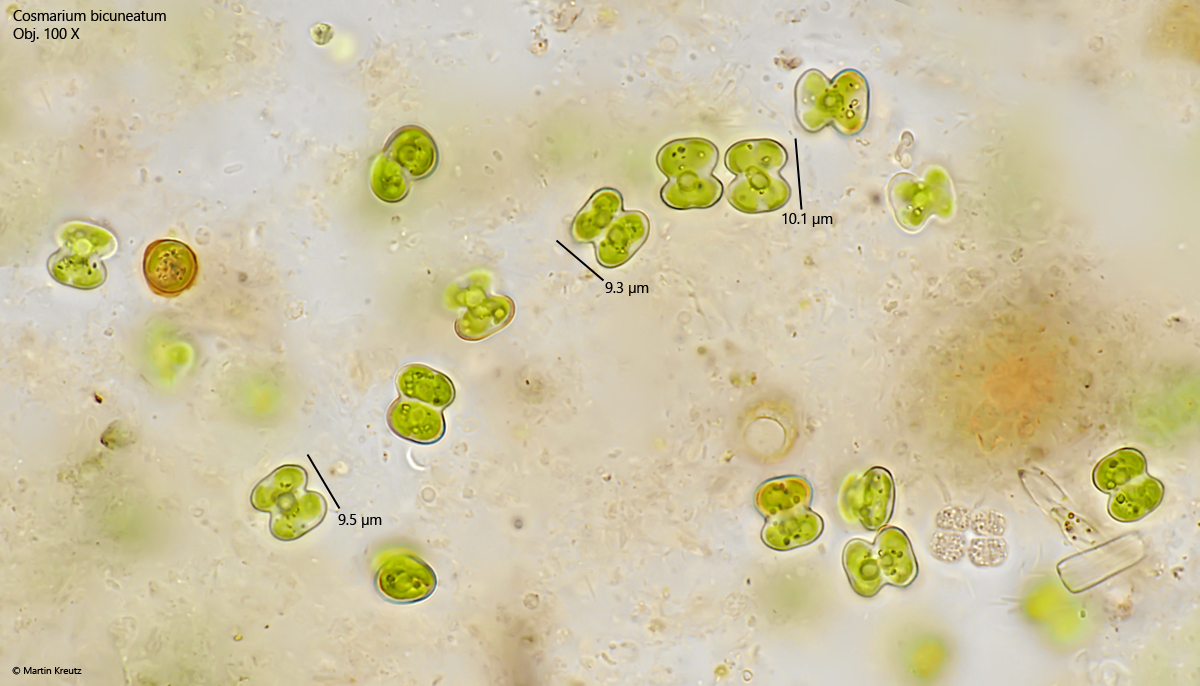
I have so far only found Cosmarium bicuneatum in samples from the Sima Moor in Austria. The cells stand out due to their very small size. In my population, the cells were only 9–10 µm long. This placed them at the lower end of the range of 10–14 µm given by Lenzenweger (1999). Another striking feature is the widely open sinus and the broad isthmus. Lenzenweger describes the apices as slightly convex. However, in my population, there were also cells with a very slight, concave indentation.


The similar species Cosmarium bioculatum and Cosmarium asphaerosporum var. corribense have a similar cell shape to Cosmarium bicuneatum, but are twice as large, measuring 18–25 µm and 16–24 µm respectively.
 

More images and information on Cosmarium bicuneatum: Wolfgang Bettighofer-Protiststen.de-Cosmarium bicuneatum

Cosmarium-bicuneatum

Fig. 1: Cosmarium bicuneatum. L = 9–10 µm. A cluster of some cells in brightfield illumination. Obj. 100 X.

Cosmarium-bicuneatum

Fig. 2: Cosmarium bicuneatum. L = 9–10 µm. A second cluster in DIC. Obj. 100 X.