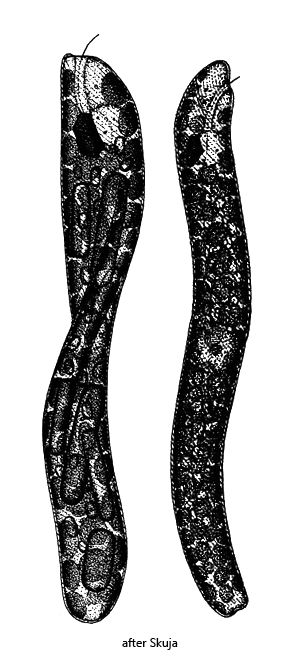
Euglena ehrenbergii is one of the largest species within the genus, which I very often find in my sampling sites. The specimens are often located between floating algae mats or on the mud layer at the bottom.
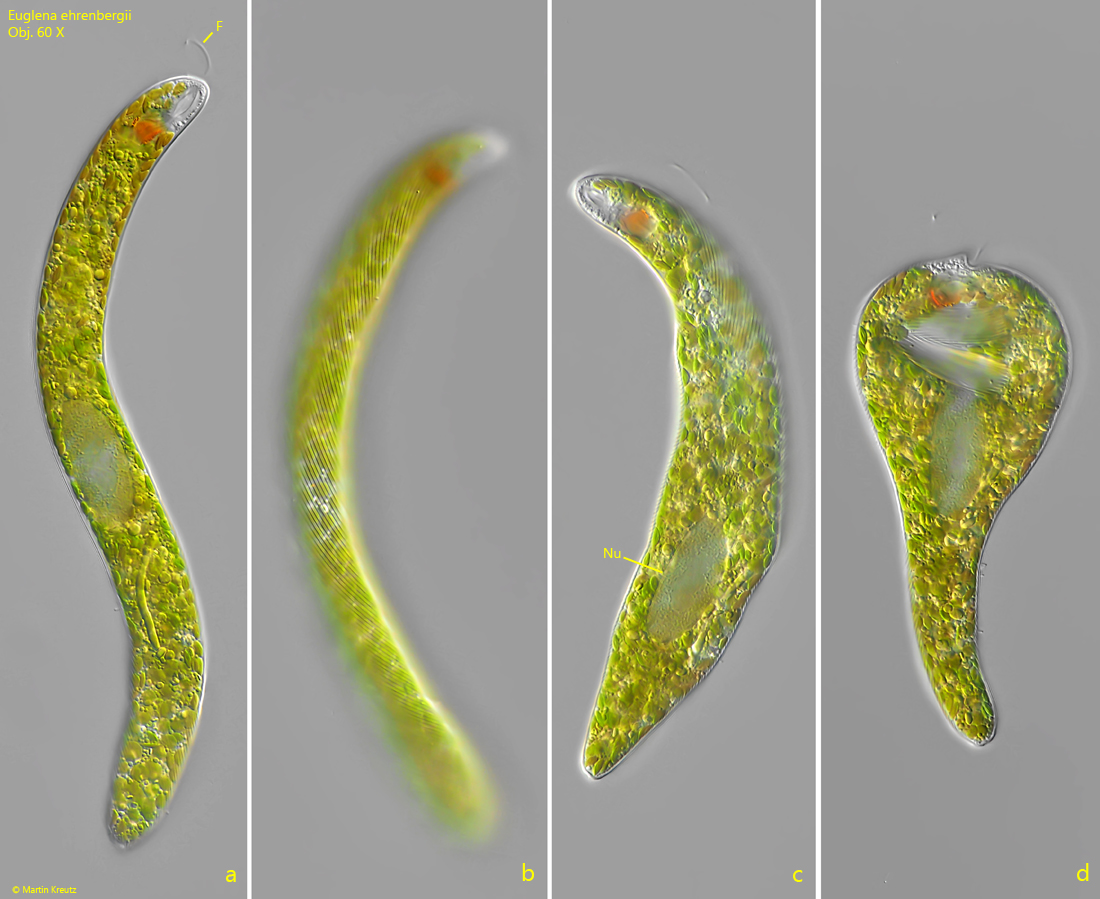
The shape and movement of Euglena ehrenbergii are very characteristic. The body is parallel-sided with rounded ends. The posterior end can also be truncated transversely. The movement is worm-like, with strong metabolic deformations of the body (s. fig. 1 a-d). I have not yet been able to observe actively swimming specimens. However, Gojdics (1953) reports that Euglena ehrenbergii is capable of swimming despite the short flagellum and takes on a spiral shape while doing so.
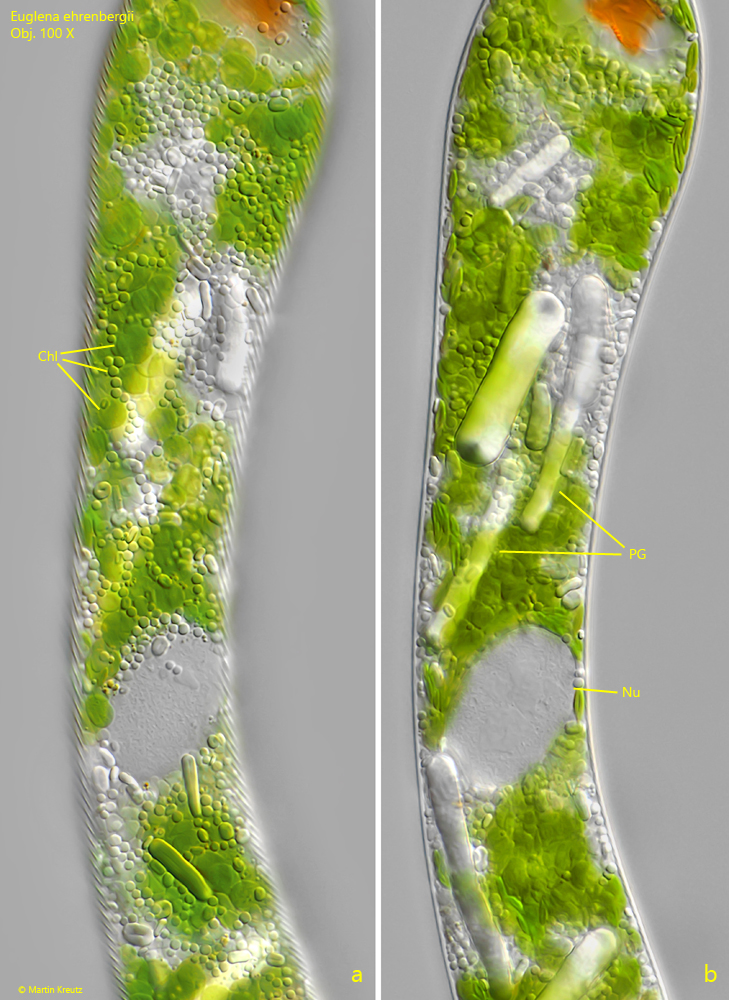
Another characteristic feature of Euglena ehrenbergii is the shape and arrangement of the paramylon grains. Above and below the centrally located nucleus, there are usually large paramylon grains, which are either regularly oblong or irregularly rod-shaped (s. fig. 5 b). Often, the rod-shaped paramylon grains show a bend or a slight kink.
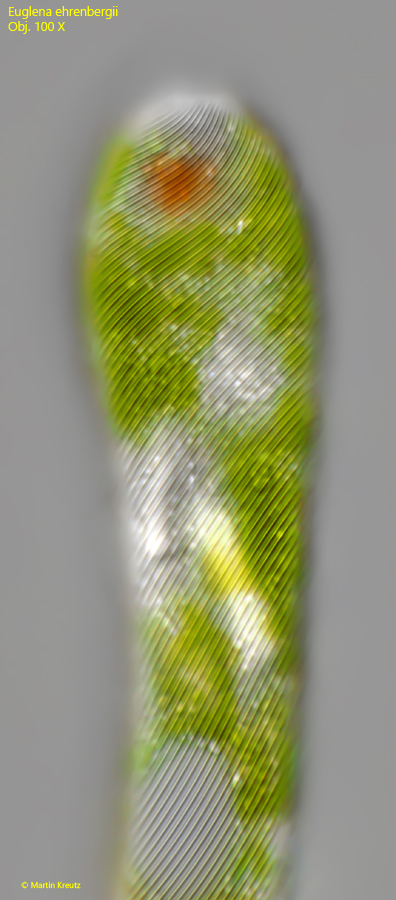
The pellicle has a distinct striation that runs clockwise over the body, which is unusual for euglenids (s. fig. 4). Beneath the pellicle, the disc-shaped chloroplasts are arranged, which often lie very densely and in several layers (s. fig. 5 a).
Fig. 1 a-d:Euglena ehrenbergii. L = 212 µm. Different phases of the euglenoid movement. Obj. 60 X.
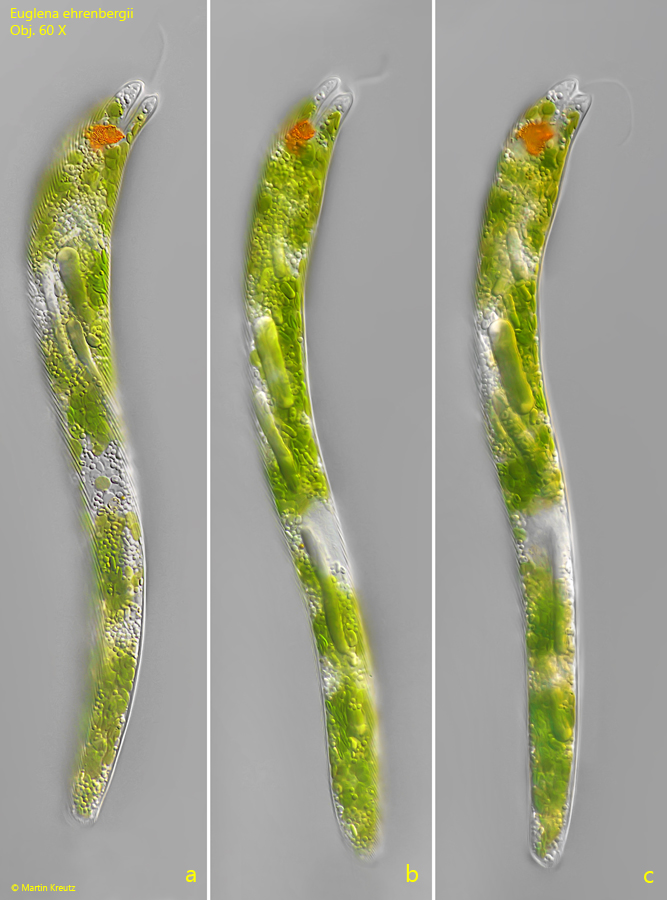
Fig. 2 a-c:Euglena ehrenbergii. L = 292 µm. Different focal planes of a second spcimen. Obj. 60 X.
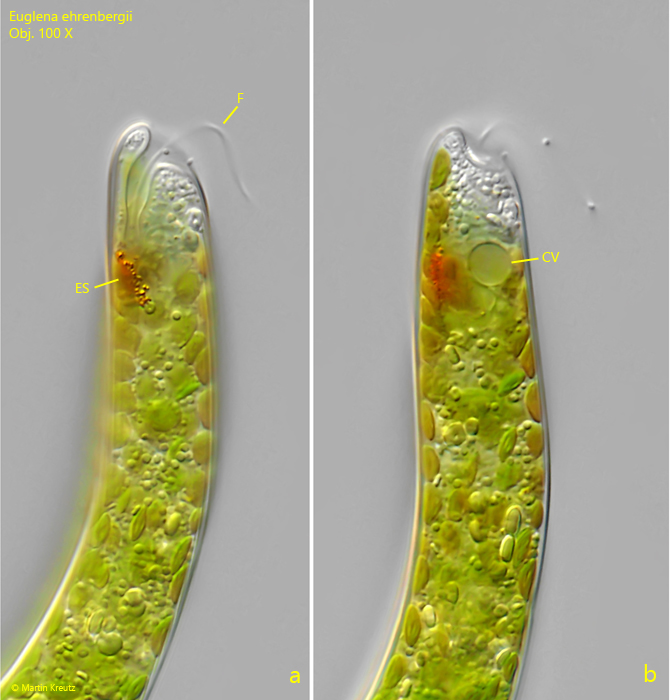
Fig. 3 a-b:Euglena ehrenbergii. The pharynx in detail. CV = contractile vacuole, ES = eyespot, F = flagellum. Obj. 100 X.
Fig. 4:Euglena ehrenbergii. The distinct striation of the pellicle is running clockwise of the body. Obj. 100 X.
Fig. 5 a-b:Euglena ehrenbergii. Two focal planes of a squashed specimen. Numerous disc-shaped chloroplasts (Chl) are arranged beneath the pellicle . The nucleus (Nu) is oval and located centrally. Above and below the nucleus, large paramylon grains (PG) are visible, which are either oblong in shape or irregularly rod-shaped. Obj. 100 X.