I find Phacus polytrophos rarely, but regularly in the Simmelried. Most of the specimens are found in floating, decomposing plant masses together with other Euglenophyceae.
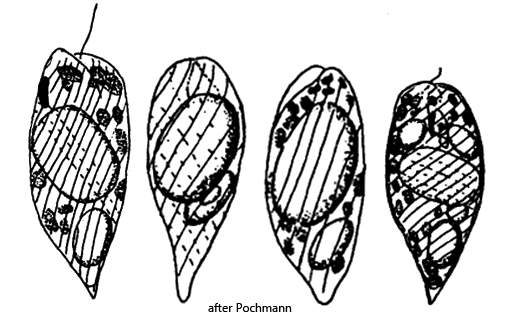
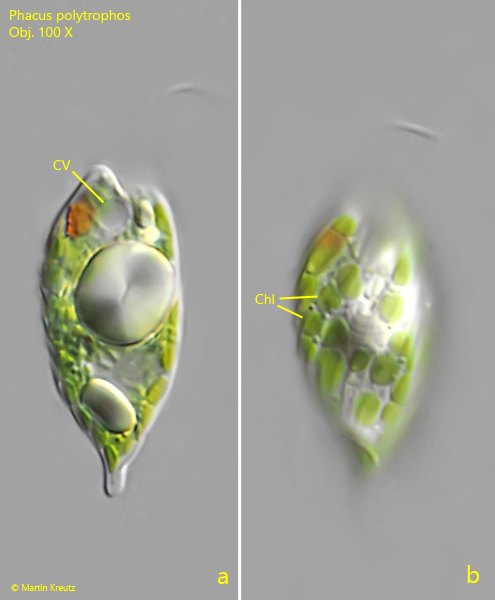
The body shape of Phacus polytrophos is quite characteristic, as the posterior end is usually drawn out into a blunt spine and the anterior end has two differently long, high protrusions. In most specimens, two large paramylon grains are present, with the anterior one always being larger than the posterior one (s. fig. 1 a). Additionally, these paramylon grains are often (not always) arranged obliquely in the cell body (s. fig. 2 a). Another important feature is the striation of the pellicle, which runs clockwise at an angle of less than 45° (s. fig. 1 c).
Phacus polytrophos can easily be confused with Phacus oscillatus and Phacus pusillus, which have a similar size and body shape. However, Phacus oscillatus is distinctly flattened dorso-laterally and Phacus pusillus has a longitudinal striations of the pellicle with little or no curvature.
Fig. 1 a-d:Phacus polytrophos. L = 32 µm. Different focal planes of a freely swimming specimen. Note the two large paramylon grains (Pg 1, PG 2) and the clockwise running striation of the pellicle. Nu = nucleus. Obj. 100 X.
Fig. 2 a-b:Phacus polytrophos. L = 27 µm. A second freely swimming specimen. Note the obliquely arranged, large paramylon grains. CV = contractile vacuole, Chl = disc-shaped chloroplasts. Obj. 100 X.
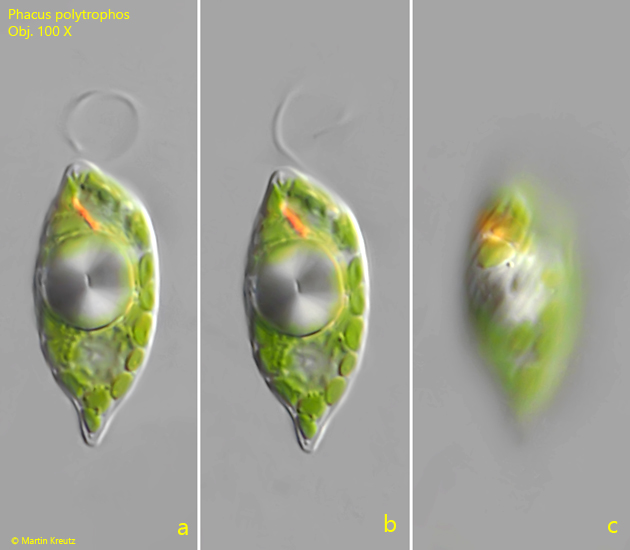
Fig. 3 a-c:Phacus polytrophos. L = 26 µm. A third specimen with only one large paramylon grain. Obj. 100 X.