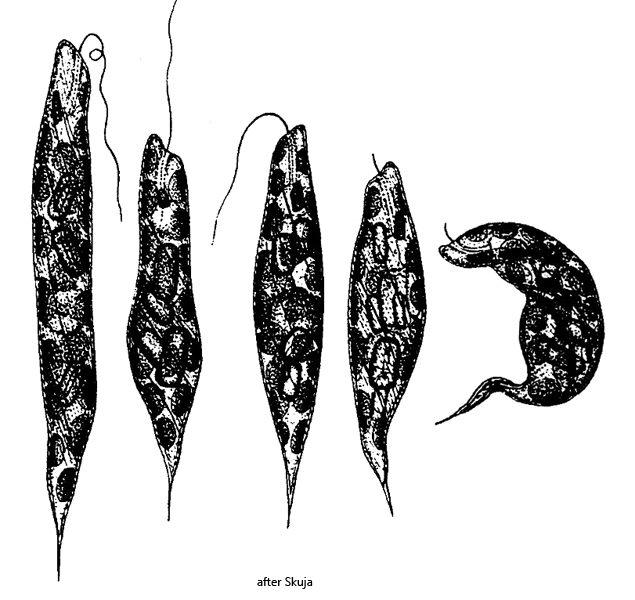
4–6 larger paramylon grains, broad elliptical or cylindrical
many smaller paramylon grains present
eyespot small
about 25 chloroplasts, discoid, lobed or squarish
flagellum one-half of body length
nucleus central
bends into C-shape
Discoplastis gasterosteus
So far, I have only found Discoplastis gasterosteus in the Simmelried. There, in April 2026, I was able to find a large population in decaying plant matter. It is possible that I had previously overlooked this small species.
Discoplastis gasterosteus was first described by Skuja (1948) as Euglena gasterosteus. In 2021, Zakryś & Łukomska transferred the species to the newly created genus Discoplastis. The genus Discoplastis includes all euglenids which have disc-shaped chloroplasts without pyrenoids and are capable of metabolic movement.
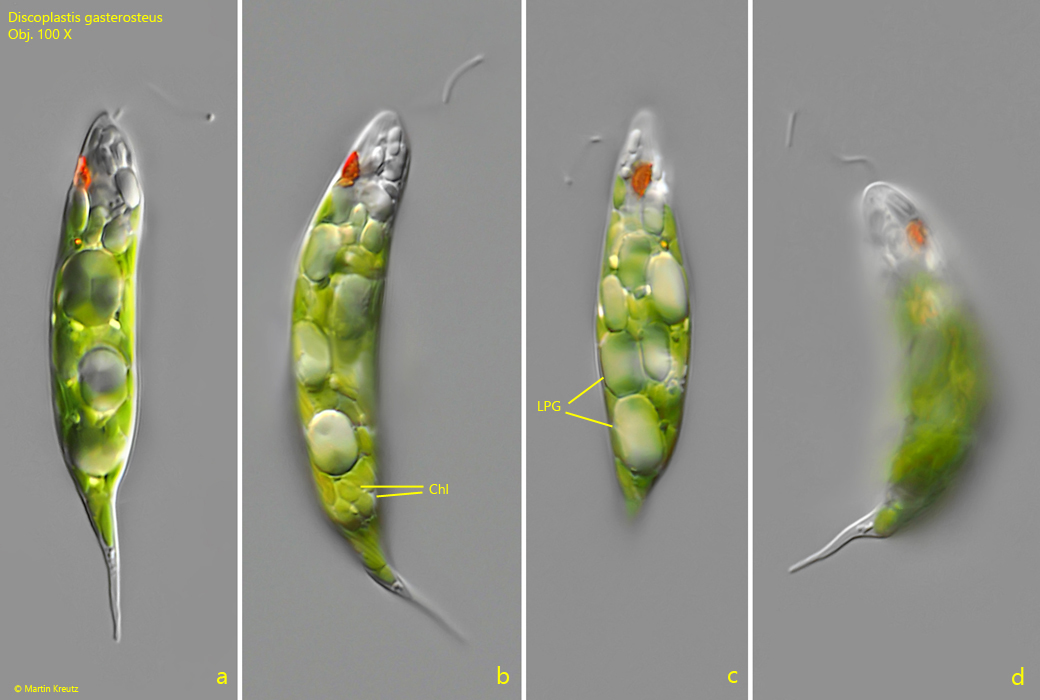
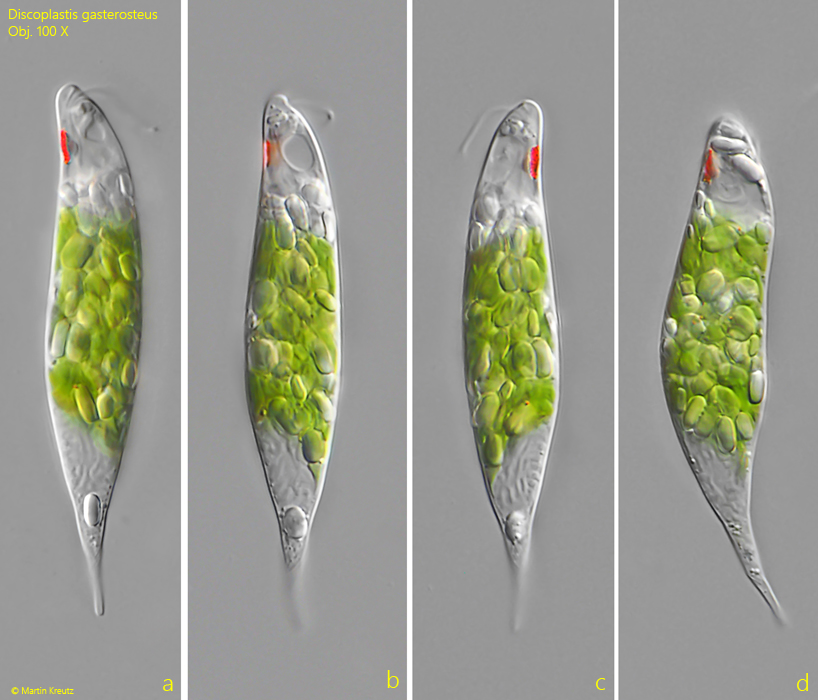
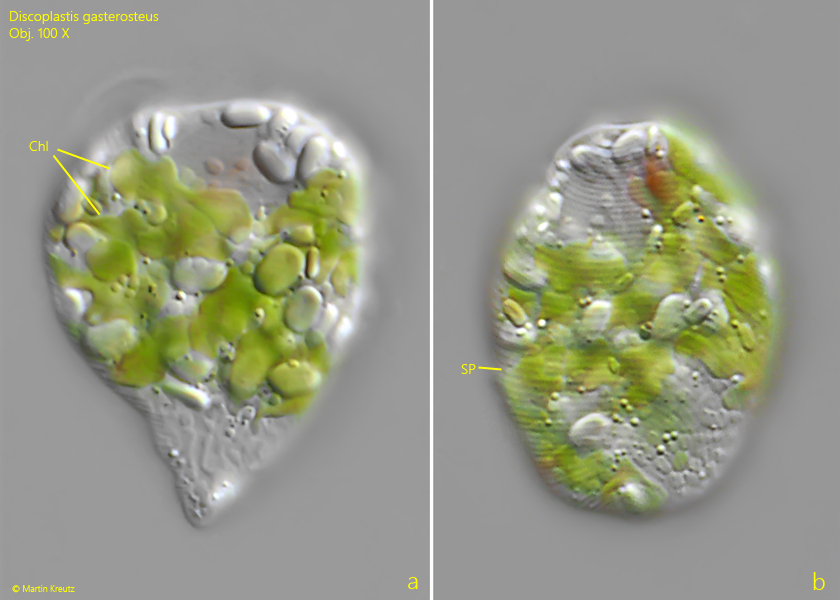
Discoplastis gasterosteus has an almost cylindrical body with parallel sides. The apical end is slanted, so that the flagellum emerges somewhat laterally. The posterior end is drawn out into a pointed tail. In the cytoplasm, several larger paramylon grains can be found, which have a quite distinct cylindrical shape (s. fig. 1 c). Skuja (1948) observed a maximum of 6 of these larger paramylon grains and no smaller ones. In my populations, there were sometimes 8 of these larger paramylon grains, and I could also recognize many smaller paramylon grains in the cell body. These smaller grains were especially found in the apical region. In some specimens the chloroplasts were disc-shaped (s. fig. 1 b) and in other specimens lobed (s. fig. 3 a) as described by Gojdics (1953). The pellicle itself is distinctly striated (s. fig. 3 b). The striation runs counterclockwise.
Fig. 1 a-d:Discoplastis gasterosteus. L = 58 µm. A freely swimming specimen. Chl = disc-shaped chloroplasts, LPG = large paramylon grains with almost cylindrical shape. Obj. 100 X.
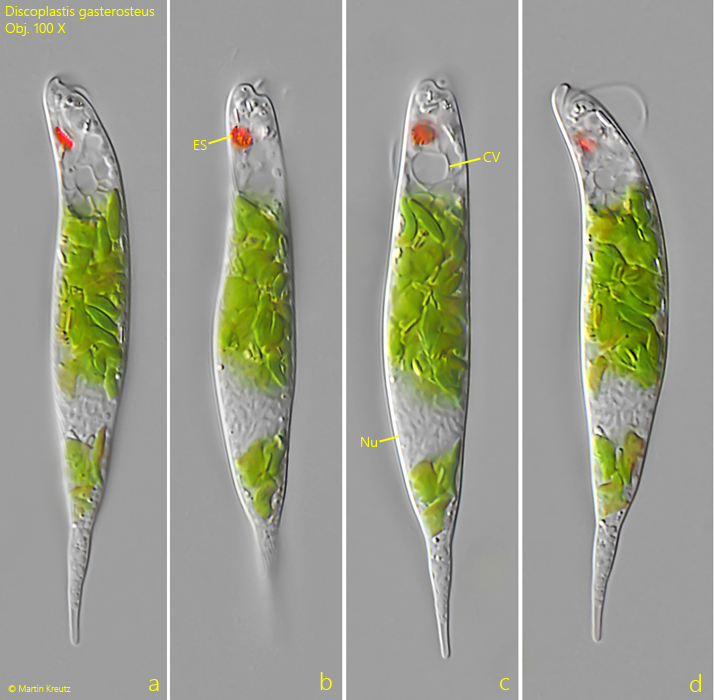
Fig. 2 a-d:Discoplastis gasterosteus. L = 63 µm. A second freely swimming specimen. CV = contractile vacuole, ES = eyespot, Nu = nucleus. Obj. 100 X.
Fig. 3 a-d:Discoplastis gasterosteus. L = 56 µm. A third freely swimming specimen. Obj. 100 X.
Fig. 2:Discoplastis gasterosteus. Focal planes on the lobed chloroplasts (Chl) and on the striation of the pellicle (SP) in a squashed specimen. The striation is running counterclockwise. Obj. 100 X.