Spirochaeta plicatilis is a very common bacterium, which can be found in almost all bodies of water with a layer of decaying sludge. It is facultatively anaerobic, which means that it can live under both aerobic and anaerobic conditions.
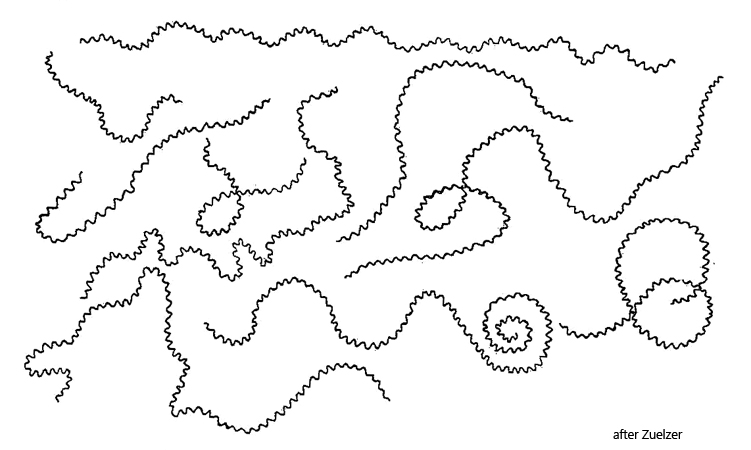
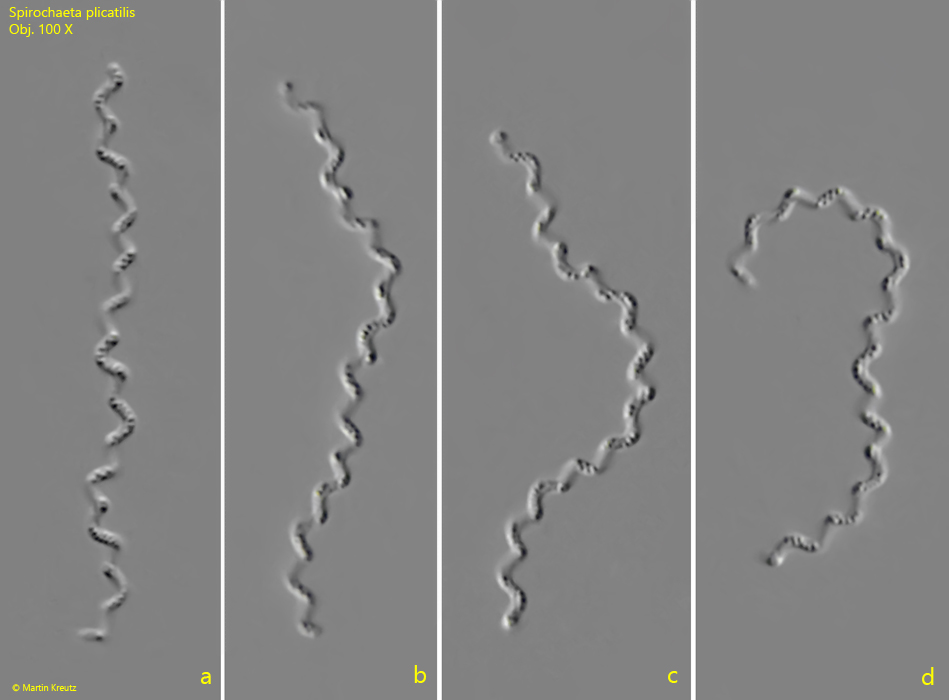
With its spiral shape, Spirochaeta plicatilis is very striking. In addition, it is enormously large at 50–250 µm, even though the body has a diameter of only about 0.5–1 µm. The bacterium often settles on the floating coverslip and can then be observed very well. It moves extremely actively. In addition to the constant bending of the body, it also moves forward in a screw-like motion.
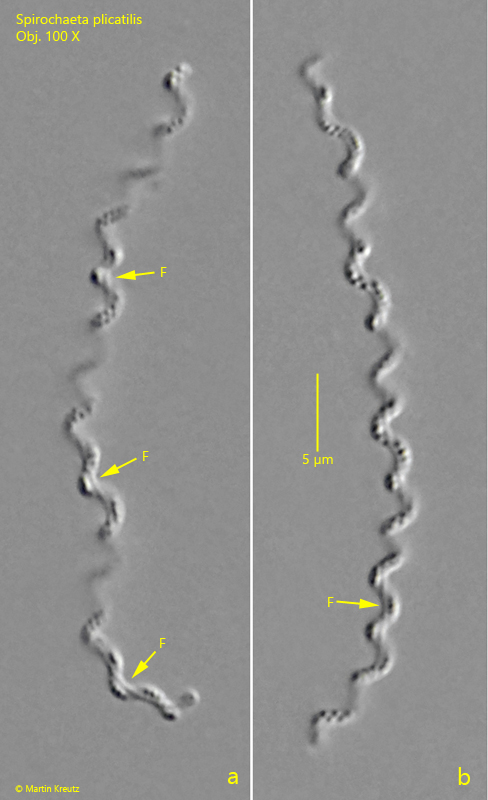
Even at high magnification, no flagella are visible at the ends of the body. This is because at both ends of the cell, a flagellum emerges subapically and these flagella lie close to the body (s. fig. 2). In the middle of the body, the flagella can also overlap. The activity of these two flagella creates a rotational movement of the body and thus the screw-like locomotion. In living cells, these flagella lying close to the body can also be seen at high magnification (s. fig. 3 a-b).
Fig. 1 a-d:Spirochaeta plicatilis. L = 48 µm. A freely moving specimen. Obj. 100 X.
Fig. 2:Spirochaeta plicatilis. A schematic drawing of the body structure according to Holt. The two flagella (F1, F2) originate subapically and lie against the spirally coiled body. In the middle of the body, the flagella may overlap. The screw-like movement is produced by the motion of the flagella.
Fig. 3 a-b:Spirochaeta plicatilis. L = 48 µm. The flagella (F) lying close to the body, as shown in fig. 2, are visible at high magnification. Obj. 100 X.