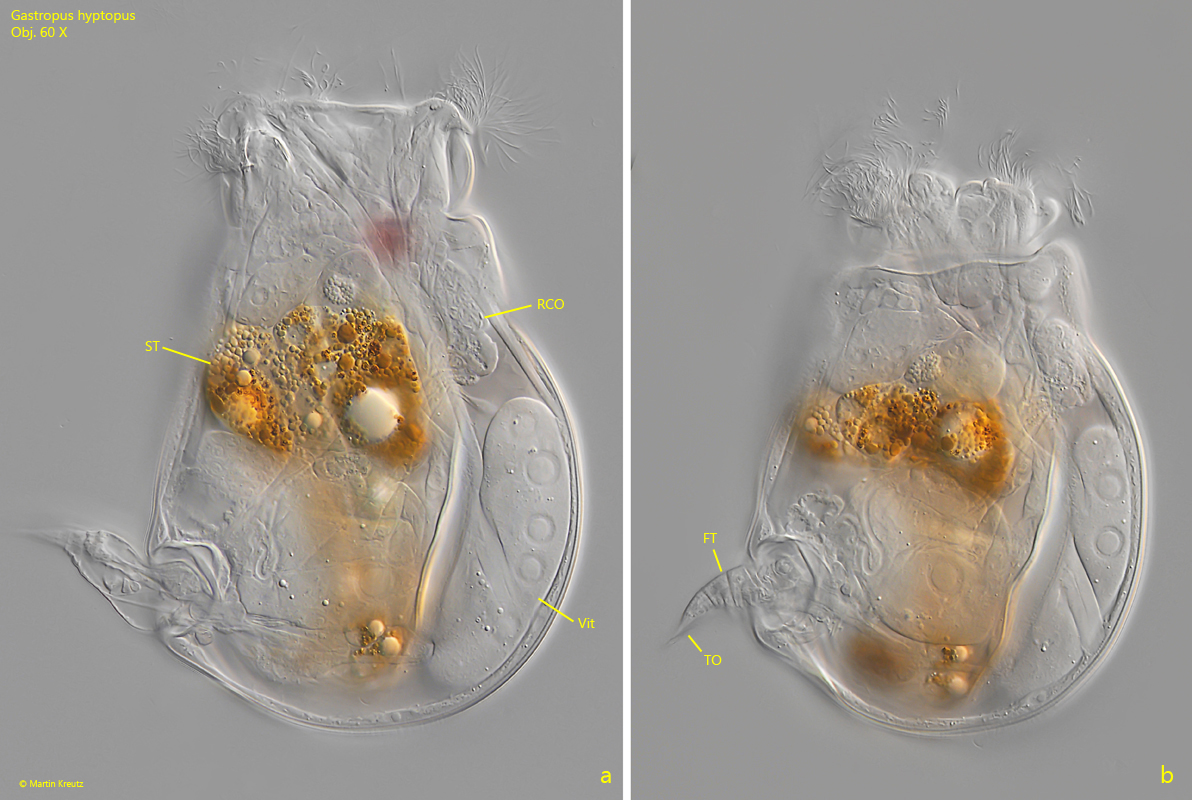
stomach colored yellow-brownish, with oil droplets
antennae arise from circular, wart-shaped protusions
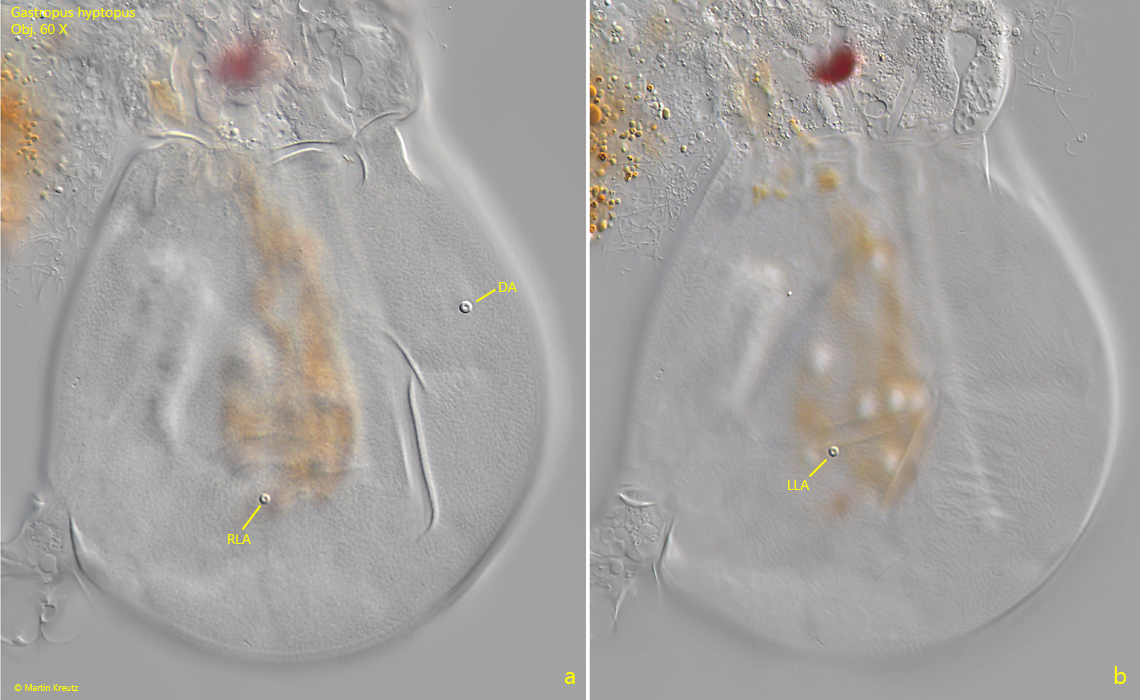
dorsal antenna above middle of body
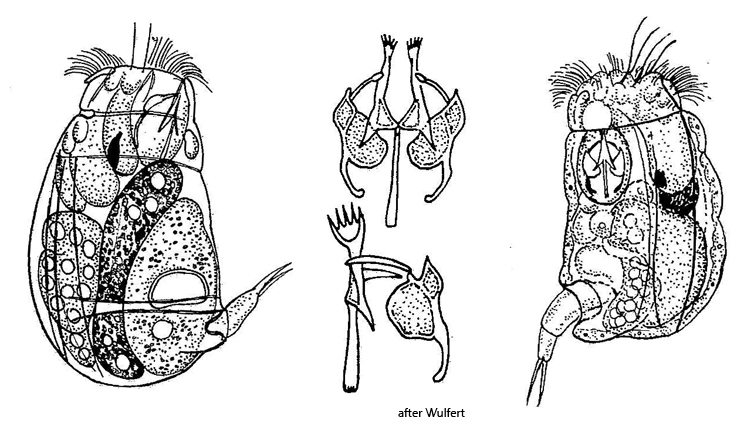
Gastropus hyptopus
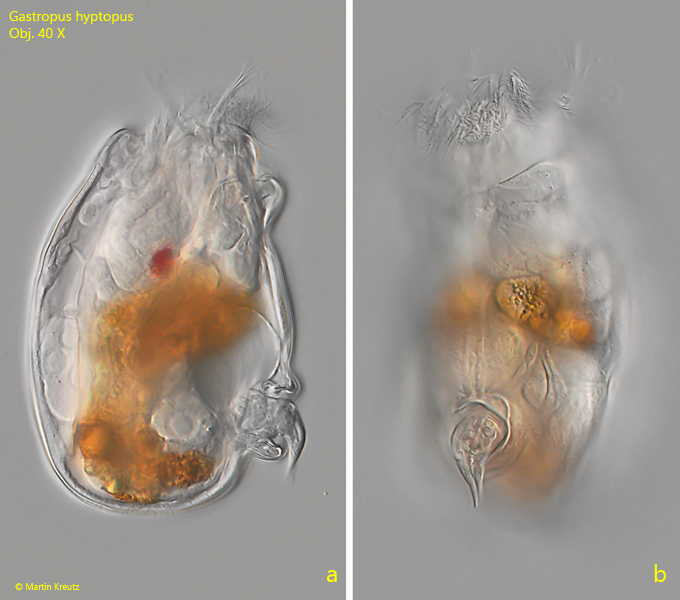
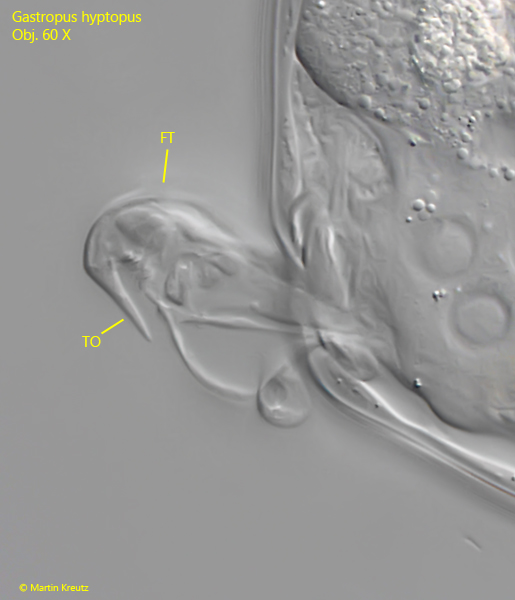
So far, I have only been able to find Gastropus hyptopus in samples from the Odertal national park. A characteristic feature of the genus Gastropus is the foot opening of the lorica, which is shifted toward the ventral side. In Gastropus hyptopus it is displaced into the posterior third. The foot is composed of two segments with two slender toes that are sharply pointed. The foot is retractable.
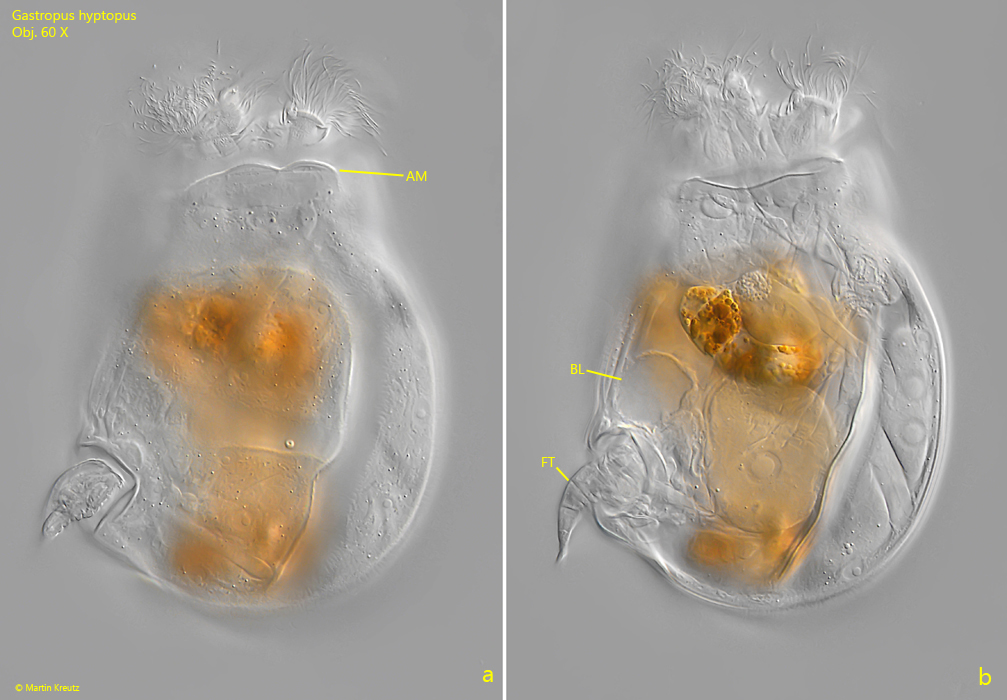
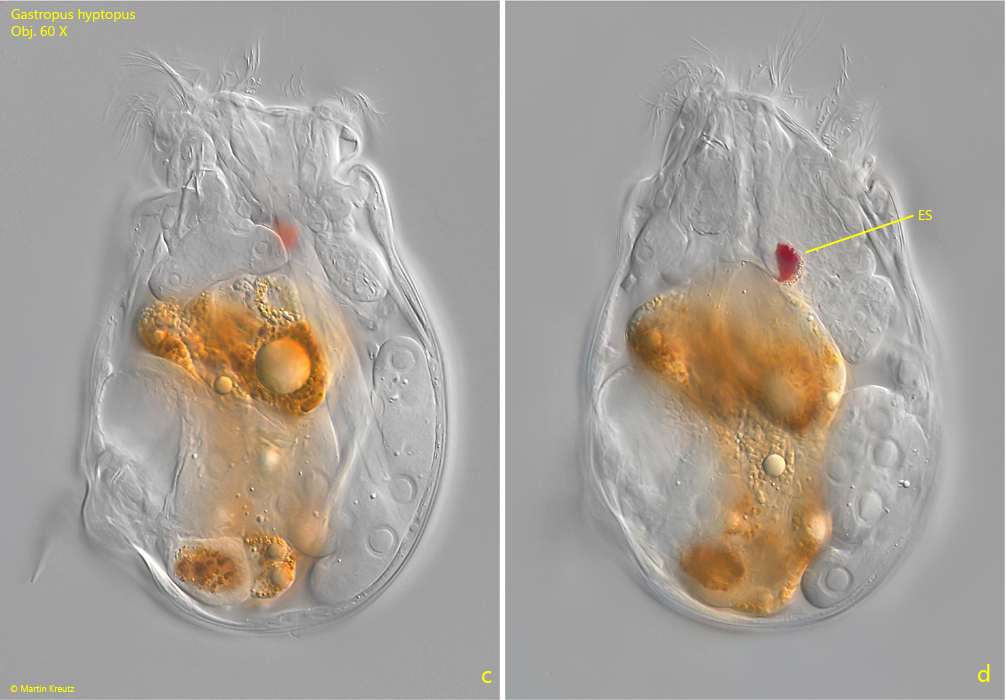
The most important characteristics of Gastropus hyptopus are the wavy apical margin of the lorica (s. fig. 2 a), the yellow-brown stomach with distinct oil droplets (s. fig. 3 a), and the dorsal antenna located above the middle of the body (s. fig. 5 a).
The similar species Gastropus minor is smaller, with a maximum length of 125 µm, and it has a neck-like tapered anterior end. In addition, the dorsal antenna in Gastropus minor is clearly situated below the middle of the body.
Fig. 1 a-b:Gastropus hyptopus. L = 140 µm. A freely swimming specimen from right (a) and from ventral (b). Obj. 40 X.
Fig. 2 a-d:Gastropus hyptopus. L = 148 µm. Different focal planes of a freely swimming specimen from left. Note the wavy shaped anterior margin (AM) of the lorica. ES = eyespot, BL = bladder, FT = foot. Obj. 60 X.
Fig. 3 a-b:Gastropus hyptopus. L = 148 µm. The same specimen as shown in fig. 2 a-d slightly squashed. FT = foot, RCO = retrocerebral organ, ST = stomach, TO = toes, Vit = vitellarium. Obj. 60 X.
Fig. 4:Gastropus hyptopus. The foot (FT) and the tapered toes (TO) in a squashed specimen. Obj. 60 X.
Fig. 5 a-b:Gastropus hyptopus. Focal planes on the right side (a) and on the left side of the strongly squashed specimen. The dorsal antenna (DA) as well as the right lateral (RLA) and left lateral (LLA) antenna are visible. Obj. 60 X.