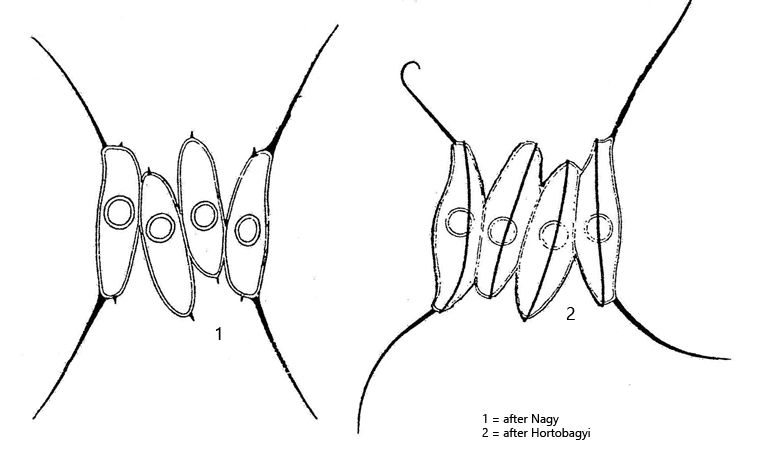
linear coenobia of 2–4 cells (rarely 8) inner cells arranged at an angle
cells 8–28 long, width 3.4–8 µm
cells ellipsoid with slightly tapered ends
lateral margins of outer cells smooth
apices of inner cells with small spines or warts
apices of outer cells with long spines (about 18 µm).
lateral surfaces of cells smooth or with ribs, often interrupted
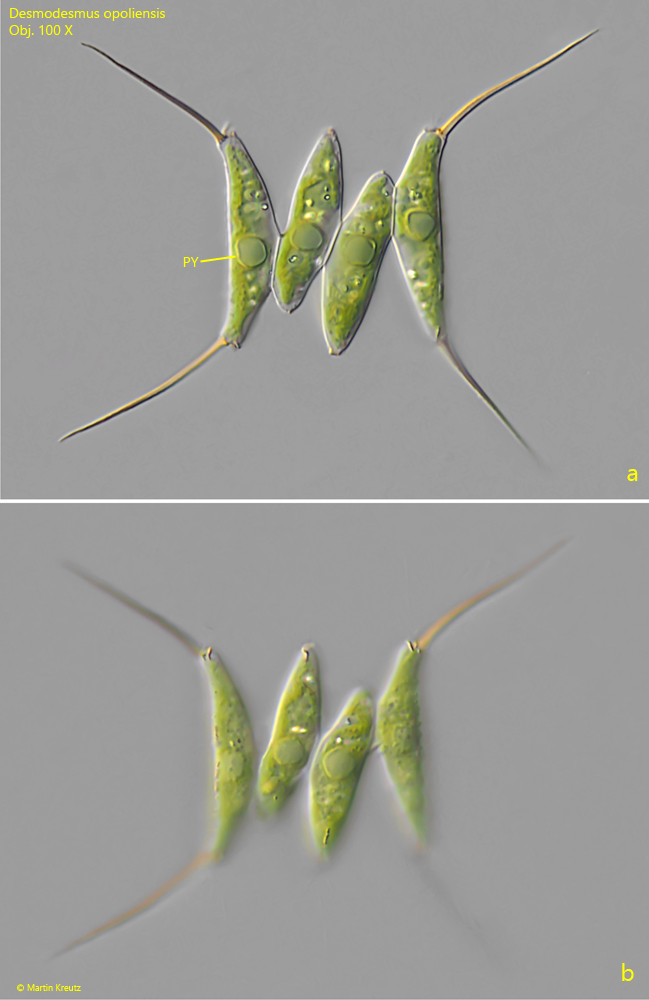
one pyrenoid per cell
Desmodesmus opoliensis
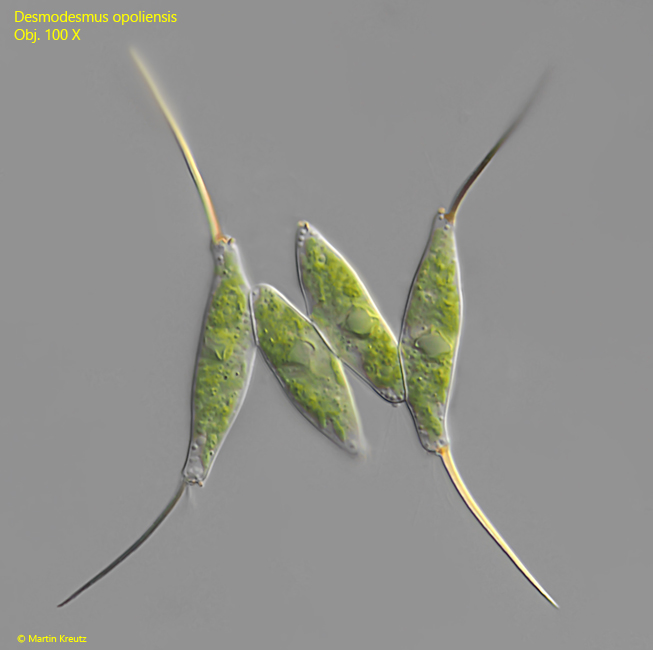
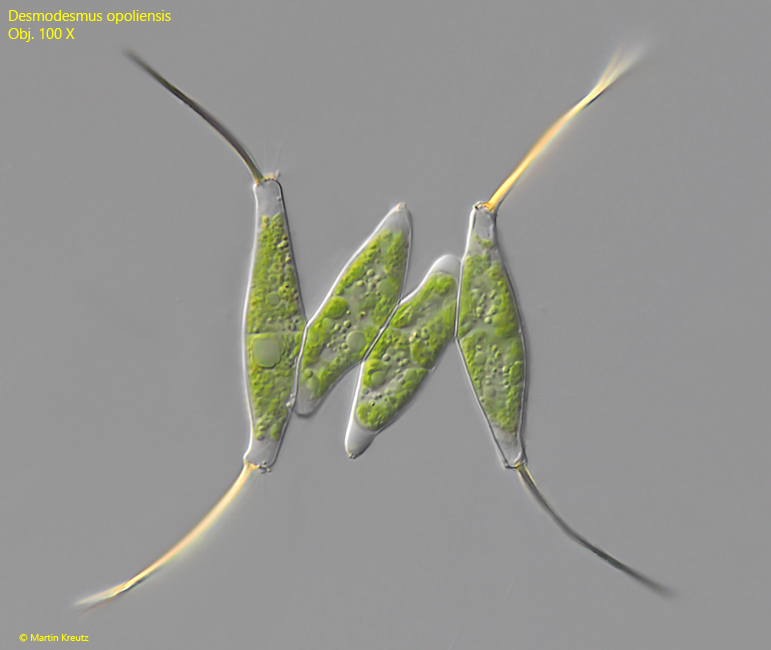
So far I have found Desmodesmus opoliensis in the plankton of the Oder only once, in May 2026. In the samples the specimens were only sparsely present. The species can be very easily recognized by the obliquely positioned middle cells. These bear only small spines or warts on their apices, while the apices of the outer cells are slightly bent outward and carry long, often curved spines. In my specimens the cells were about 25 µm long. The outer flanks of the cells were described as smooth by Komarek & Fott (1983). In my population, however, I was able to observe short sections of ribs near the cell ends. These were always shorter than 5 µm and in no case continuous over the entire cell length.
Fig. 1:Desmodesmus opoliensis. L = 37 µm (of coenobium). A coenobium of 4 cells with two angled cells in the middle. Obj. 100 X.
Fig. 2:Desmodesmus opoliensis. L = 41 µm (of coenobium). A second coenobium of 4 cells. Obj. 100 X.
Fig. 3 a-b:Desmodesmus opoliensis. L = 27 µm (of coenobium). Two focal planes of a third coenobium. PY = pyrenoid. Obj. 100 X.