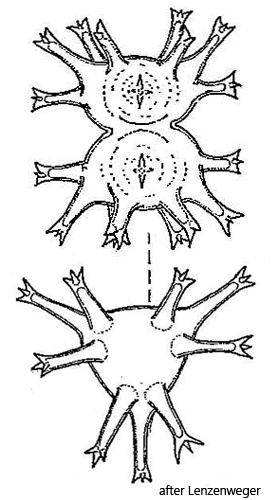
lateral angles with two processes with 4 spines each
apical angles with each 2 processes, ends with 2–3 spines
3 lateral processes in middle of each semi-cell
in apical view with convex sides
cell wall smooth
Staurastrum tohopekaligense
So far I have found Staurastrum tohopekaligense only once, in June 2025, in the Schwemm Moor in Austria. However, only very few specimens were present in the samples. Lenzenweger (1997) lists only the Ibmer Moor as the sole locality in Austria.
The somewhat unusual species name “tohopekaligense” is derived from the locality where Wolle found and described the first specimens in 1885. Lake Tokopekaligense in Florida was called that by the Seminoles in their language, which means roughly: where we want to gather.
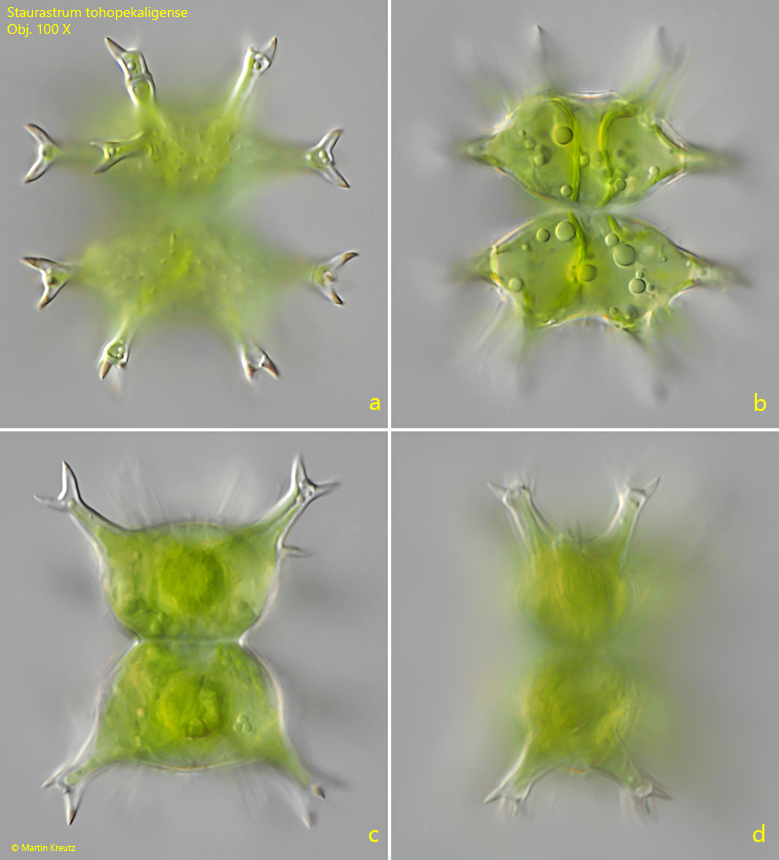
Characteristic are the long processes at the apical angles. At each angle there are 2 processes, so 6 in total. In addition, at the lateral angles in the middle of each semi-cell a process arises, 3 in total. Altogether, each semi-cell therefore has 9 processes, which bear 2–3 short spines at their ends. In my specimens these spines were brownish in color (s. fig. 1 a). According to Lenzenweger, the cell wall is described as smooth. In my population, however, I was able to observe a finely granulated surface (s. fig. 1 a).
Fig. 1 a-d:Staurastrum tohopekaligense. L = 51 µm (with processes). Different focal planes of a specimen found in June 2025 in the Schwemm Moor. Obj. 100 X.