terminal vacuole with one gypsum crystal (rarely several)
Closterium cornu
Closterium cornu is a comparatively common species. I found numerous specimens in old samples from the Lauchsee Moor in Austria in September 2025.
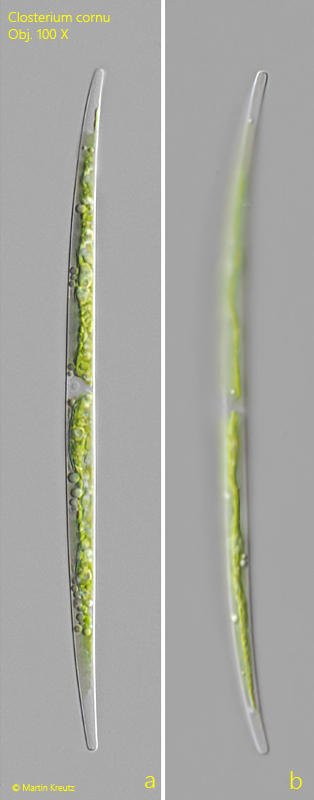
This medium-sized form has a slender cell shape with a very weak curvature. An important feature for identification is the shape of the apices. In Closterium cornu they are broadly rounded, almost somewhat flattened. In the similar species Closterium acutum, the apices taper much more into thin points. The cell wall of Closterium cornu is smooth and without structure.
In my population I could not clearly determine the number of pyrenoids and the shape of the chloroplasts due to embedded starch grains. I also could not clearly identify the terminal vacuoles, in which either a larger crystal or several smaller ones are supposed to be present.
Fig. 1 a-b:Closterium cornu. L = 127 µm. Two focal planes of a specimen found in the Lauchsee Moor. Obj. 100 X.
Fig. 2:Closterium cornu. The rounded and slightly flattened apex in detail. Obj. 100 X.