So far I have found Phacus helikoides only in the Simmelried. There the species appears periodically at larger intervals. Most specimens are located between aquatic plants or on the layer of mud near the shore.
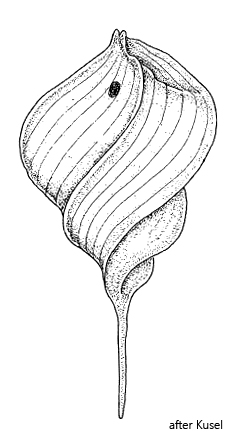
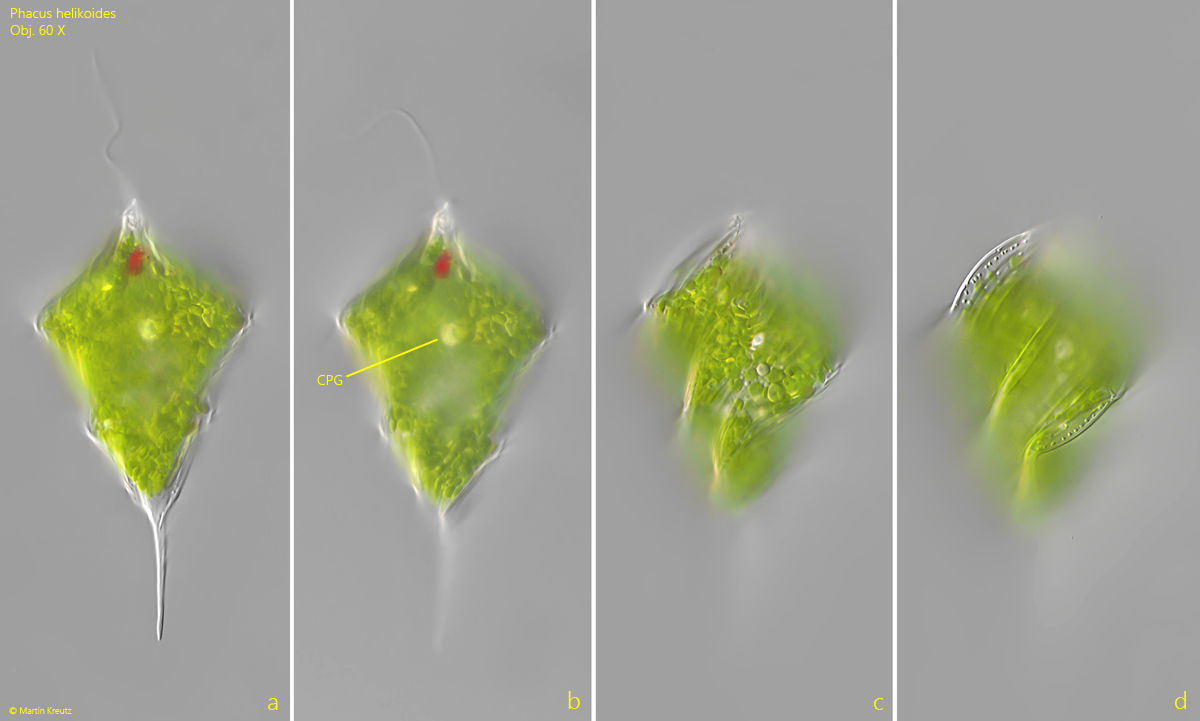
The body of Phacus helikoides is strongly twisted in a spiral. If one follows the twisted lateral margins, there are 1.5–2 turns clockwise before the body tapers into a straight spine, which also shows a spiral twist. Because of the strong spiraling of the body, the internal structure is difficult to discern. The species has only one larger paramylon grain in the middle of the body, which in my population turned out to be quite small and was only faintly visible (s. fig. 1 b).
Fig. 1 a-d: Phacus helikoides. L = 120 µm. Different focal planes of a slightly squashed specimen. CPG = central paramylon grain. Obj. 60 X.