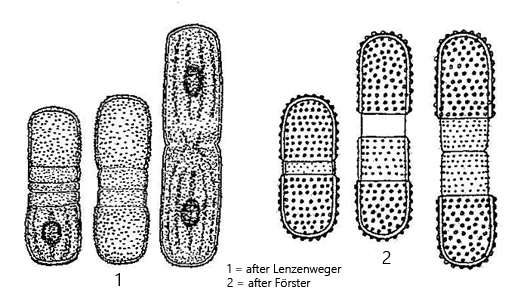
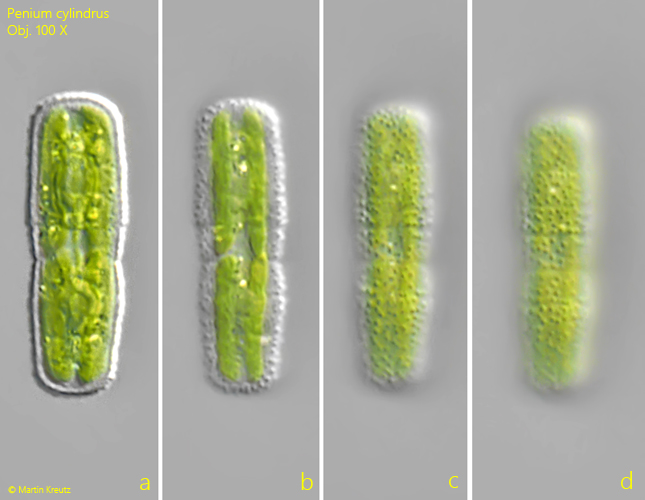
cells cylindrical, apices flattened or broadly rounded
cells slightly constricted in the middle
older cells sometimes brown or yellowish
length 25–50 µm, width 10–16 µm
cell wall granulated
chloroplasts with 3–4 ridges
1–2 (rarely 3) pyrenoids per chloroplast
pyrenoids globular or elongated
girdle bands present
Penium cylindrus
I found a few specimens of Penium cylindrus in old samples from Schwemm Moor in July 2025. The cells are easy to recognize by their cylindrical shape. However, the cell wall’s granulation is only clearly visible at medium magnification or higher. In older specimens, the cell wall turns yellowish or brown. If girdle bands are present, they can be recognized in areas where the cell wall is smooth and lacks granules. The pyrenoids are often elongated or oval. Although the species is described as widespread, documented records are rather rare.
Fig. 1 a-d:Penium cylindrus. L = 30 µm. Several focal planes of a young specimen with colorless cell wall. Obj. 100 X.