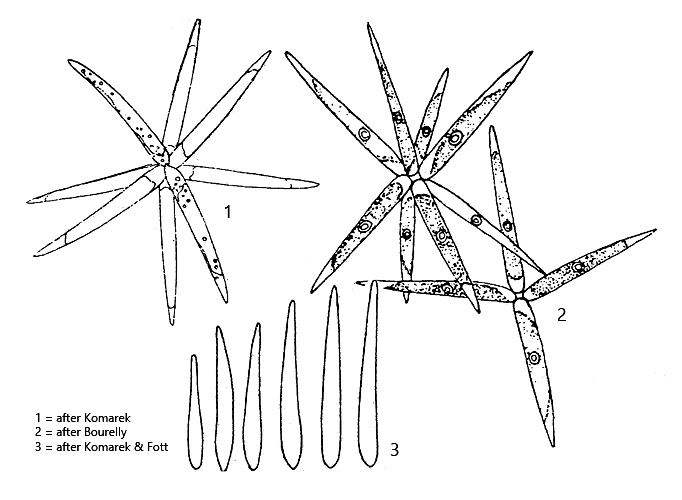
cells club-shaped or spindle-shaped, distal ends tapered and rounded
length (of cells) 12–36 µm
one parietal chloroplast
one pyrenoid
ends of cell transparent
nucleus near connected cell pole
Actinastrum hantzschii var. subtile
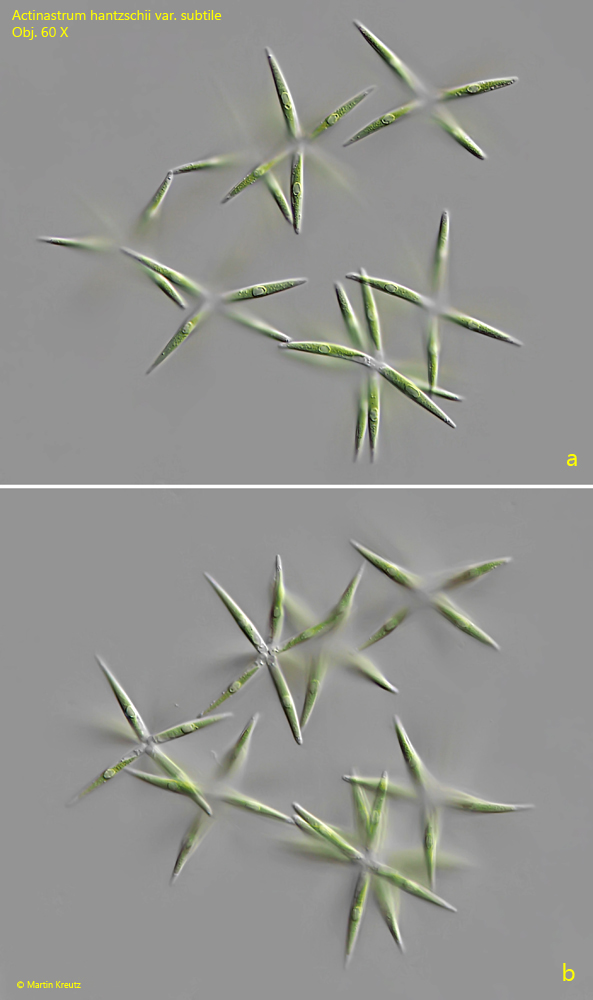
I found Actinatrum hantzschii var. subtile in the plankton of the Oder in May 2026. In the samples, the star-shaped colonies were easy to recognize. The colonies usually formed larger aggregates of about 5–10 colonies.
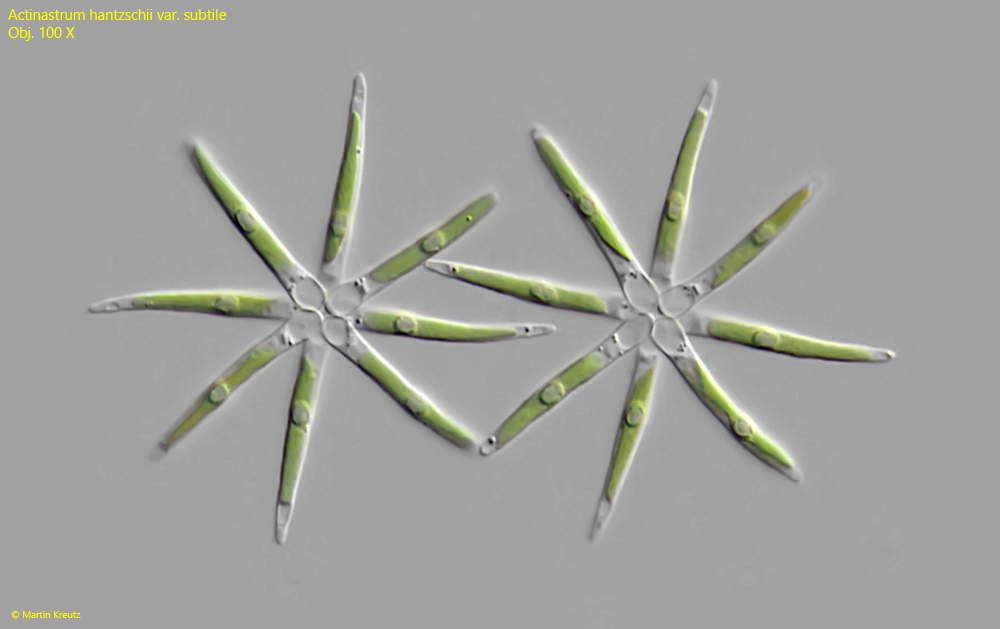
The individual cells of the colonies are somewhat club-shaped. The cells are centrally connected to each other with the thickened end (s. fig. 3). Towards the distal end, the cells taper and are narrowly rounded at the end. The cells are often somewhat curved or slightly irregularly shaped.
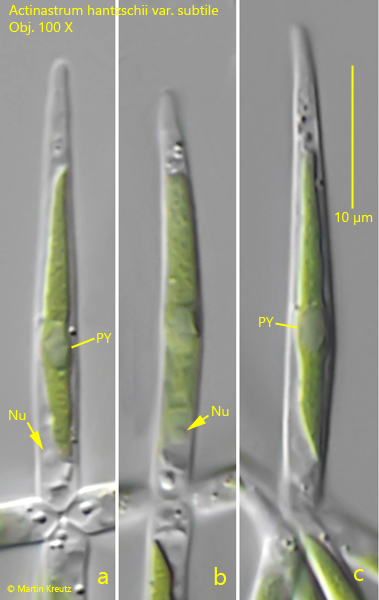
The chloroplast lines only the middle part of the cells. The thickened end and the tip of the cells always remain transparent. In the center of the chloroplast, there is a single pyrenoid (s. fig. 4 a-c). The cell nucleus is located near the thickened end of the cell (s. fig. 4 a-c). The cells in my population were between 20–33 µm long. Accordingly, the colonies had a diameter of about 40–60 µm. Even with coverslip pressure, the cells could not be separated from each other.
Actinastrum hantzschii var. subtile is considered an indicator alga for highly eutrophic waters (Wolf et al., 2002). This fits with the fact that the Oder is considered a highly eutrophic river due to inputs from agriculture and adjacent industrial operations.
Fig. 1 a-b:Actinastrum hantzschii var. subtile. L = 24–30 µm (of cells). Two focal planes of an acculumation of star-shaped colonies. Each colonies consists of 6–8 cell. Obj. 60 X.
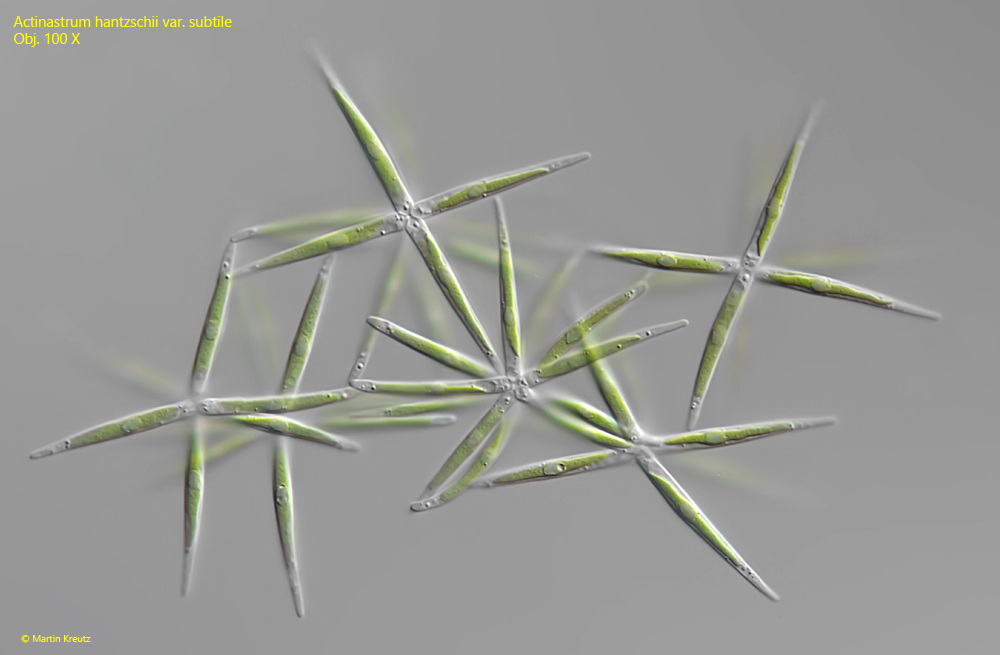
Fig. 2:Actinastrum hantzschii var. subtile. L = 28–31 µm (of cells). A second acculumation of star-shaped colonies. Obj. 100 X.
Fig. 3:Actinastrum hantzschii var. subtile. L = 21–24 µm (of cells). Two squashed colonies of each 8 cells. The cells are connected via the slightly inflated cell pole. Obj. 100 X.
Fig. 4 a-c:Actinastrum hantzschii var. subtile. L = 30–33 µm. Three cells in detail. Nu = nucleus, PY = pyrenoid. Obj. 100 X.