Ankistrodesmus arcuatus Korshikov, 1953

Most likely ID: n.a.


Synonym: Monoraphidium arcuatum


Sampling location: Pond of the convent Hegne


Phylogenetic tree: Ankistrodesmus arcuatus 


Diagnosis: 

  • cells elongated spindle-shaped, circularly curved or sigmoid
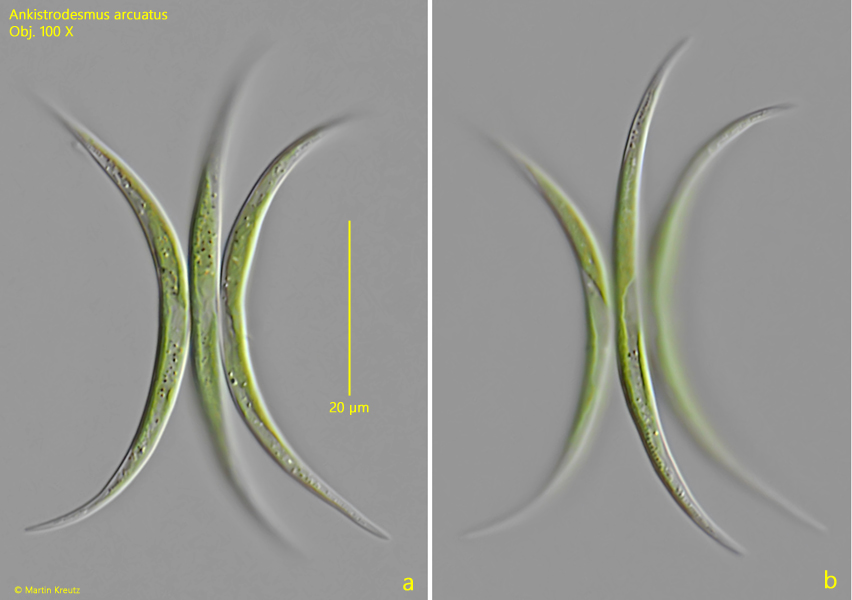
  • cells connected via the convex sides
  • length 26–90 µm, width 2–4.4 µm
  • one parietal chloroplast
  • pyrenoid absent
  • nucleus central in notch of chloroplast
Ankistrodesmus-arcuatus
Ankistrodesmus arcuatus
So far, I have only found Ankistrodesmus arcuatus in the pond of the convent Hegne, where the species is, however, rare. Due to its slender and strongly curved shape, the alga is easy to recognize. There is only one chloroplast present, which lies against the convex side of the cell (s. fig. 3 b). In the middle of the concave side is the very small nucleus, which is often located in an indentation of the chloroplast (s. fig. 3 a). After cell division, the daughter cells remain connected by their concave sides before these aggregates later break down into individual cells (s. fig. 1 a).
Ankistrodesmus-arcuatus

Fig. 1 a-b: Ankistrodesmus arcuatus. L = 50–60 µm. Two focal planes of 3 specimens connected with their convex sides. Obj. 100 X.

Ankistrodesmus-arcuatus

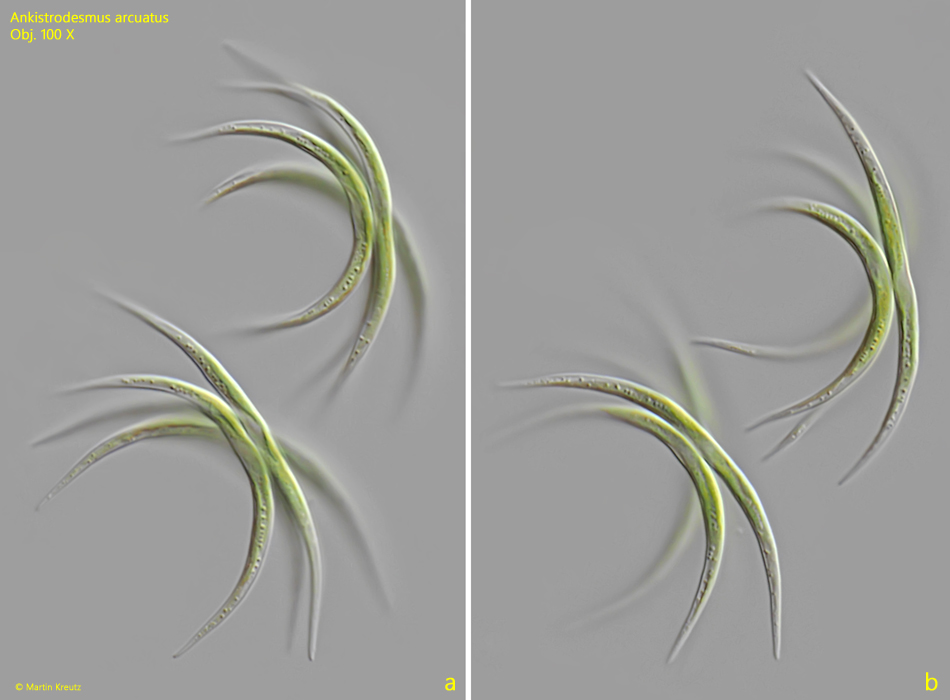
Fig. 2 a-b: Ankistrodesmus arcuatus. L = 50–60 µm. Two colonies of 4 cells each. Obj. 100 X.

Ankistrodesmus-arcuatus

Fig. 3 a-b: Ankistrodesmus arcuatus. L = 50–60 µm. Four squashed cells. Note the very small nucleus (Nu) near the concave side of the cell. The single chloroplast (Chl) is attached to the convex side. SG = starch grains. Obj. 100 X.