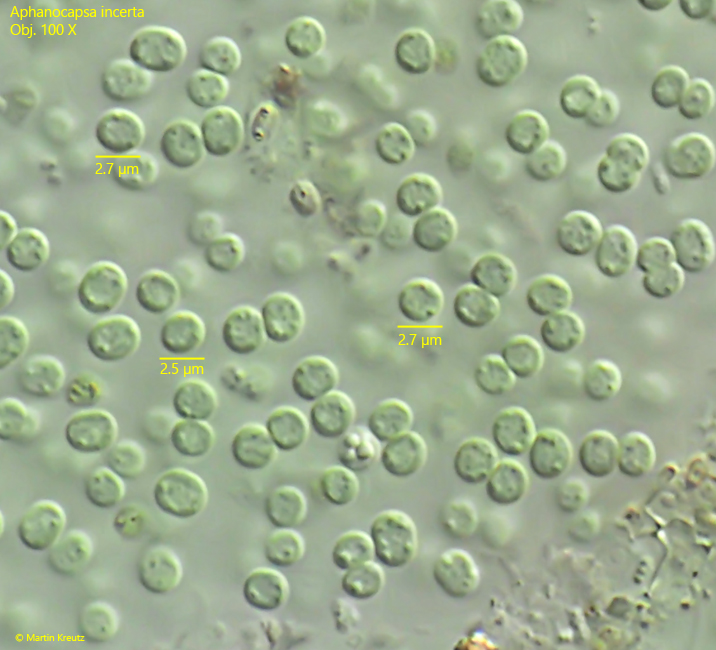
I only rarely find the colonies of Aphanocapsa incerta. Mostly, they lie on the top layer of mud or are found in the growth of aquatic plants.
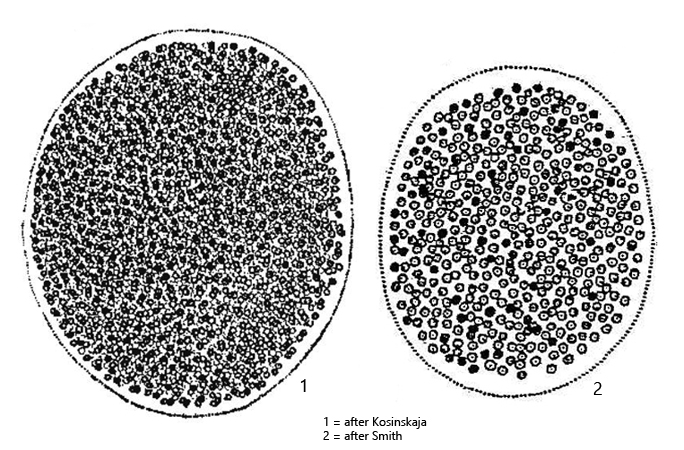
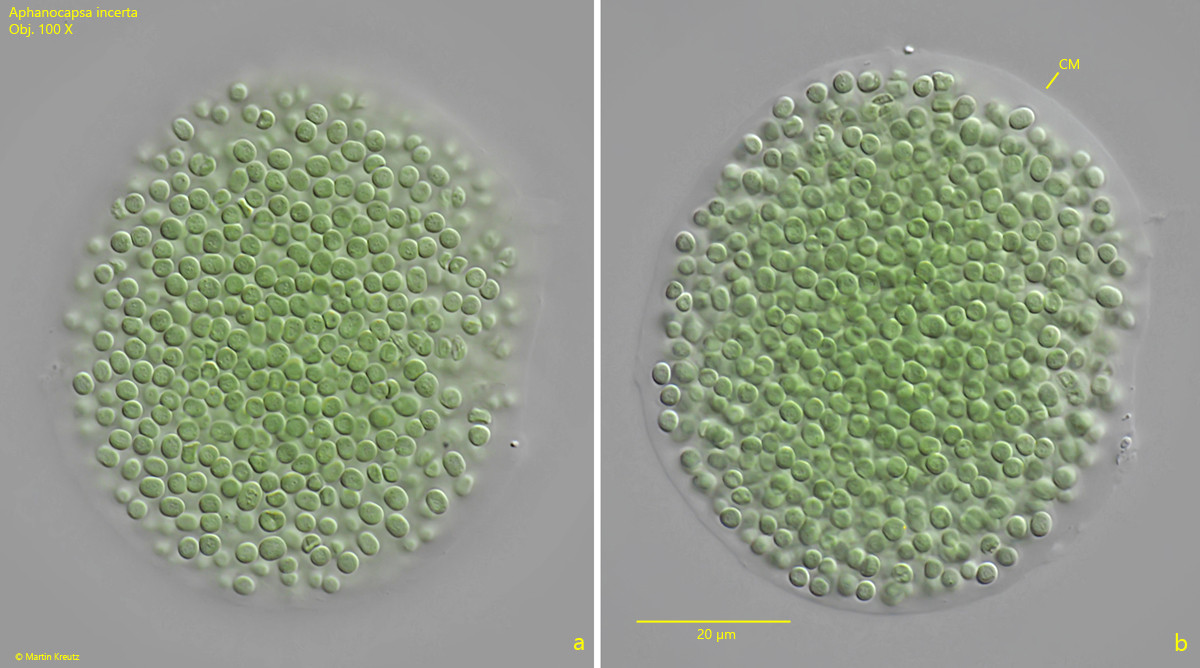
The most striking feature of Aphanocapsa incerta is the dense arrangement of the cells in the gelatinous matrix of the colony. Additionally, the colonies are usually approximately spherical. In my population, the colonial mucilage was always quite sharply defined (s. figs 1 b and 3 b). Komarek & Anagnostidis (1999) report that the mucilage envelope can also be indistinctly defined.
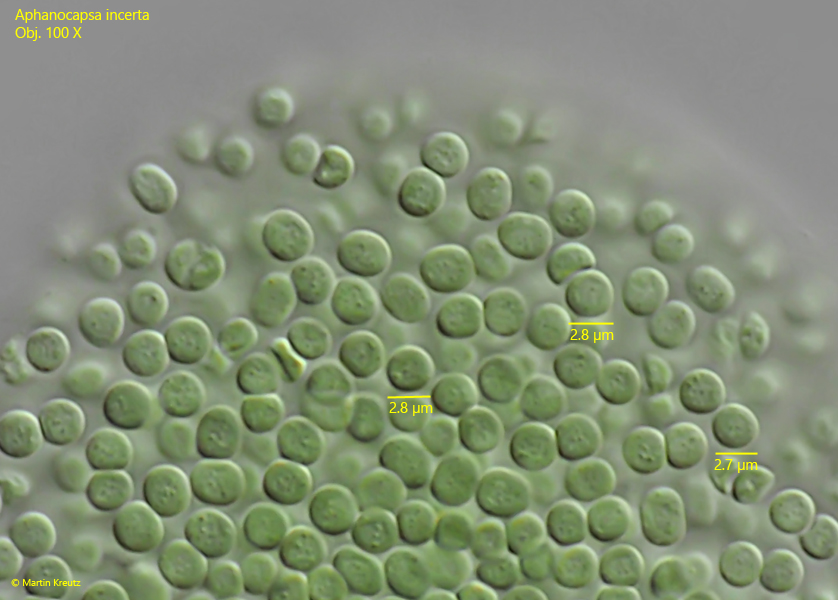
The cells are all spherical (difference from Aphanothece) and had a diameter of 2.5–2.9 µm in my population. The cytoplasm always contained very fine granules. The color of the cells was mostly a pale blue-green, often with a yellowish tint.
Fig. 1 a-b:Aphanocapsa incerta. D = 68 µm (of colony). Two focal planes of a slightly squashed, almost spherical colony. Note the margin of the colonial mucilage (CM). Obj. 100 X.
Fig. 2:Aphanocapsa incerta. D = 2.7–2.8 µm (of cells). A part of the colony as shown in fig. 1 a-b in details. The spherical cells are densely arranged. The cytoplasm contains fine granules. Obj. 100 X.
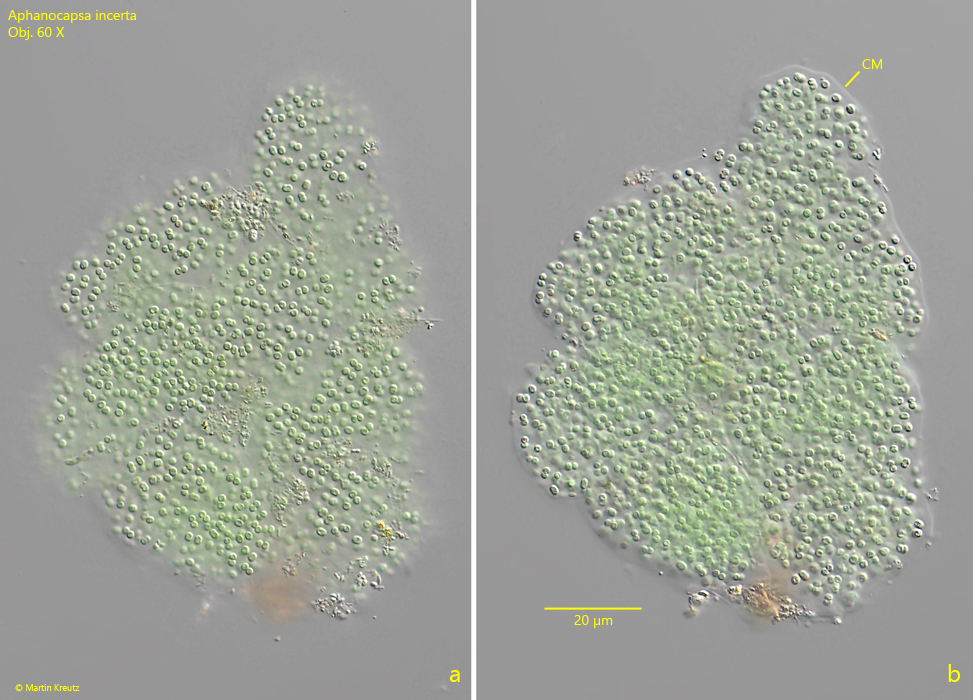
Fig. 3 a-b:Aphanocapsa incerta. D = 88 µm (of colony). Two focal planes of a second irregular colony. CM = margin of the colonia mucilage. Obj. 60 X.
Fig. 4:Aphanocapsa incerta. D = 2.5–2.7 µm (of cells). A part of the colony as shown in fig. 3 a-b in detail. Obj. 100 X.