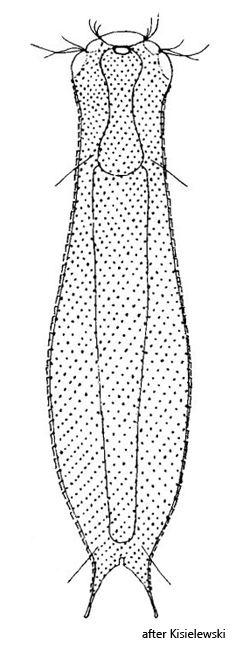
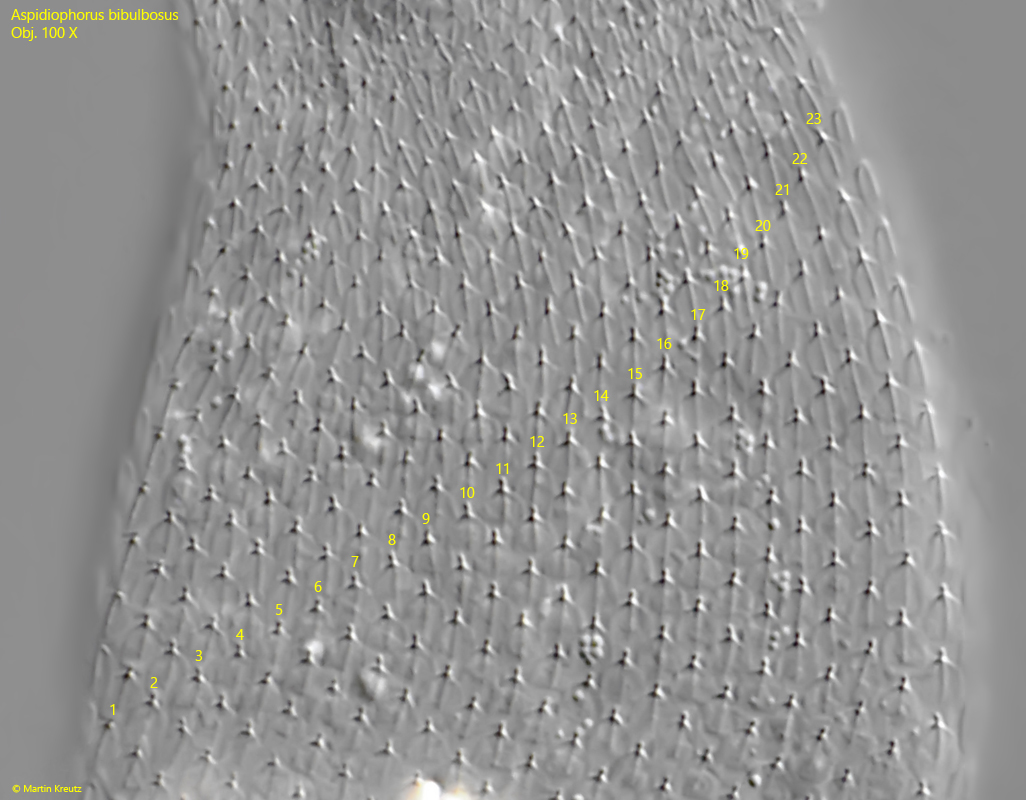
dorsally 23 longitudinal rows of leaf-shaped scales
dorsal scales 2–3 µm long, on 0.5 µm stalks
ventral field with 8–9 rows of small, stalked scales
two spined terminal scales ventrally
toe base fully scaled, adhesive tubes thin
Aspidiophorus bibulbosus
I found Aspidiophorus bibulbosus in the Paradieswiesen in Austria. In the locations in my vicinity, I have not been able to detect this species so far.
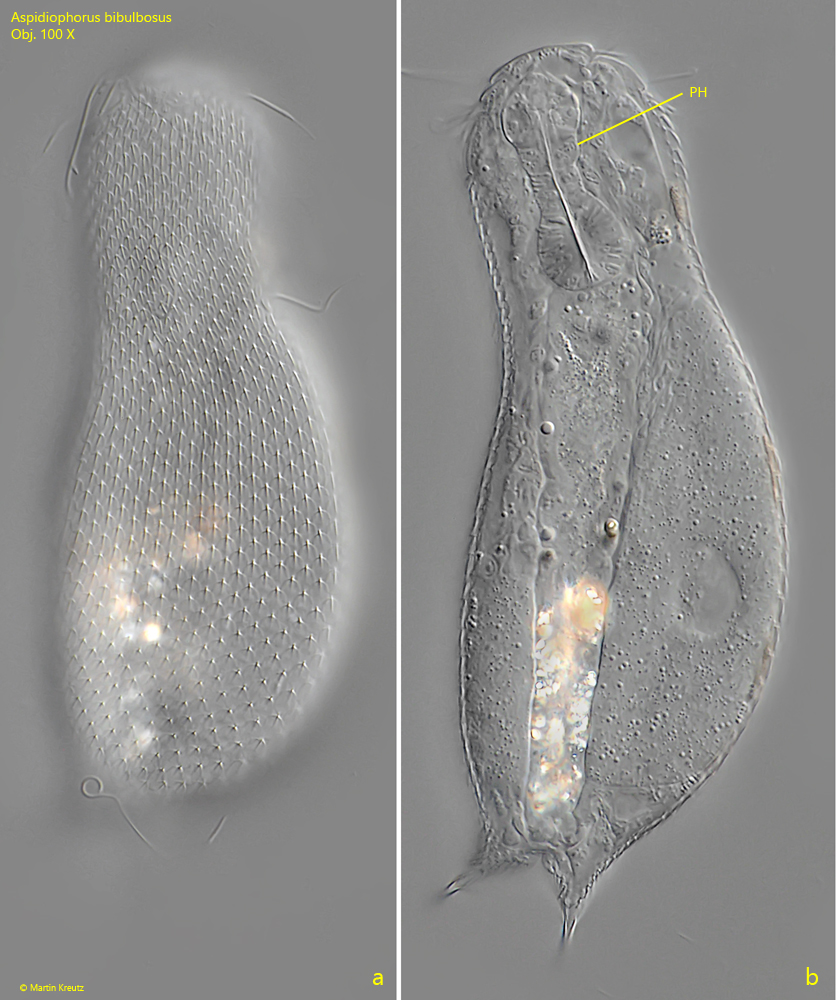
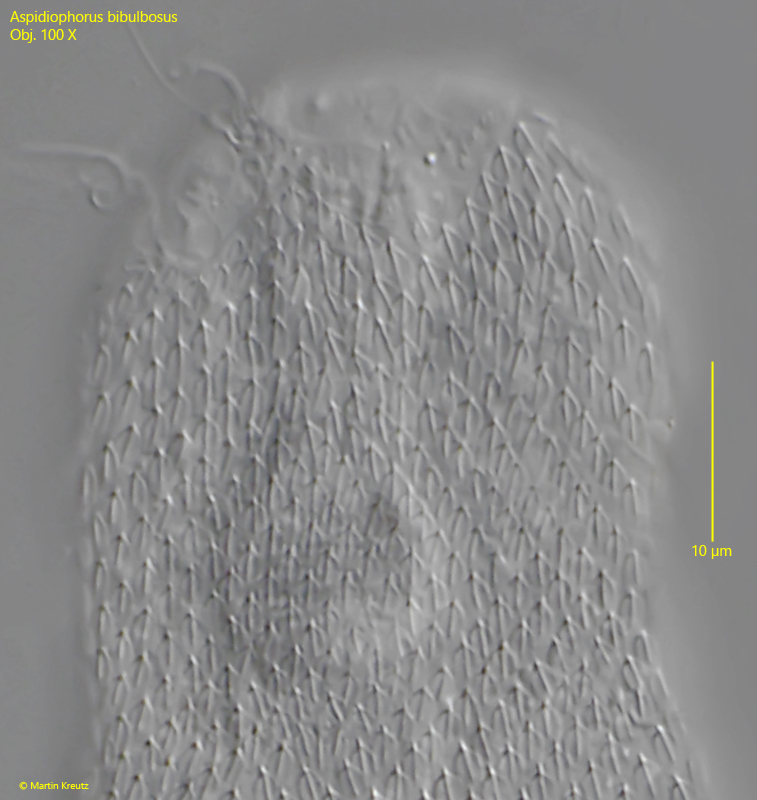
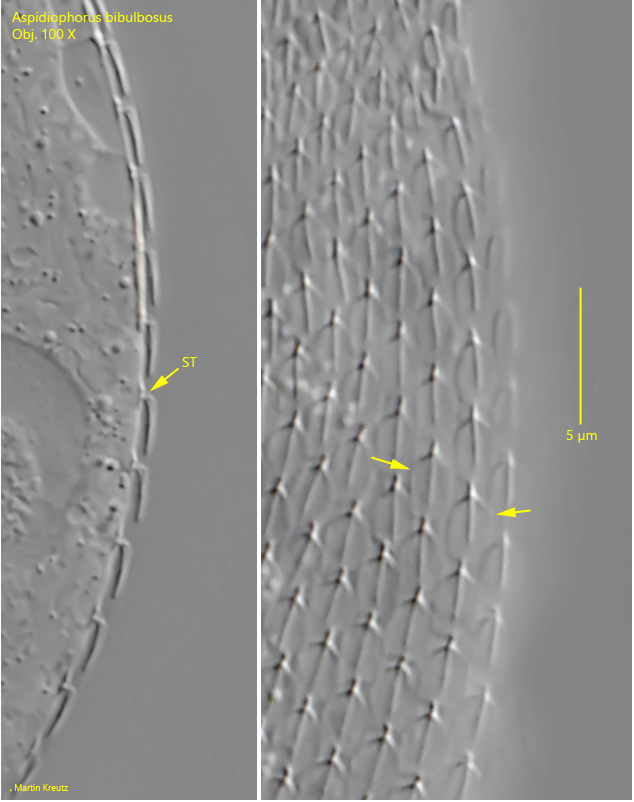
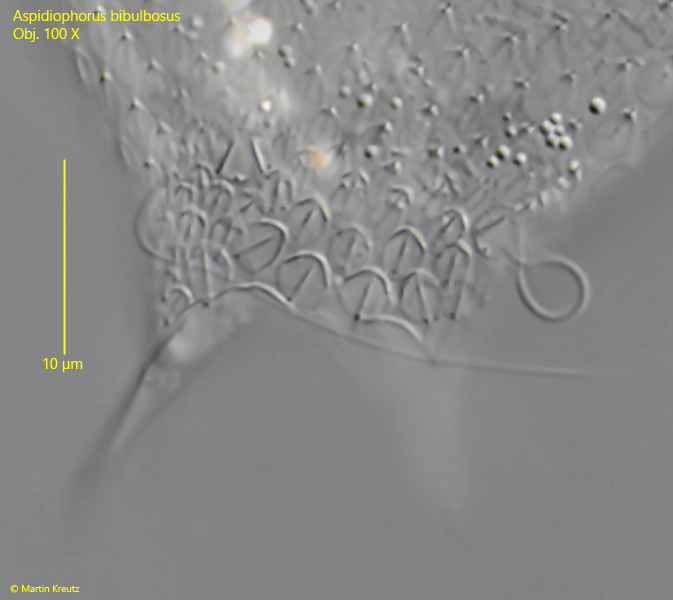
The most striking feature of Aspidiophorus bibulbosus is the clearly dumbbell-shaped pharynx (s. fig. 1 b). The scaled skin consists, as in all species within the genus Aspidiophorus, of small, stalked scales that overlap. Kisielewski (1979) reports 23 rows of longitudinal scale rows on the dorsal side. I found exactly this number as well (s. fig. 4). Kisielewski did not specify the shape of the dorsal and ventral scales. According to my observations, the dorsal scales are ellipsoid in shape with only slightly convex lateral sides. They have a flat keel that occupies about two-thirds of the scale length (s. fig. 3 b). Laterally, I was also able to clearly see the approximately 0.5 µm high stalk of the dorsal scales (s. fig. 3 a). In the dorsal after region, there is a field with enlarged, round scales, which also have a keel, but it extends to the distal end of the scales (s. fig. 5).
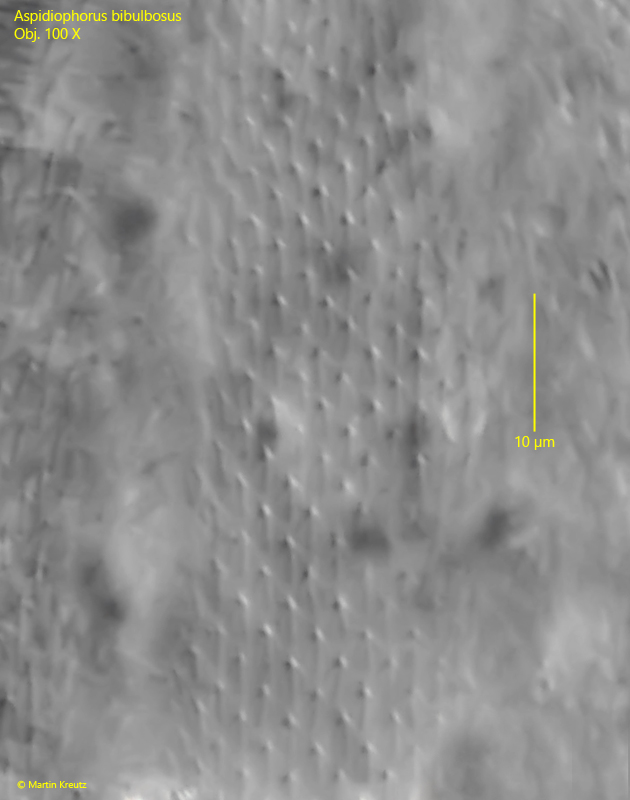
Unfortunately, I could only examine the ventral scales from the dorsal side. They have obviously the same shape as the dorsal scales but are somewhat smaller (s. fig. 6). According to my count, there are 10–12 longitudinal rows of ventral scales.
Fig. 1 a-b:Aspidiophorus bibulbosus. L = 122 µm. Two focal planes of a slightly squashed specimen from dorsal. Note the distinctly dumbbell-shaped pharynx (PH). Obj. 100 X.
Fig. 2:Aspidiophorus bibulbosus. The dorsal scales of the head- and neck-region. Obj. 100 X.
Fig. 3 a-b:Aspidiophorus bibulbosus. The dorsal scales from lateral (a) and in frontal view. The scales have a short stalk (ST) and an ellipsoid shape with a short keel (arrows, b). They have a length of 2–3.5 µm. Obj. 100 X.
Fig. 4:Aspidiophorus bibulbosus. This specimen hast 23 longitudinal rows of dorsal scales. Obj. 100 X.
Fig. 5:Aspidiophorus bibulbosus. A field of larger scales in the dorsal after region. Obj. 100 X.
Fig. 6:Aspidiophorus bibulbosus. The scales of the ventral side viewed from the dorsal side. They seem to have the same shape as the dorsal scales. Obj. 100 X.