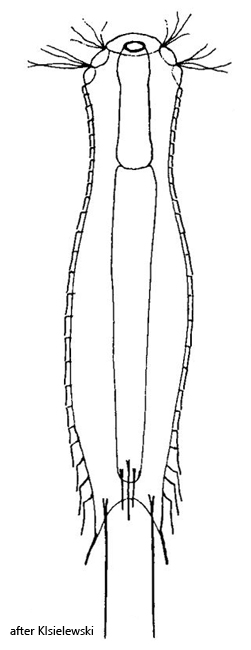
dorsally 13–14 longitudinal rows of 24 stalked scales
dorsal scales rhombic, 6–7 µm in mid-body, 2 µm in neck
at posterior end dorsal scales 10 µm long, spine-like pointed
ventral side naked apart from 2 scaleless spines (about 10 µm)
near posterior end 3 scaleless spines (18–20 µm)
at toe base pair of long spine (39 µm), exceeding body
furca 18–20 µm long, unscaled
adhesive tubes thin and pointed
Aspidiophorus longichaetus
So far, I have found only a single specimen of Aspidiophorus longichaetus in May 2025 in the Purren pond. The specimen was in a sample with decaying leaves and was 114 µm long without the posterior spines.
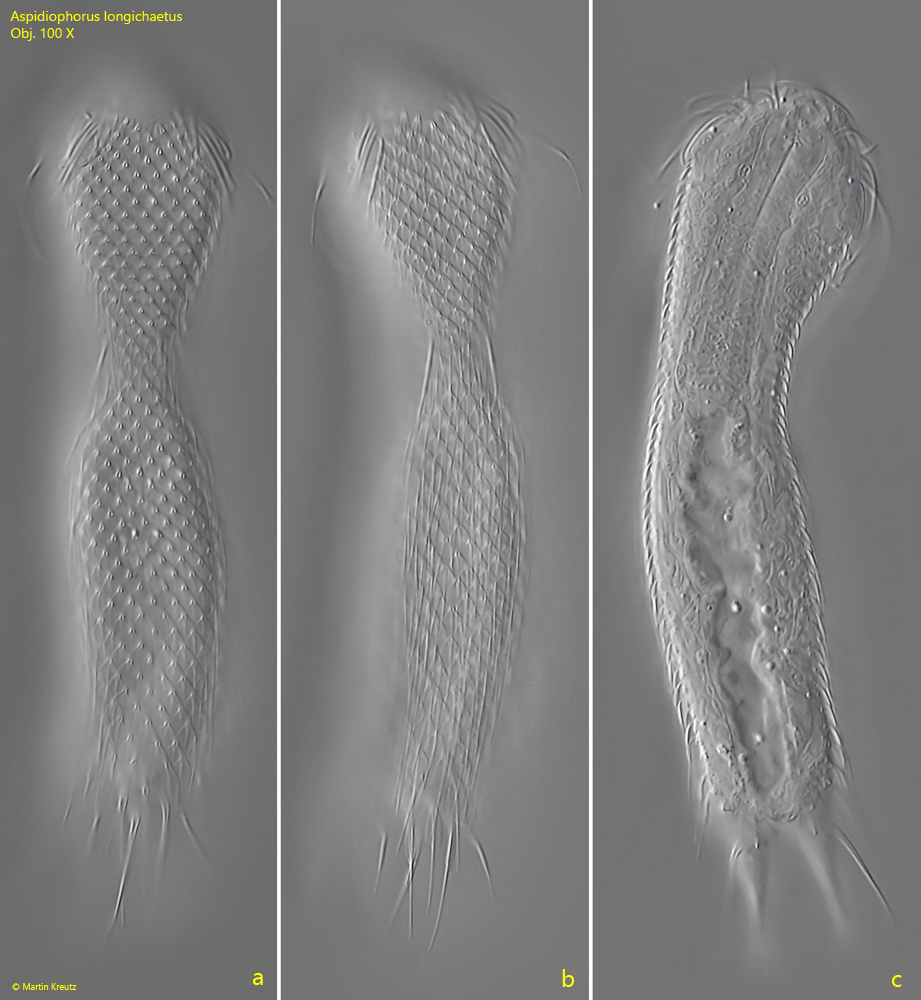
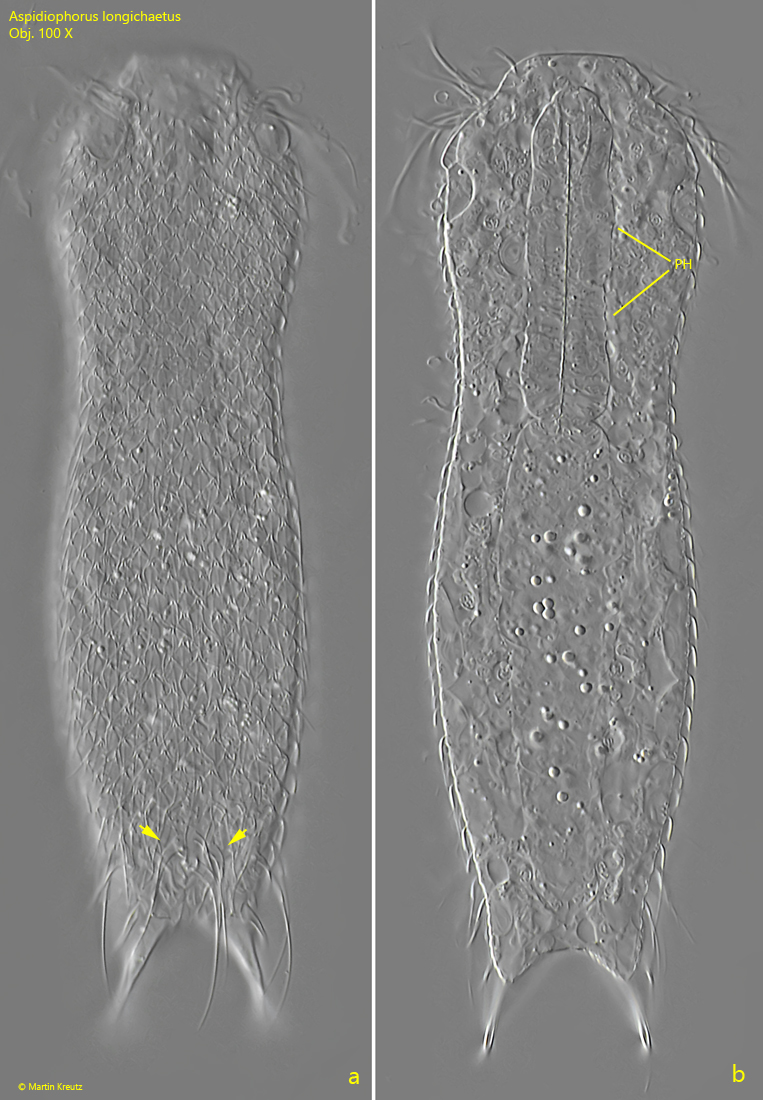
The most striking feature of Aspidiophorus longichaetus are the elongated spines at the posteriorend, which arise laterally from the base of the toes. The dorsal scales are stalked, which is typical for the genus. In my specimen, I found many matches with the description by Kisielewski, but also some deviations.
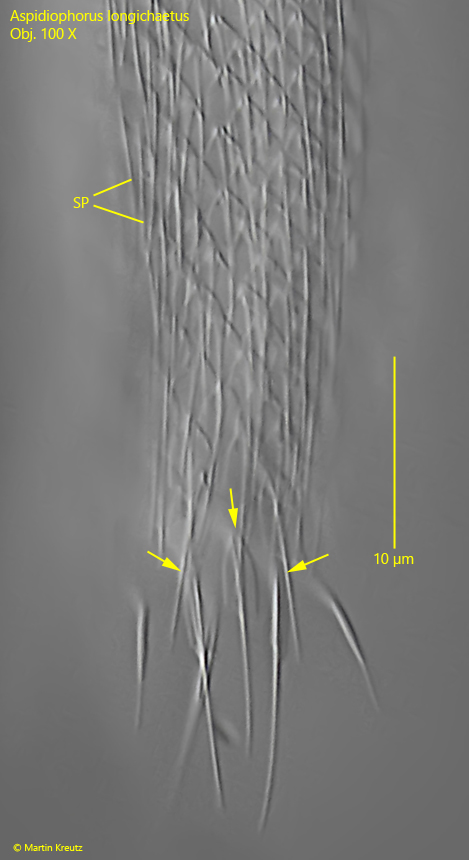
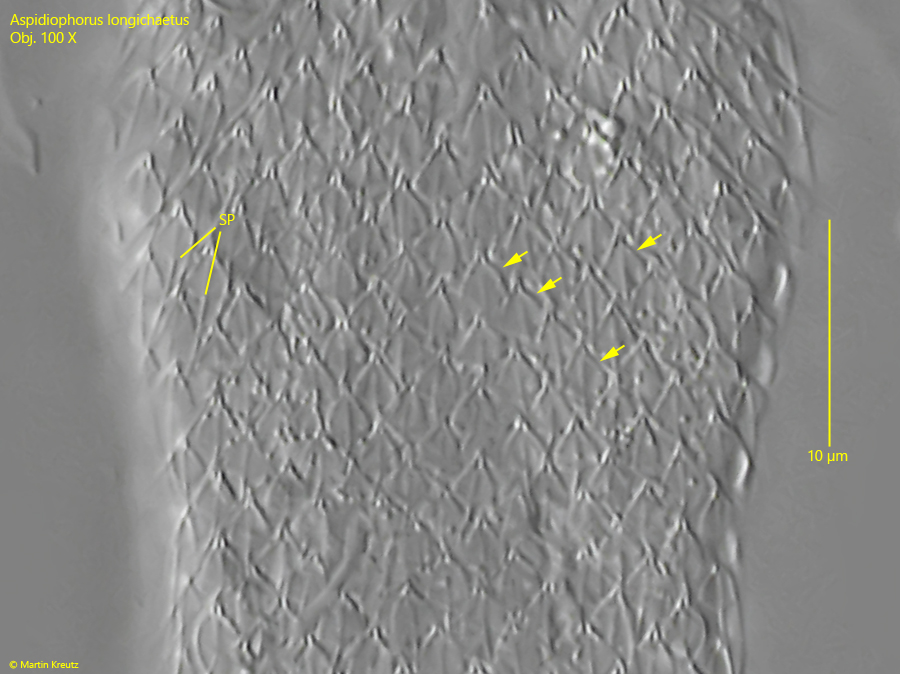
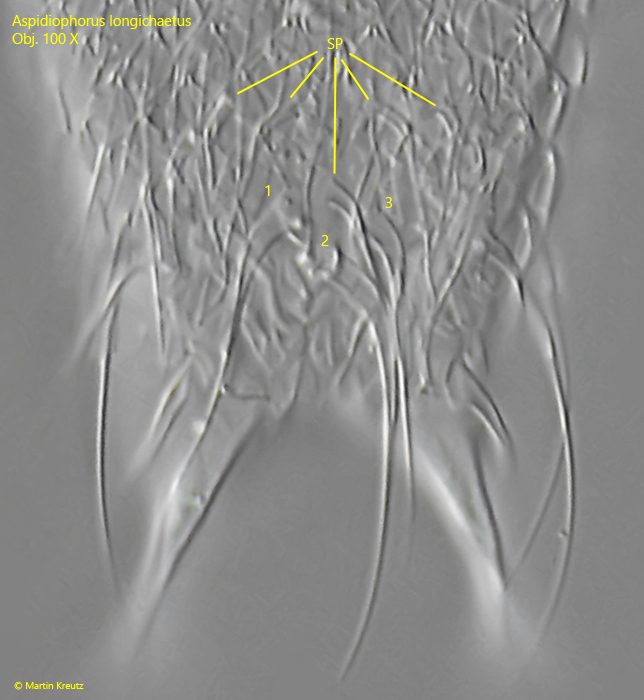
I was able to clearly see that the dorsal rhombus-shaped scales each bear a very thin spine, which lies close to the body (s. fig. 2). Therefore, these delicate spines are not noticeable at medium magnification. They can only be seen at higher magnification and in specimens that are not too strongly squashed. As described by Kisielewski, I found three dorsal, large spines near the posterior end (s. fig. 6). However, above them, there were additional, but shorter spines visible, which appeared to be arranged in a belt-like fashion (s. fig. 6). Furthermore, I found enlarged and elongated dorsal scales in front of the three large dorsal spines, which, however, did not taper to a point as described by Kisielewski, but each had a straight, thin spine (s. fig. 2).
Overall, the structure of the dorsal scales is more complex than described by Kisielewski. Especially in the posterior third, there are more spines with different length and shapes present. To what extent these are constant features of my population can only be clarified through further findings. Unfortunately, I was not able to examine the ventral side of my specimen.
Fig. 1 a-c:Aspidiophorus longichaetus. L = 114 µm (without posterior spines). A freely swimming specimen from dorsal. Obj. 100 X.
Fig. 2:Aspidiophorus longichaetus. L = 114 µm (without posterior spines). A crop from fig. 1 b. The dorsal scales have a very delicate spine (SP), arise from the anterior end of the scales. The posterior scales are elongated (arrows) and bearing also a spine. Obj. 100 X.
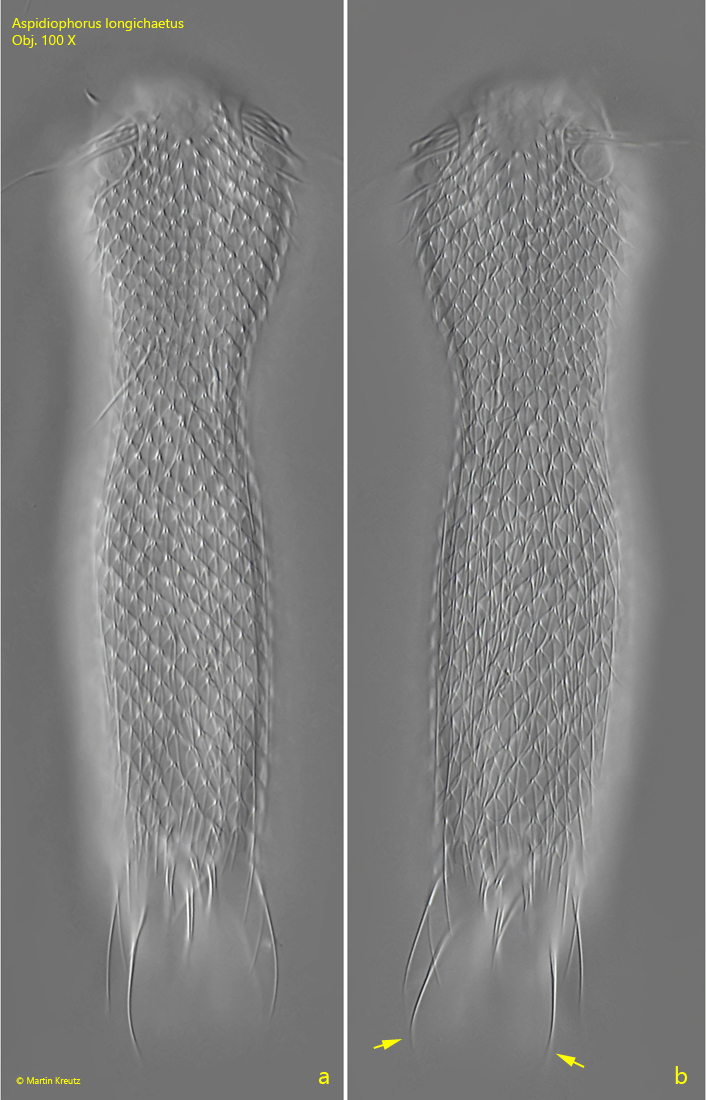
Fig. 3 a-b:Aspidiophorus longichaetus. L = 114 µm (without posterior spines). The slightly squashed specimen as shown in fig. 1 a-c. Note the two lateral spines arising from the base of the toes (arrows). Obj. 100 X.
Fig. 4 a-b:Aspidiophorus longichaetus. Two focal planes of the sqaushed specimen as shown in fig. 1 a-c. At the posterior end the three dorsal spines can be seen (arrows). The pharynx (PH) is almost cylindrical. Obj. 100 X.
Fig. 5:Aspidiophorus longichaetus. A crop of fig. 4 a with details of the dorsal neck region. The scales are rombic with a length of about 3 µm (arrows). The delicate spines (SP) of the scales are hard to see. Obj. 100 X.
Fig. 6:Aspidiophorus longichaetus. A crop of fig. 4 a with details of the dorsal posterior end. The three large dorsal spines are visible (1–3) and further, shorter spines (SP) above them. Obj. 100 X.