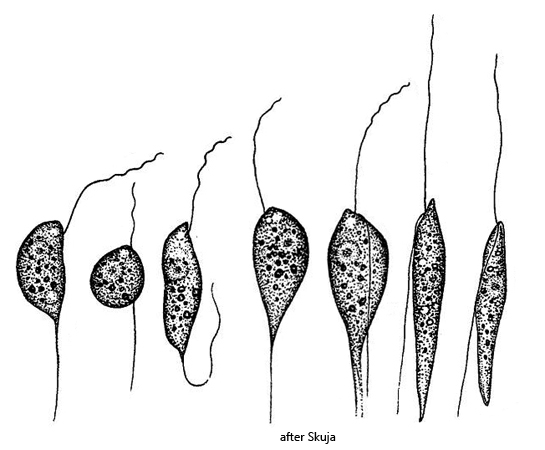
one trailing flagellum, about twice of body length
two contractile vacuole, mid-body and anterior
nucleus with central nucleolus in anterior third
cytoplasm with fine granules and strongly refracting granules
pseudopodia exclusively at anterior end
Cercomonas varians
I have so far only found Cercomonas varians in the sludge from the Simmelried. Due to their small size, the specimens are difficult to find in fresh samples. One is somewhat dependent on chance if specimens are located under the coverslip.
Cercomonas varians has an amoeboid movable body, with the front end usually consistently broad or narrowly rounded, and finger-shaped pseudopodia formed exclusively at the posterior end. The trailing flagellum is pulled behind in a straight form without any visible movement during smooth gliding (s. fig. 1 h). The somewhat shorter leading flagellum provides the locomotion. An important distinguishing feature from other species within the genus Cercomonas is the two contractile vacuoles. One is always located at the front end (s. fig. 1 d). I mostly found the second contractile vacuole in the middle of the body or in the posterior third (s. fig. 1 b). The cell nucleus is apical with a clearly visible, central nucleolus (s. fig. 1 c).
Fig. 1 a-h:Cercomonas varians. L ~ 20 µm. Different focal planes of a freely gliding specimen. Note the two contractile vacuoles (CV 1, CV 2) and the nucleus (Nu) near the anterior end. LF = leading flagellum, TF = trailing flagellum. Obj. 100 X.