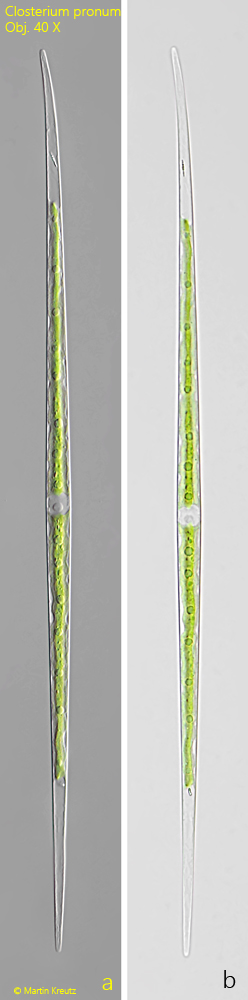
cell long, slender, apices not or very slightly curved
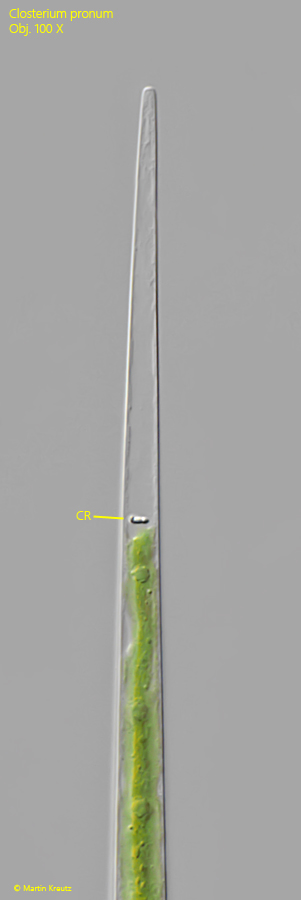
apices sharply rounded
middle part straight or very slightly curved
length 200–420, width 6–10 µm
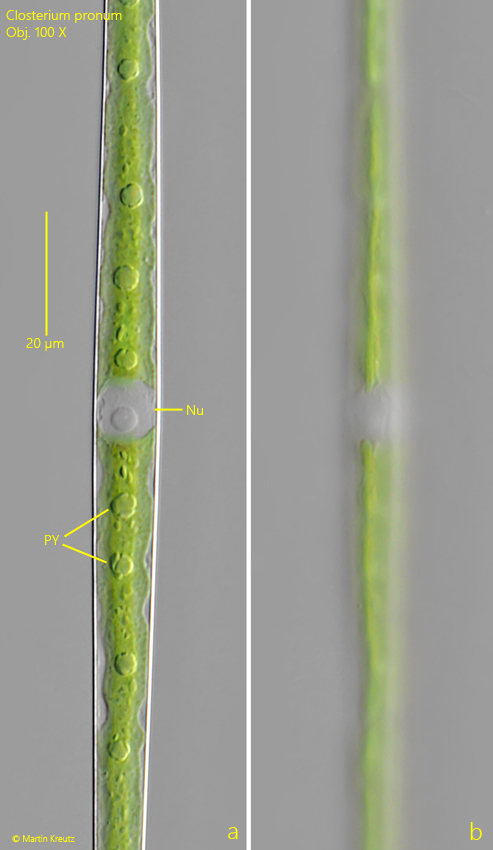
chloroplasts with 3–4 longitudinal ridges, sometimes ribbon-shaped
5–14 pyrenoids per cell
girdle bands absent
cell wall smooth
terminal vacuoles indistinct, with 2–3 crystals
apices without porus
Closterium pronum
I occasionally find Closterium pronum sporadically in the Simmelried. This species can be recognized by its almost straight shape and the transparent apices. The apices taper evenly and are sharply rounded. I was only able to make out the terminal vacuoles in my population in a very faint way. They seemed elongated to me and not round. In most of them there were 1–3 small crystals, but in other vacuoles no crystals were present. The cell wall is completely smooth and without girdle bands.
Fig. 1 a-b:Closterium pronum. L = 388 µm. A specimen in DIC (a) and brightfield illumination (b). Obj. 40 X.
Fig. 2 a-b:Closterium pronum. Two focal planes of the middle part of the cell as shown in fig. 1 a-b. The cell wall is smooth without striation (b). Nu = nucleus, PY = pyrenoids. Obj. 40 X.
Fig. 3:Closterium pronum. The apex of the cell shown in fig. 1 a-b in detail. The shape of the terminal vacuole is quite indistinct to discern. It contains 2-3 crystals (CR). Obj. 100 X.