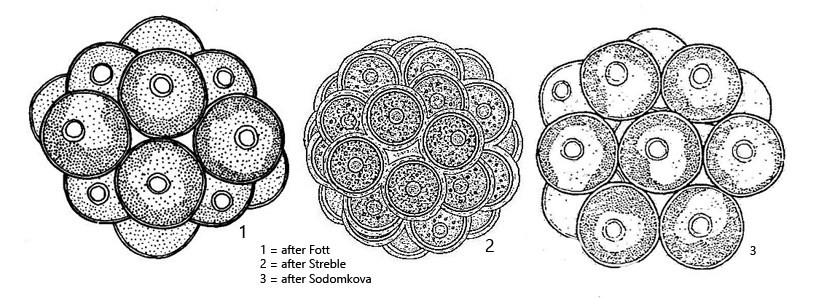
cells without connecting projection to neighbour cells
intercellular spaces about half of cell diameter
one parietal chloroplast with one pyrenoid
Coelastrum microporum
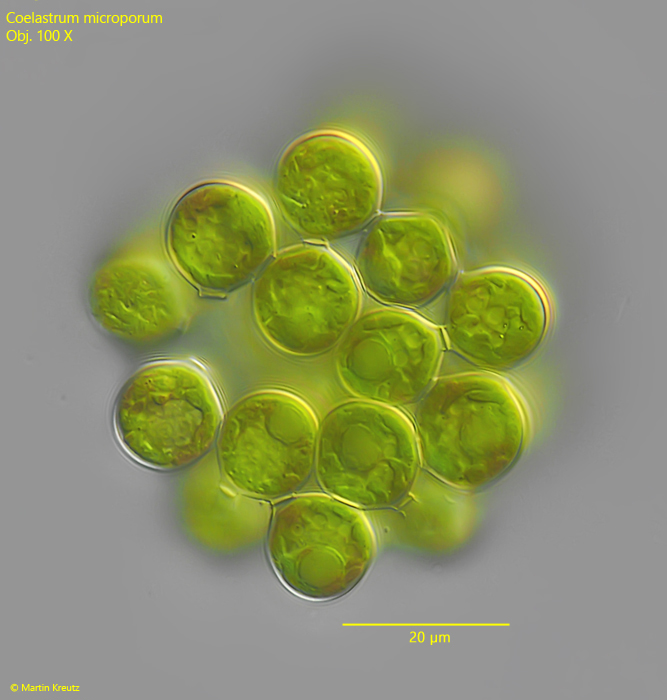
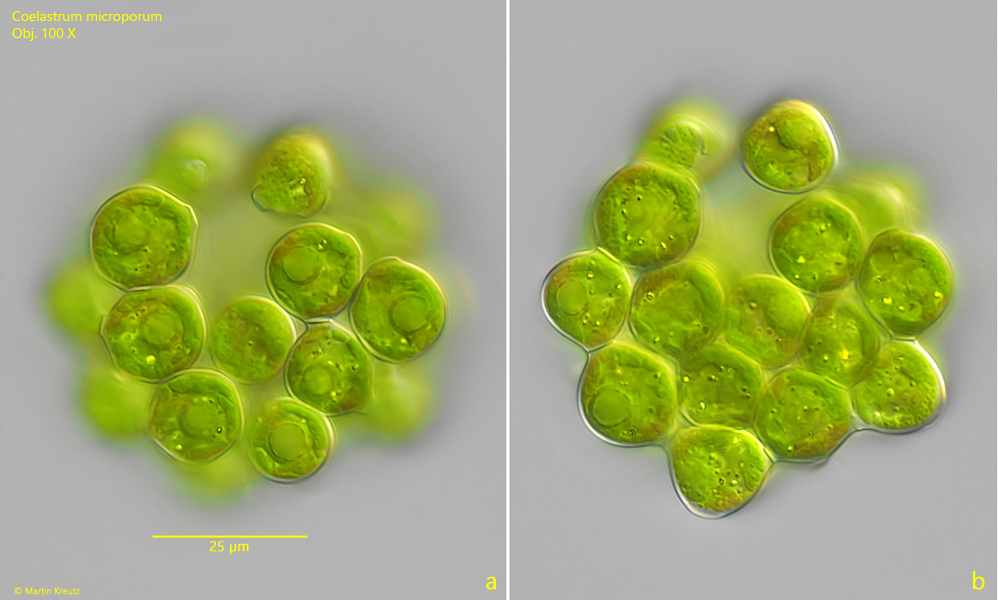
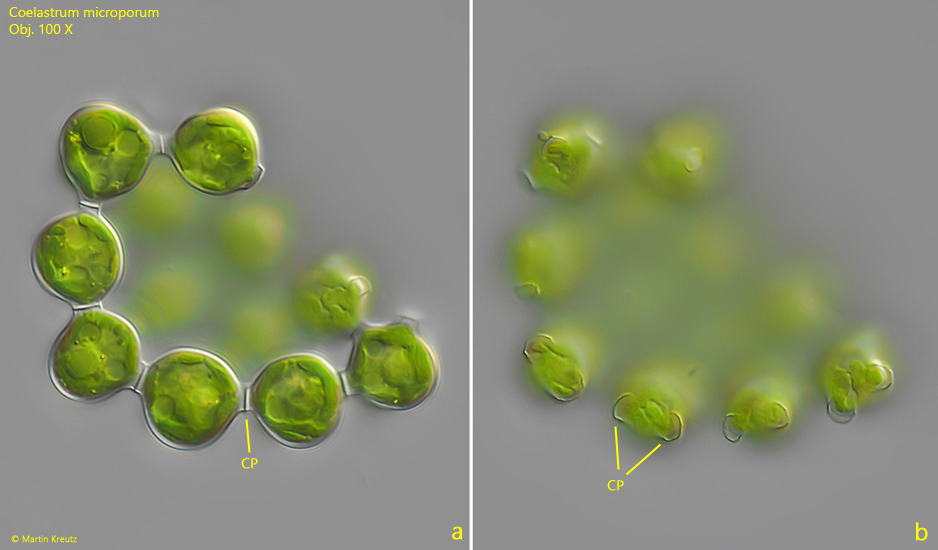
I found many coenobia of Coelastrum microporum in the plankton of the pond of the waste disposal company Constance. The coenobia had a diameter of 50–70 µm. I mostly found spherical coenobia with 16 or 32 cells. I did not find smaller or larger coenobia. Additionally, some coenobia were broken (s. fig. 4 a-b). Most coenobia were found in autumn.
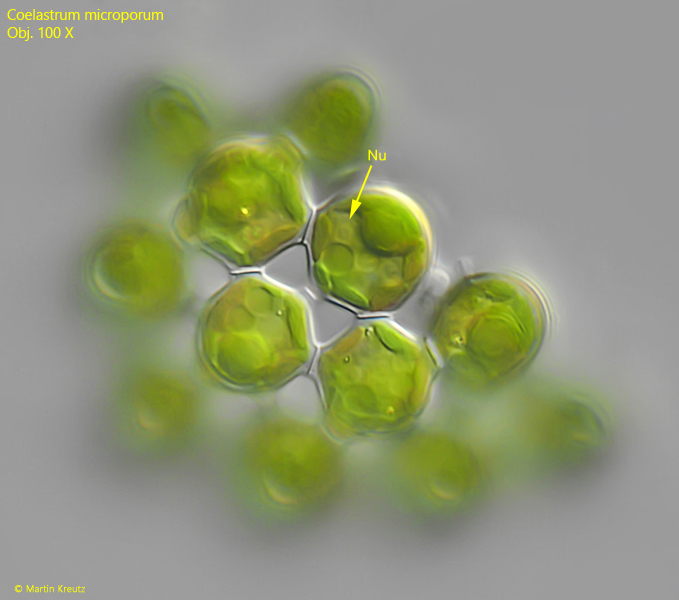
The cells in the coenobia in my population were mostly slightly ovoid in shape with a slight tapering of the polar end of the cell, which points outward. The connection points between the cells were flattened, giving the cells a slightly polyhedral appearance (s. fig. 5).
Coelastrum microporum differs from the similar species Coelastrum pseudomicroporum in the shape of the cells and in the connections to neighboring cells. Coelastrum pseudomicroporum has ovoid cells that are connected not only to the lateral neighboring cells via short projections but also to the inner cells at their basal surfaces.
Fig. 1:Coelastrum microporum. D = 58 µm (of coenobium). A coenobium of 32 spherical cells. Obj. 100 X.
Fig. 2 a-b:Coelastrum microporum. D = 69 µm (of coenobium). Two focal planes of a second coenobium of 32 cells. Obj. 100 X.
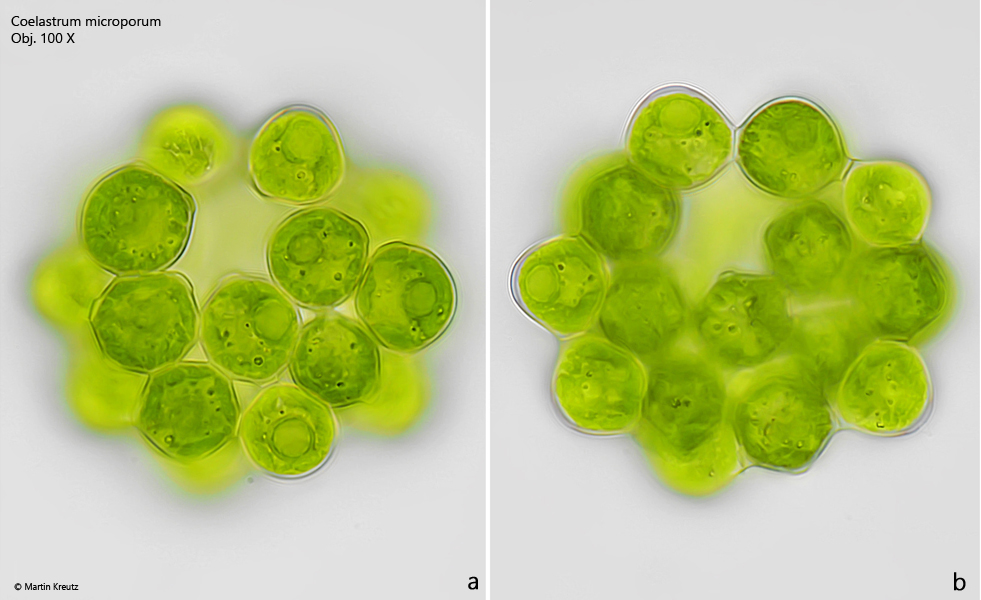
Fig. 3 a-b: Coelastrum microporum. D = 69 µm (of coenobium). The same coenobium as shown in fig. 2 a-b in brightfield illumination. Obj. 100 X.
Fig. 4 a-b:Coelastrum microporum. A broken coenobium with focal plane on the connecting projections (CP) of the cells. Obj. 60 X.
Fig. 5:Coelastrum microporum. Another broken colony. The focus is on some outer cells that are still connected to their neighboring cells. Nu = nucleus. Obj. 100 X.