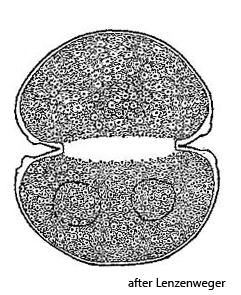
papillae att the basal corners on one or both sides
two pyrenoids per semi-cell
Cosmarium perforatum var. rauchii
So far I have found only a few specimens of Cosmarium perforatum var. rauchii in about 6 weeks old samples from the Schwemm Moor in July 2026. This variety seems to be rare, since Lenzenweger (1999) was able to detect it only in the Egelsee near Abtenau (Austria).
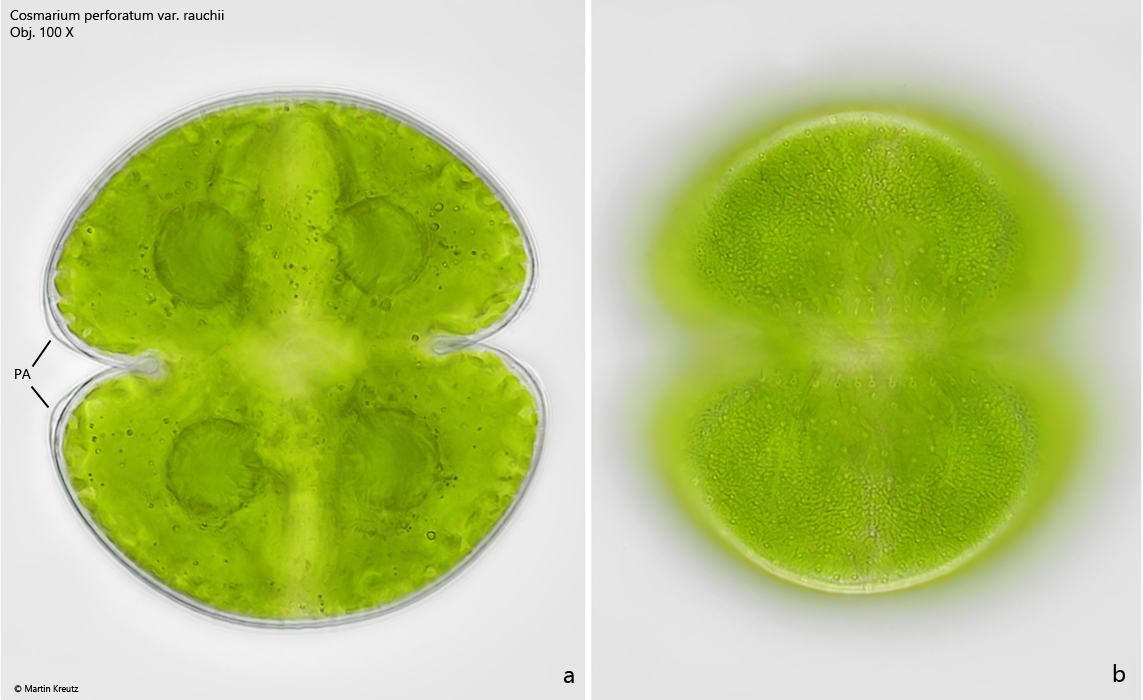
The variety “rauchii” differs from the basic species Cosmarium perforatum only by papillae at the corners of the basal lobes (s. fig. 1 a). These are thickenings of the cell wall. They may be present only on one side or on both sides. In my specimens, they were always pronounced on only one side.
Contrary to the description by Lenzenweger, my specimens, with a length of 90 µm or even slightly more, were almost 30% longer than the range he specified. Whether this is a site-specific variety, or whether the variability of this species is greater than known, can only be shown by further findings and investigations.
Fig. 1 a-b:Cosmarium perforatum var. rauchii. L = 92 µm. Two focal planes of a specimen in brightfield illumination. Note the papillae (PA) on one side as a thickening of the basal corners. Obj. 100 X.
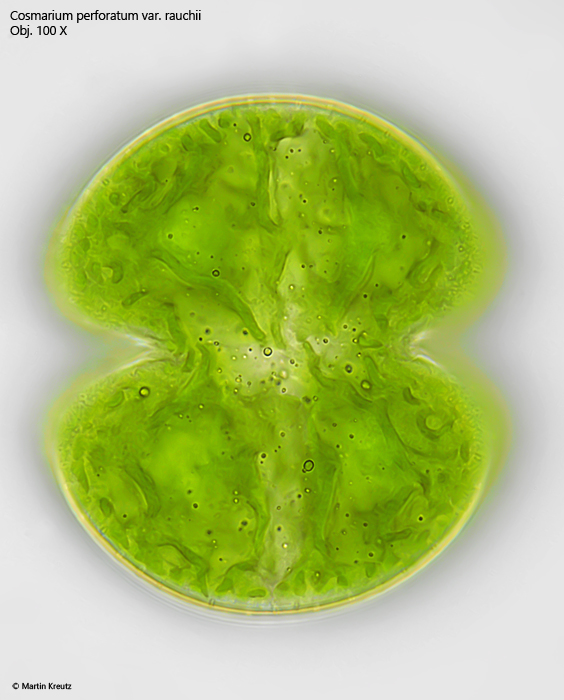
Fig. 2:Cosmarium perforatum var. rauchii. L = 92 µm. Focal plane on the lobed chloroplast of the specimen. Obj. 100 X.
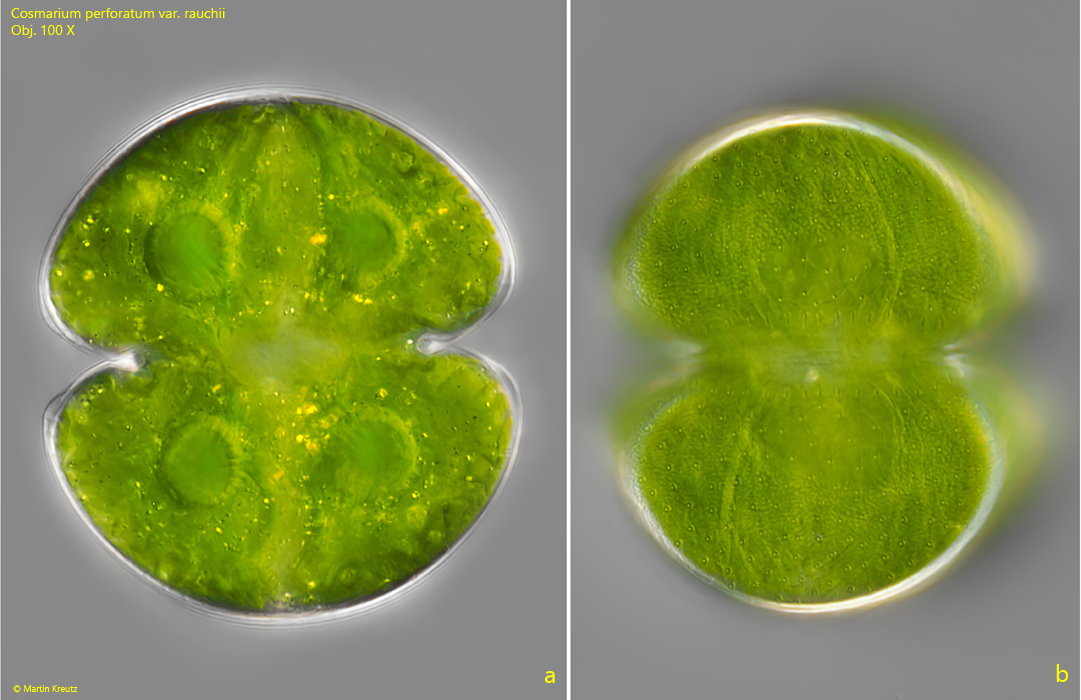
Fig. 3 a-b:Cosmarium perforatum var. rauchii. L = 92 µm. The same specimen as shown in fig. 1 a-b in DIC. Obj. 100 X.