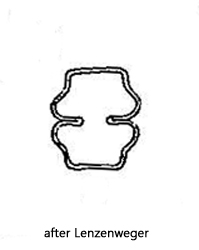
lateral margins of semi-cell concave in upper half
sinus deep, linear closed
cell with some, small pores
one pyrenoid per semi-cell
Cosmarium trilobulatum var. depressum
I find Cosmarium trilobulatum var. depressum very frequently in the Simmelried. In my other collection sites, I have not been able to detect this species so far.
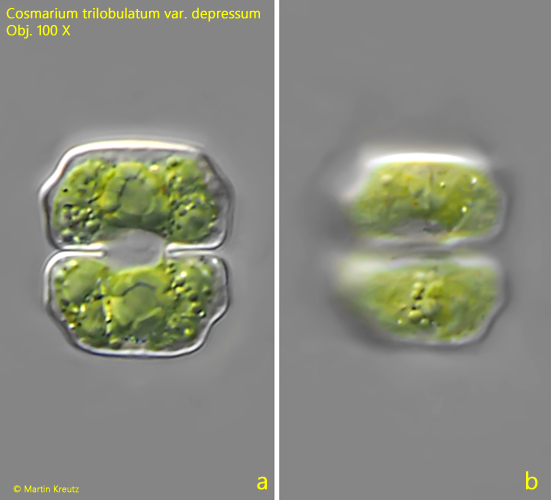
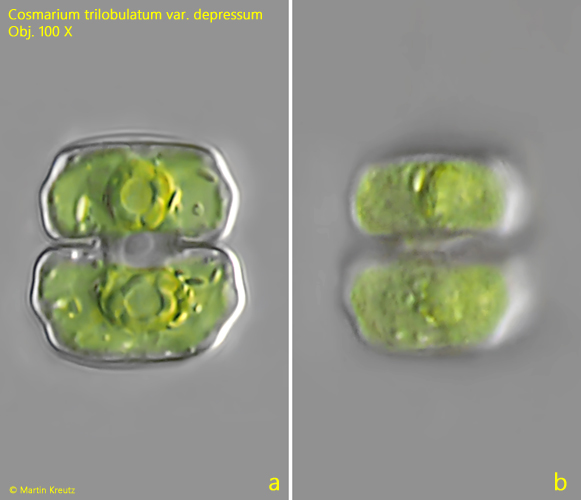
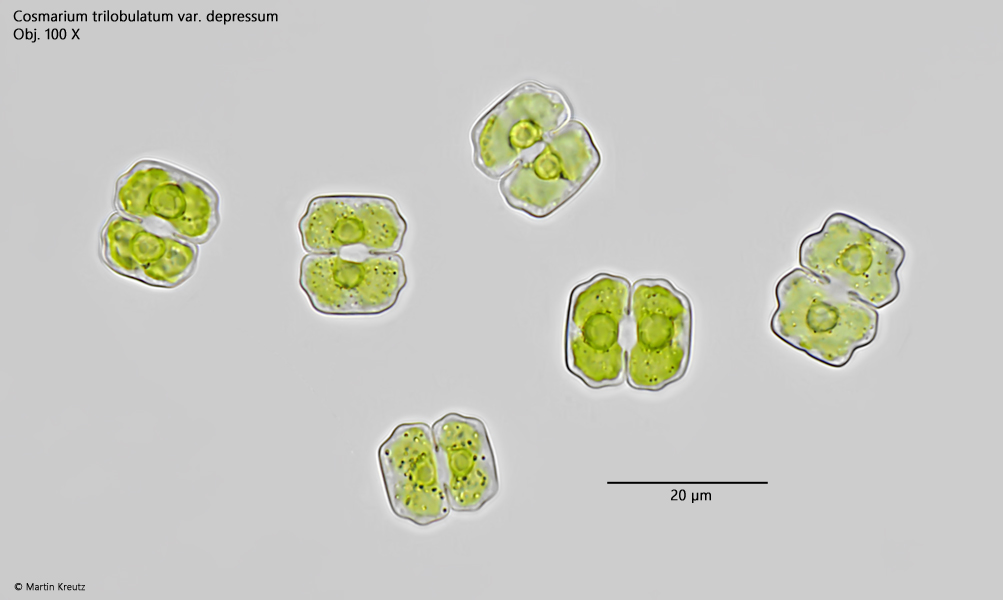
Cosmarium trilobulatum var. depressum is particularly easy to find in old samples with little plant material. Then, clusters of Cosmarium trilobulatum var. depressum often appear on the bottom of the vessels. Although the alga is very small, it is easy to identify due to its characteristic shape. The semi-cells have concave indentations on the lateral sides, which transition into the flat or slightly concave apices. The cell wall is said to have a few pores, which I, however, could not recognize.
The parent form Cosmarium trilobulatum is significantly larger, measuring 15–30 µm in length, and the basal angles of the semi-cells are more angularly formed.
Fig. 1 a-b:Cosmarium trilobulatum var. depressum. L = 15.2 µm. Two focal planes of a specimen found in the Simmelried. Obj. 100 X.
Fig. 2 a-b:Cosmarium trilobulatum var. depressum. L = 14.7 µm. Two focal planes of a second specimen. Obj. 100 X.
Fig. 3:Cosmarium trilobulatum var. depressum. L = 13.9–17.3 µm. Several specimens in brightfield illumination. Obj. 100 X.