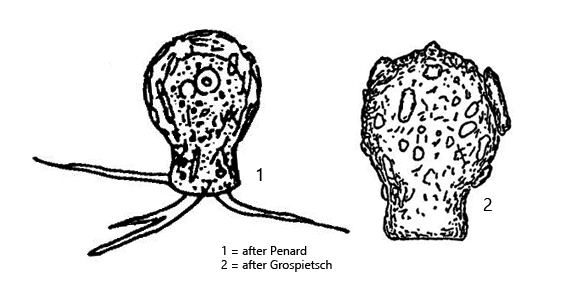
shell chitinuous, brownish-yellowish, with few xenosomes
nucleus in posterior third
one contractile vacuole, posterior third
slender pseudopodia, slightly branched
Cryptodifflugia sacculus
I have found Cryptodifflugia sacculus very rarely in the Simmelried and very frequently in samples from the Schwemm Moor in Austria. The specimens are often found in detritus and gel between floating aquatic plants and in Sphagnum moss.
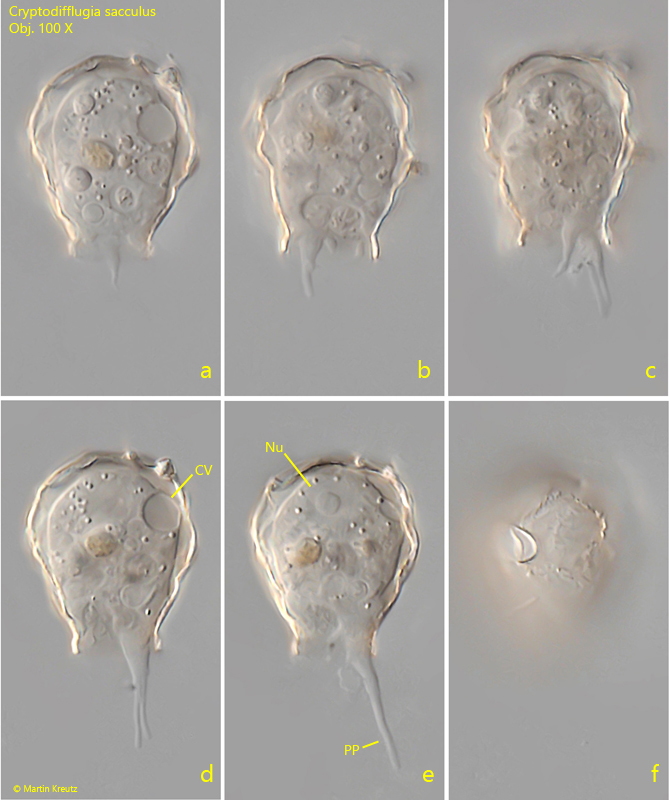
Cryptodifflugia sacculus has a characteristic shell. It is pear-shaped and somewhat irregular in form. It often has slight indentations. Additionally, Xenosomes are always attached to the outside of the shell. The Xenosomes are usually quartz grains or shells of diatoms. The mouth opening of the shell is round. The protoplast does not completely fill the shell. In some places, the protoplast is in contact with the shell. The pseudopodia are usually slender and only slightly branched. According to my observations, they grow about as long as the shell. The nucleus as well as the contractile vacuole are located in the posterior third.
Fig. 1 a-f:Cryptodifflugia sacculus. L = 25 µm. Different focal planes of a specimen. Note the nucleus (Nu) and contractile vacuole (CV) in the posterior third. PP = pseudopodia. Obj. 100 X.