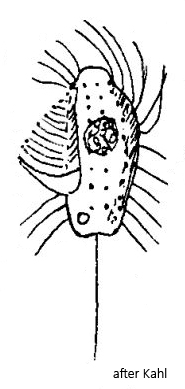
So far I have found Cyclidium elongatum only in the Simmelried, between decomposing plant material. The essential differences from the widespread species Cyclidium glaucoma are the slender shape of the body and the undulating membrane, which extends to the posterior third of the body, where the mouth opening is located. In addition, the posterior end of Cyclidium elongatum is transversely truncated, whereas in Cyclidium glaucoma it is broadly rounded.
In 1988 Foissner remarked that in his opinion Cyclidium elongatum and Cyclidium glaucoma should be synonymized, without, however, giving reasons for this. So far such a synonymization has not been carried out and Cyclidium elongatum is treated as a separate species. After observing the specimens in my population, I also consider Cyclidium elongatum to be a distinct species, at least according to the morphological characteristics, which exactly match Kahl’s description. In his description of Cyclidium elongatum, Kahl also noted that the features are very consistent, which is why the species cannot be confused with Cyclidium glaucoma and Cyclidium citrullus.
Fig. 1 a-h:Cyclidium elongatum. L = 17 µm. Different focal planes of a freely swimming specimen from left. CC = caudal cilium, CV = contractile vacuole, FP = frontal plate, Ma = macronucleus, UM = undulating membrane. Obj.1040 X.