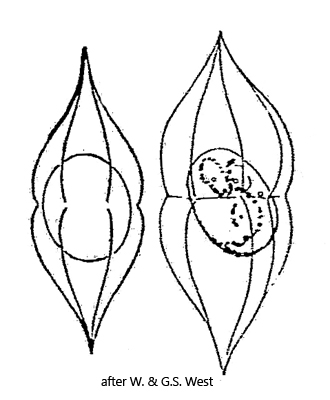
length up to 22 µm, width up to 9 µm (of cell envelope)
cell spherical, much smaller than cell envelope
cell with cup-shaped chloroplast
one pyrenoid
Desmatractum plicatum
So far, I have found only a single specimen of Desmatractum plicatum in August 2024. The specimen had settled on a floating cover glass in a sample from the Simmelried.
Desmatractum plicatum was previously described only by W. & G.S. West in 1902. The authors described a population from Ceylon (= Sri Lanka). Apparently, there are no further records of this alga.
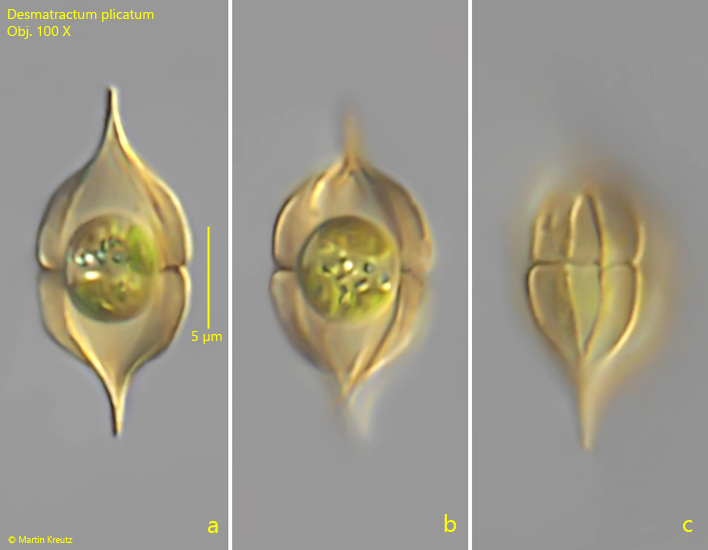
The main characteristic of Desmatractum plicatum is the spindle-shaped cell envelope, which has only short extended tips and a clearly indented cell equator. In addition, the cell envelope has 8–10 longitudinal ribs, which are clearly visible (s. fig. 1 c). The cell itself is spherical and sits centrally in the much larger cell envelope. In my specimen, the cell had a diameter of 5.2 µm. I could not discern the shape of the chloroplast or the pyrenoid.
The similar species Desmatractum bipyramidatum is significantly longer, about 30 µm in length. In addition, the cell envelope is slimmer in shape and does not have an indented equator.
Fig. 1 a-c:Desmatractum plicatum. L = 17 µm. Three focal planes of yellowish colored specimen. Note the distinct constriction at the equator of the cell envelope and the longitudinal ribs. The spherical cell in the center has a diameter of 5.2 µm. Obj. 100 X.