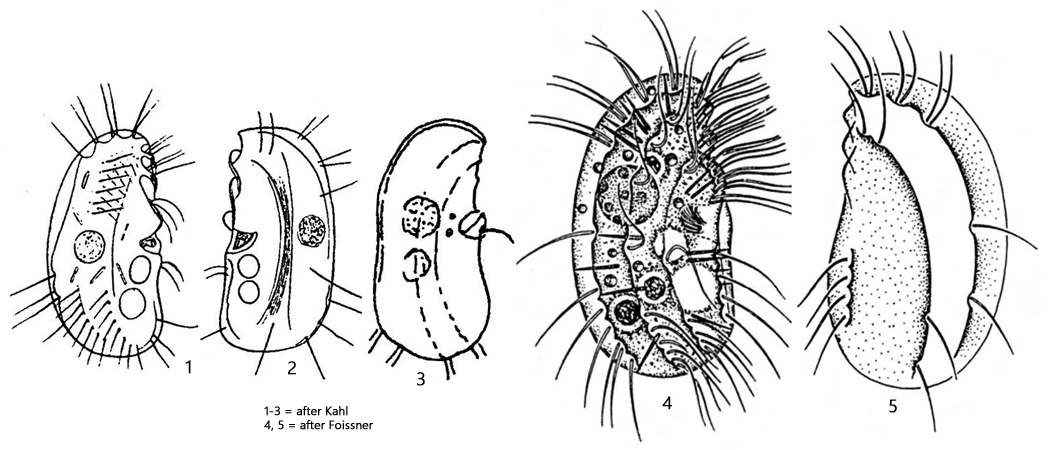
body ellipsoid, ventral margin straight, dorsally convex
laterally flattened
length 25–40 µm
on left side a longituginal, curved furrow
oral apparatus cavity in middel of ventral margin
three preoral rows of cilia
seven short rows of somatic cilia
macronucleus spherical, central
one small, spherical micronucleus
contractile vacuole slightly below oral apparatus
a second vacuole behind contractile vacuole for food residues
short canal between contractile vacuole and oral apparatus
several extrusomes, spindle-shaped
Drepanomonas revoluta
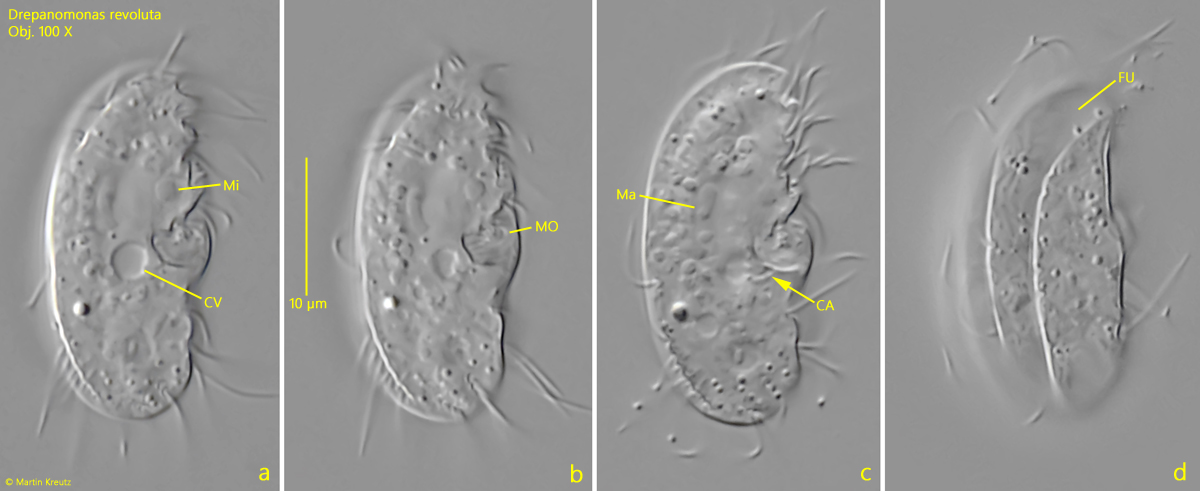
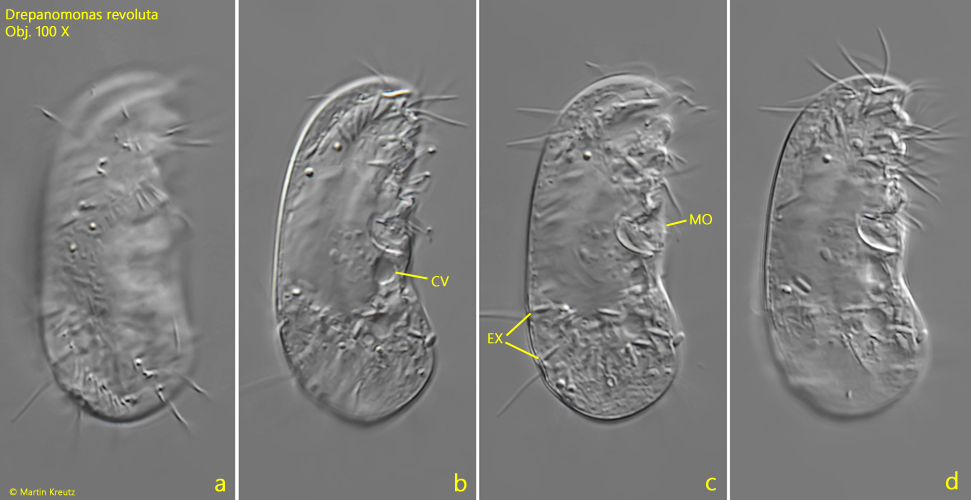
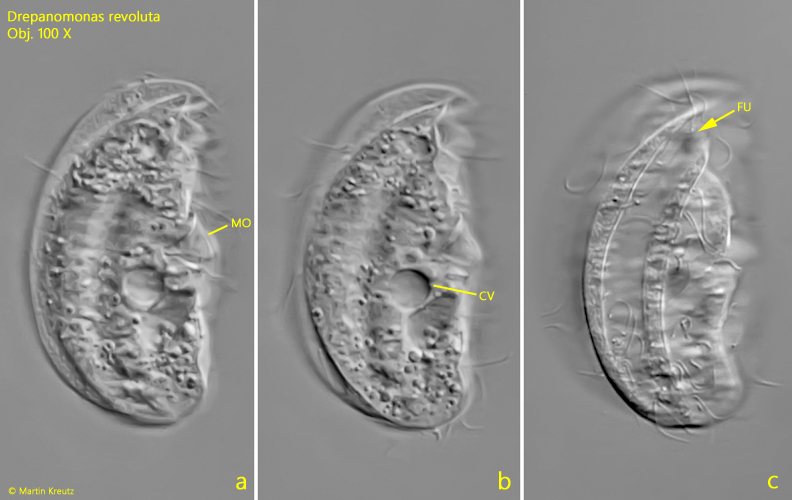
So far, I have only found Drepanomonas revoluta in a few specimens in mosses and in bog waters. The body is laterally flattened, and on the left side, there is a distinct, slightly curved furrow (s. figs. 1 d and 3 c). Under the coverslip, the specimens often lie on their left side, so that the right side faces the coverslip, and one has to focus through the specimens to recognize the shape of the left side. The ventral margin appears almost straight, with three small apical indentations where the adoral membranelles are located. The mouth opening is a distinct depression in the middle on the ventral side (s. figs. 1 b and 2 c).
The contractile vacuole is located almost in the center of the body at the level of the mouth opening (s. fig. 1 a). From it runs a short, hard-to-see excretory canal to the ventral side (s. fig. 1 c). Just below the contractile vacuole, there is often a second vacuole where digested food residues are collected before being excreted.
The exact arrangement of the sparse ciliation is difficult to recognize without silver impregnation. Essentially, it is limited to the right side, with rows of cilia that are interrupted in the middle of the body, while the right side is almost bare.
Fig. 1 a-d:Drepanomonas revoluta. L = 27 µm. Different focal planes of a freely swimming specimen from right. CA = excretion canal of contractile vacuole, CV = contractile vacuole, FU = curved furrov on left side (from right), Ma = macronucleus, Mi = micronucleus, MO = mouth opening. Obj. 100 X.
Fig. 2 a-d:Drepanomonas revoluta. L = 43 µm. A specimen found in July 2017 in the bog of the Pillersee (Austria). CV = contractile vacuole, EX = extrusomes, MO = mouth opening. Obj. 100 X.
Fig. 3 a-c:Drepanomonas revoluta. L = 34 µm. A third specimen found in June 1997 on the Postalm (Austria). CV = contractile vacuole, MO = mouth opening, FU = curved furrov on left side (from right). Obj. 100 X.