So far I have found Euastrum insigne only in samples from the Schwemm in Austria. In June 2025, however, I found only a few specimens in the samples. The species is described by Lenzenweger (1996) as widespread, sometimes occurring in masses.
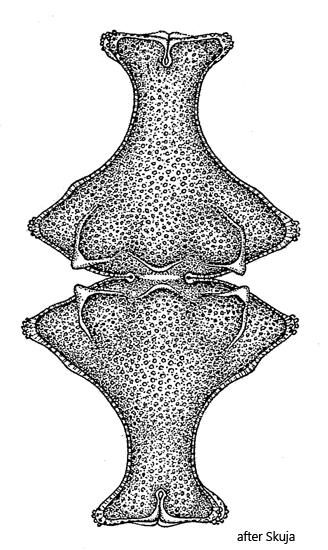
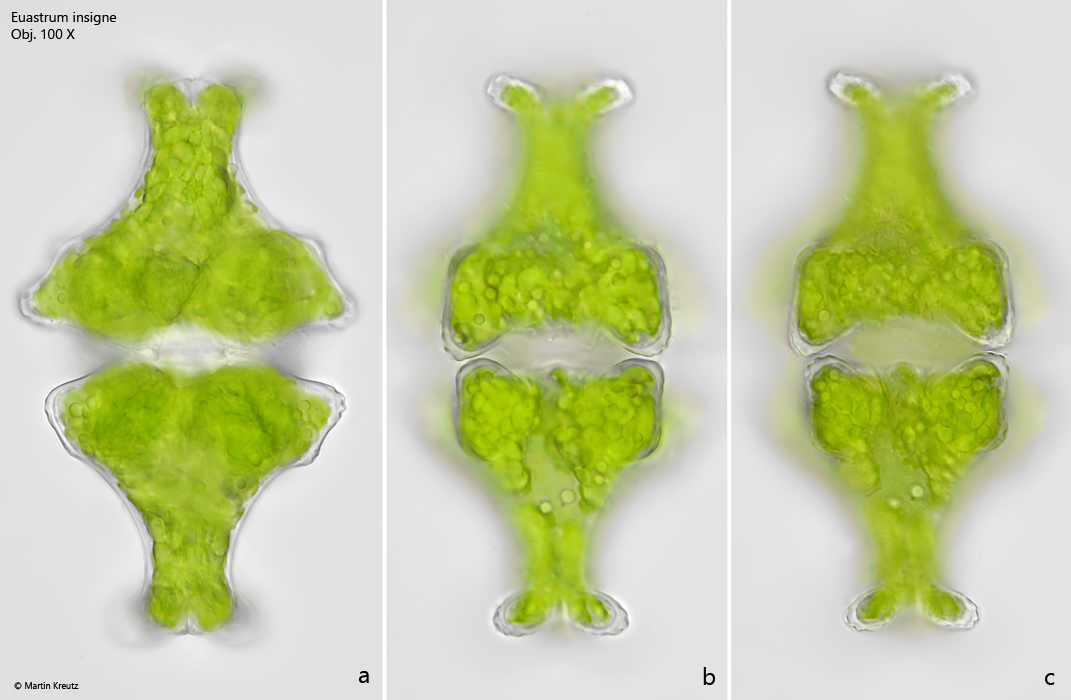
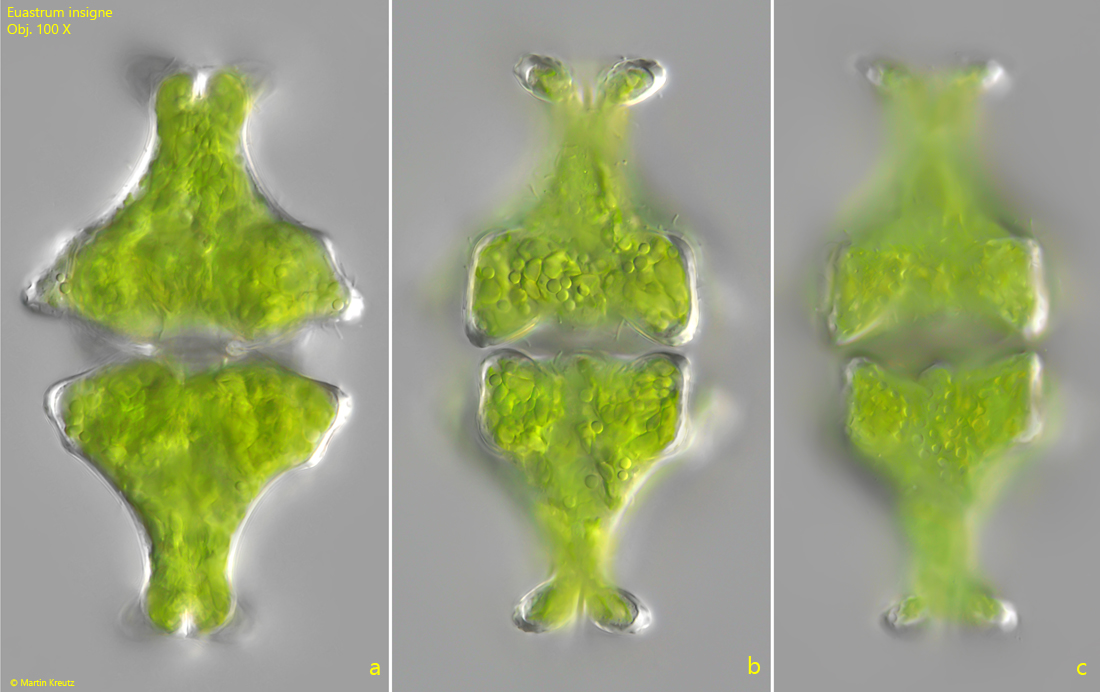
Euastrum insigne can easily be recognized by the strongly constricted semi-cells, which are elongated in a neck-like manner. The apices are broadened in an anvil shape with lateral lobes. The cell wall is ornamented with warts. These are particularly pronounced on the lateral margins of the lobes, but also in the center of the semi-cells.
At the base of the semi-cells there are two swellings that are nose-shaped and extend to the sinus. As a result, these swellings from both semi-cells almost touch each other in the middle of the cells (s. figs. 1 c and 2 b). Skuja drew horn-like thickenings of the cell wall on these swellings, which I was not able to observe.
Fig. 1 a-c:Euastrum insigne. L = 106 µm. Three focal planes of a specimen in brightfield illumination. Obj. 100 X.
Fig. 2 a-c:Euastrum insigne. L = 106 µm. The same specimen as shown in fig. 1 a-c in DIC. Obj. 100 X.