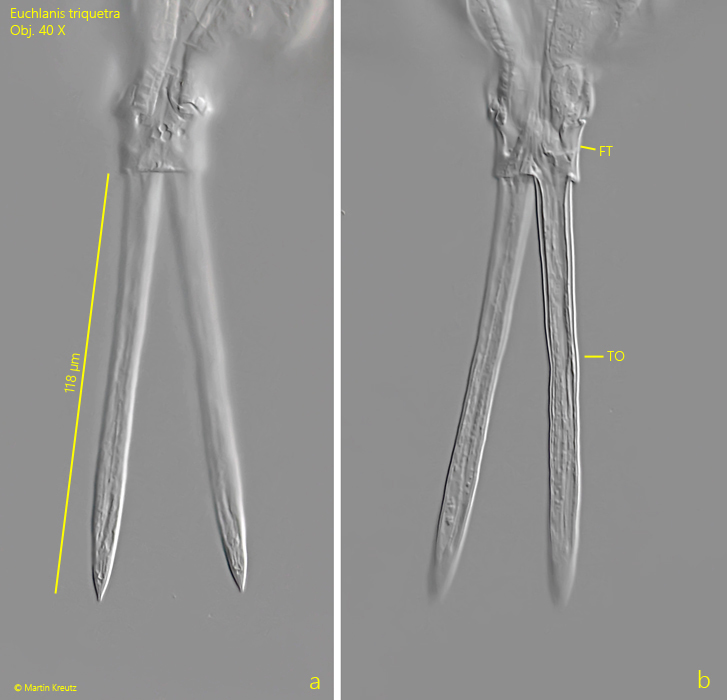
slender toes up to 150 long, parallel sided with a short tip
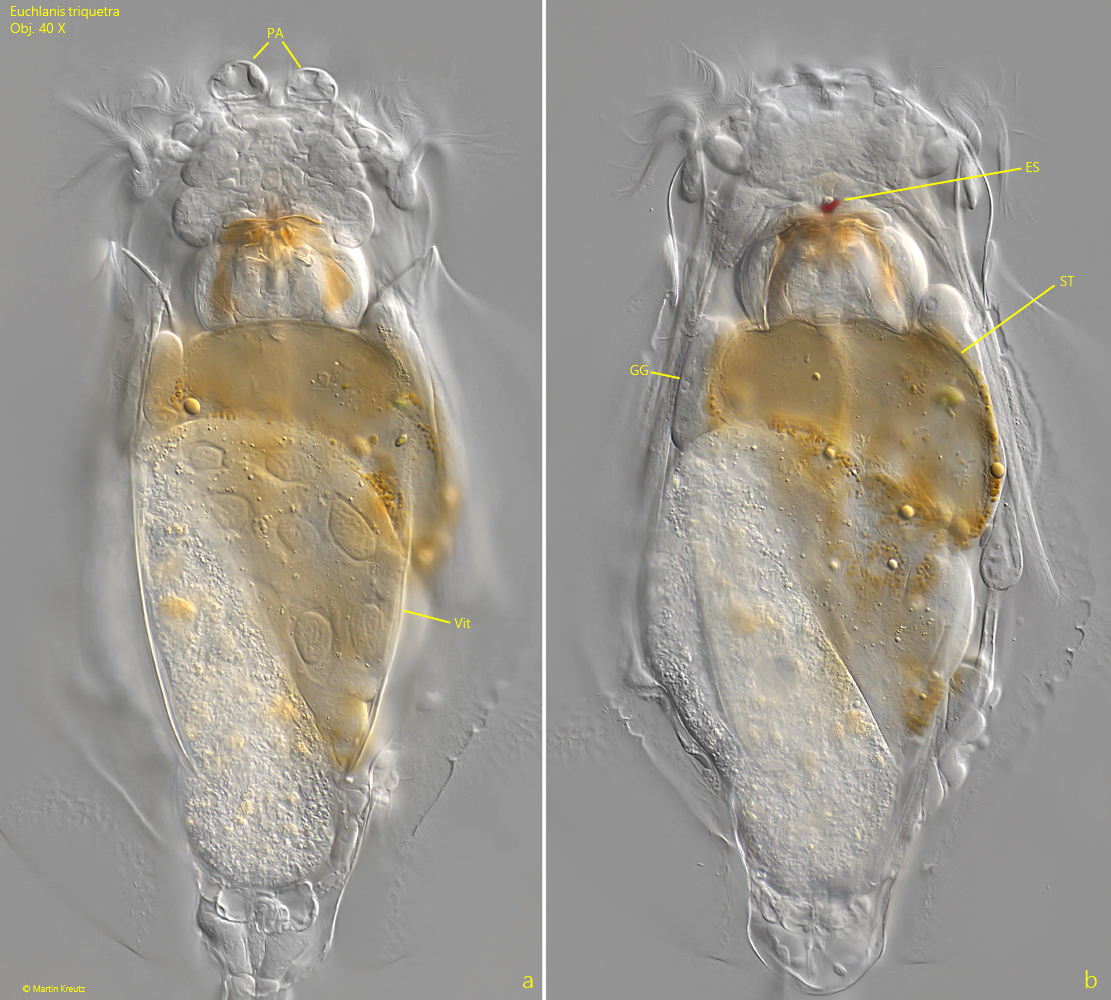
stomach usually green, yellow or brown
a pair of setae at the distal end of first foot segment
one eyespot with lens
Euchlanis triquetra
Euchlanis triquetra is usually found in bodies of water with many aquatic plants, where this species likes to stay. Its diet consists mainly of algae and flagellates.
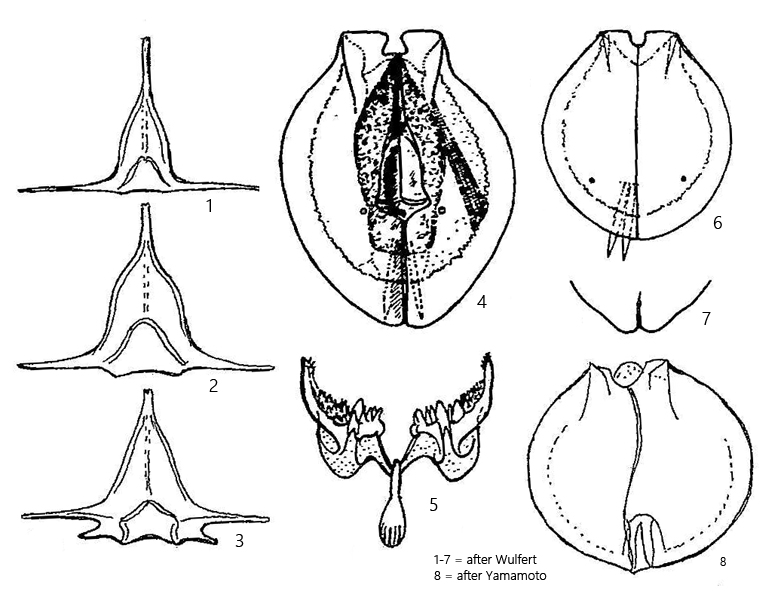
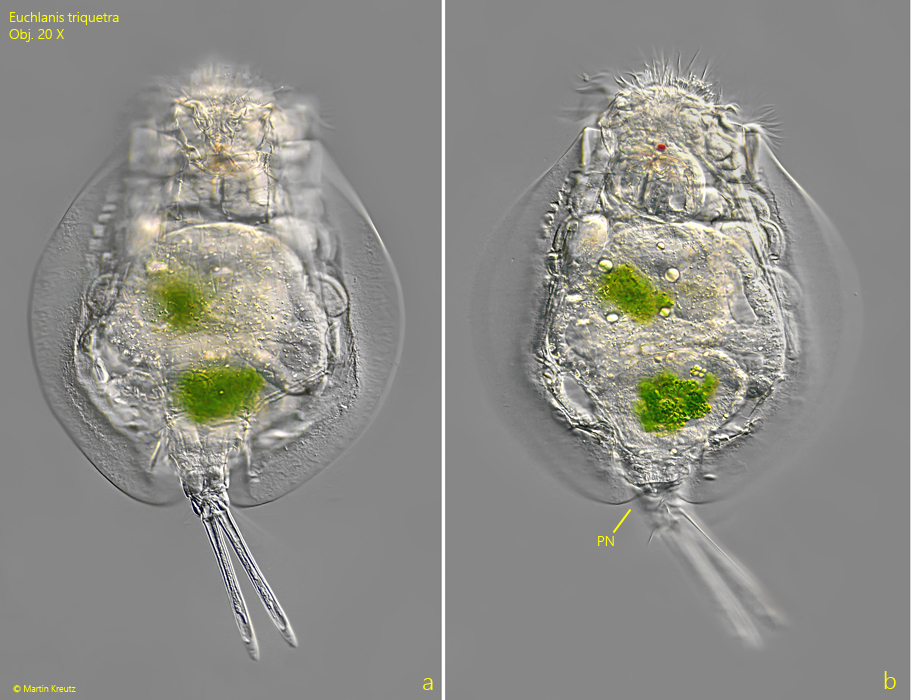
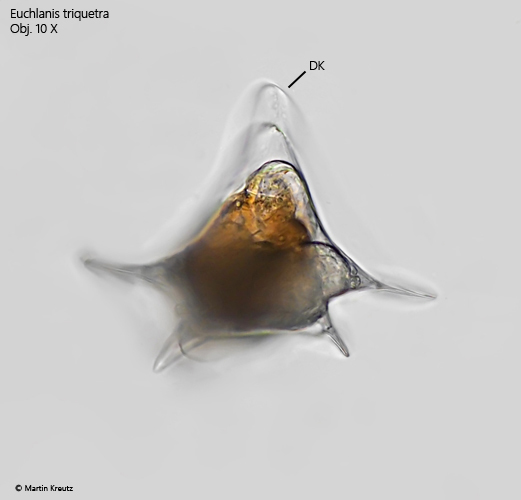
Euchlanis triquetra is best identified in freely swimming specimens. It is important to recognize the keel of the dorsal plate of the lorica. The dorsal plate is also wing-like in shape and often has a V-shaped notch at the posterior end. A ventral plate is absent. The lorica can grow up to 710 µm long. In specimens from my population, the loricae were 300–350 µm long.
Euchlanis triquetra can easily be confused with Euchlanis incisa. This species also has a dorsal keel. But Euchlanis incisa has a clearly visible oval ventral plate, and its lorica is only up to 270 µm long.
Fig. 1 a-b:Euchlanis triquetra. L = 315 µm (of lorica). Two focal planes of a slightly squashed specimen from ventral. Note the posterior V-shaped notch (PN) of the dorsal plate. Obj. 20 X.
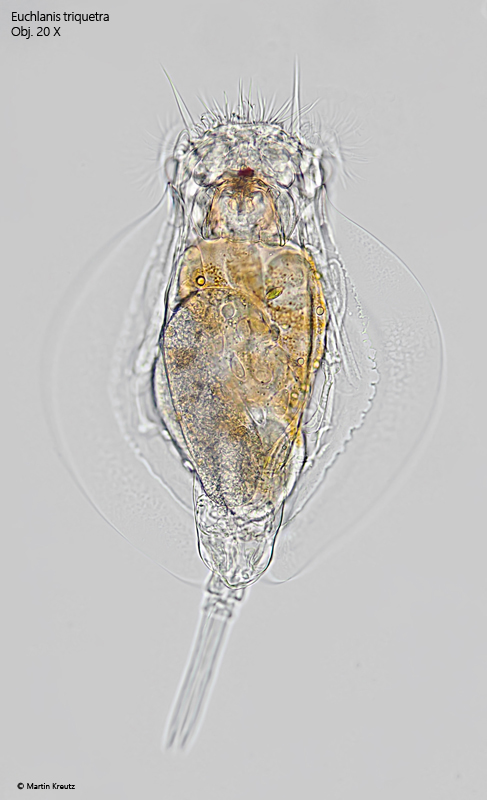
Fig. 2:Euchlanis triquetra. L = 325 µm (of lorica). A freely swimming specimen in brightfield illumination. Obj. 20 X.
Fig. 3:Euchlanis triquetra. Apical view of a freely swimming specimen. Note the prominent dorsal keel (DK). Obj. 10 X.
Fig. 4:Euchlanis triquetra. L = 334 µm (of lorica). A slightly squashed specimen from ventral. Obj. 40 X.
Fig. 5 a-b:Euchlanis triquetra. L = 340 µm (of lorica). Two focal planes of the body. Note the two apical palps (PA) and the eyespot with lens (ES). GG = gastric gland, ST = stomach, Vit = vitellarium. Obj. 40 X.
Fig. 6 a-b:Euchlanis triquetra. The foot (FO) and the toes (TO) with a length of 118 µm in detail. Obj. 40 X.