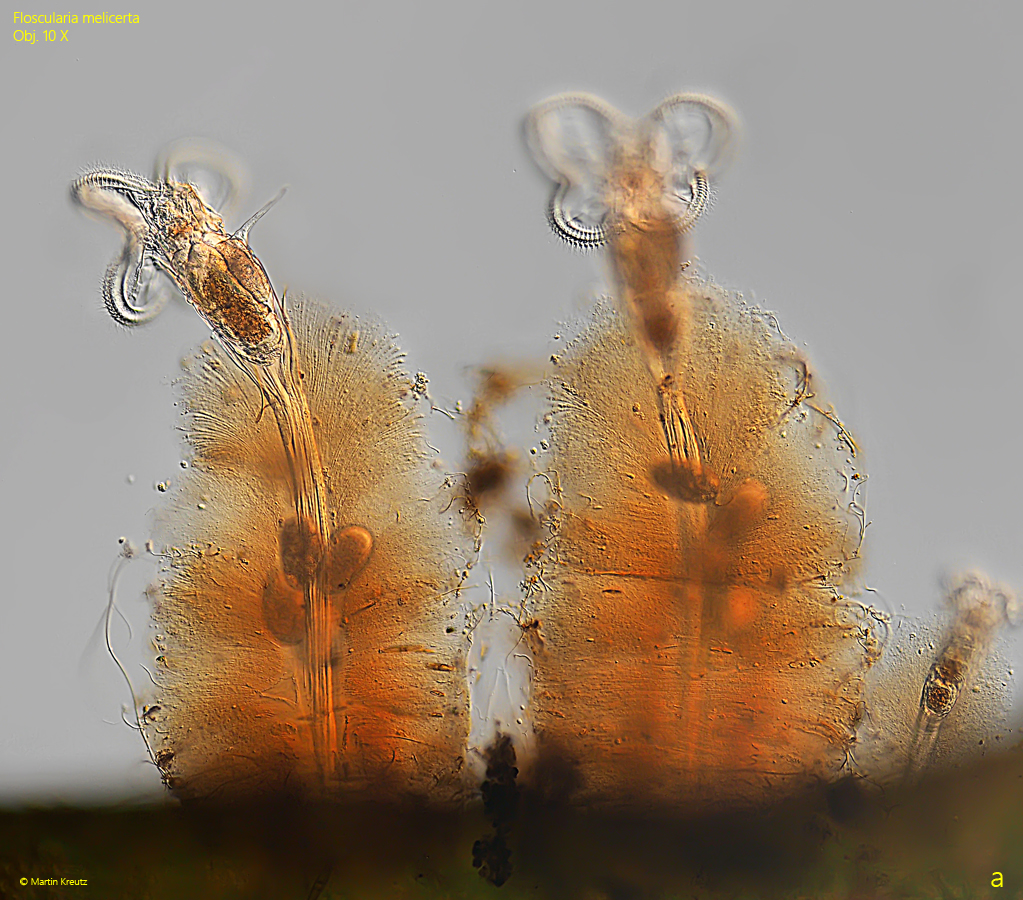
I found Floascularia melicerta in June 2020 on leaves of Myriophyllum spec. in Ulmisried. However, there were only a few specimens. The species is described as rare, and apart from this single find I have not been able to locate any further specimens so far.
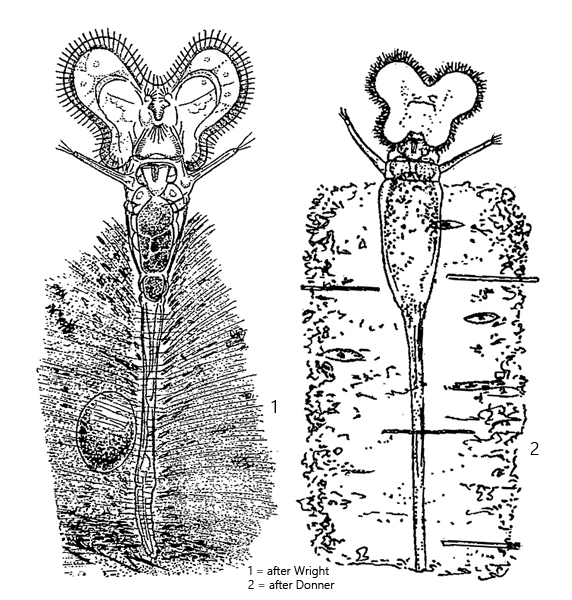
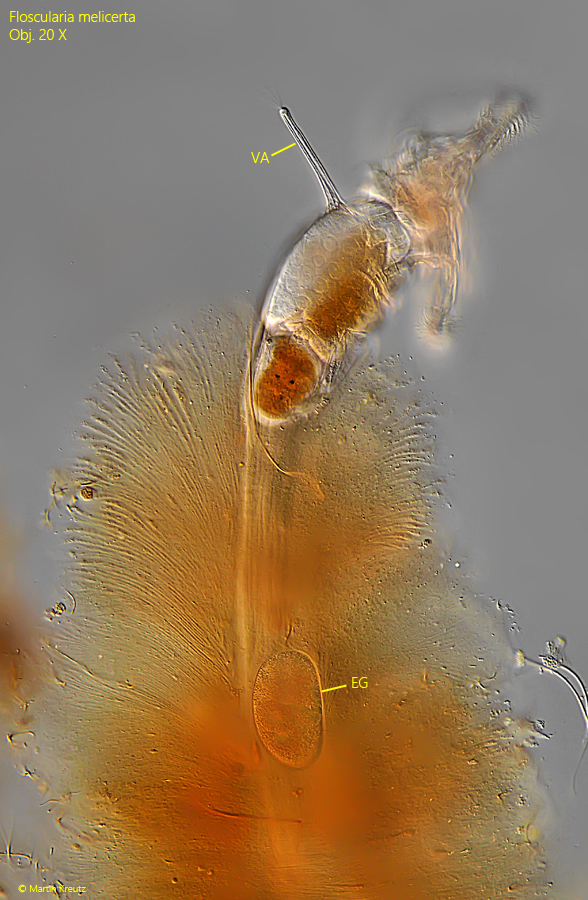
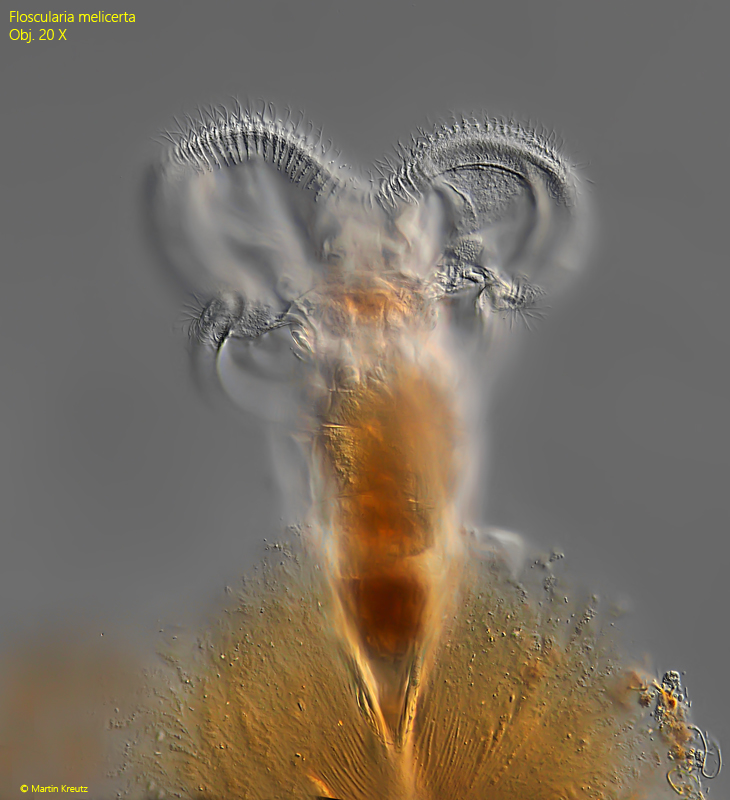
The species of the genus Floscularia can easily be recognized by the corona, which consists of 4 lobes. The species Floscularia melicerta is easily identified by the tube, which consists of a layered, gelatinous matrix. The layers appear in lateral view as a radial striation (s. fig. 2). Usually the tube is yellowish in color. In my population all the tubes were clearly orange in color.
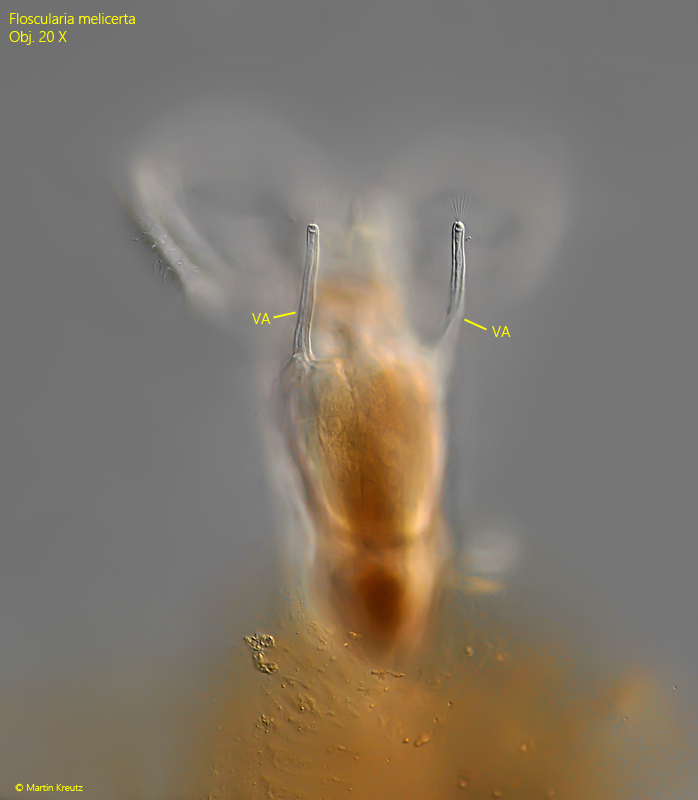
Compared to the body, the corona of Floscularia melicerta is quite large. Striking are the two long ventral antennae, which are always clearly visible in extended specimens (s. fig. 4). In my population the extended specimens were about 1000 µm long.
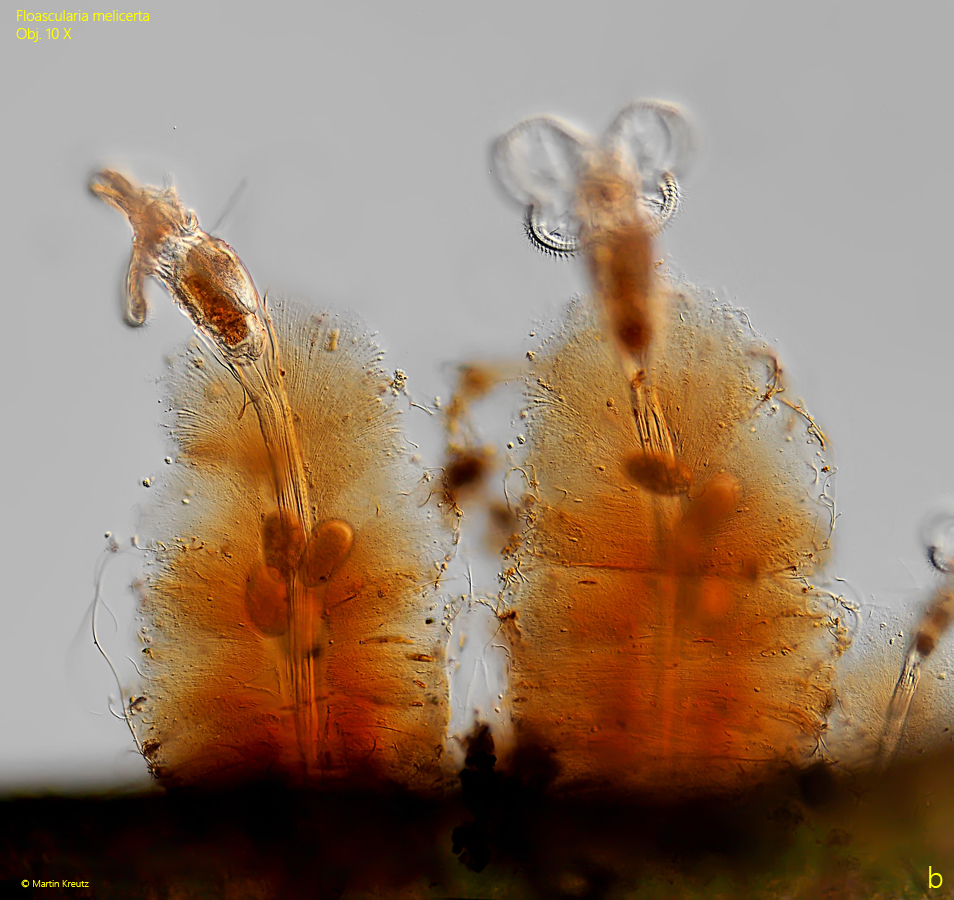
Fig. 1 a-b:Floscularia melicerta. L = 955–1000 µm. Two specimens in orange colored tubes attached to leaves of Myriophyllum spec. Obj. 10 X.
Fig. 2:Floscularia melicerta. An elongated specimen in lateral view from left. One of the two ventral antenna (VA) is in the focal plane. Note the fine, radially striation of the tube and the egg (EG) deposited in the tube. Obj. 20 X.
Fig. 3:Floscularia melicerta. Ventral view with focal plane on the two ventral antennae (VA). Obj. 20 X.
Fig. 4:Floscularia melicerta. Ventral view with focal plane on the four lobes of the corona. Obj. 20 X.