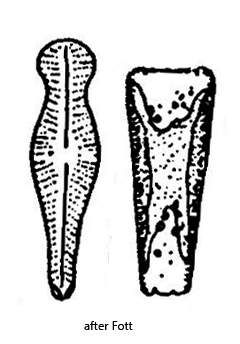
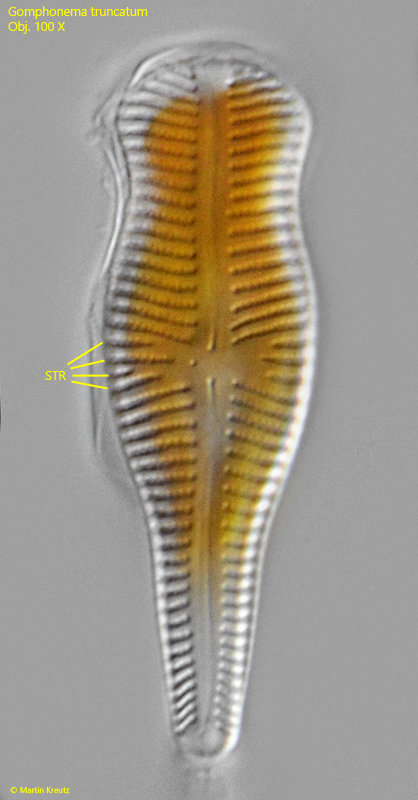
in valve view club-shaped with constriction at headpole
length 13–75 µm, width 7–17 µm
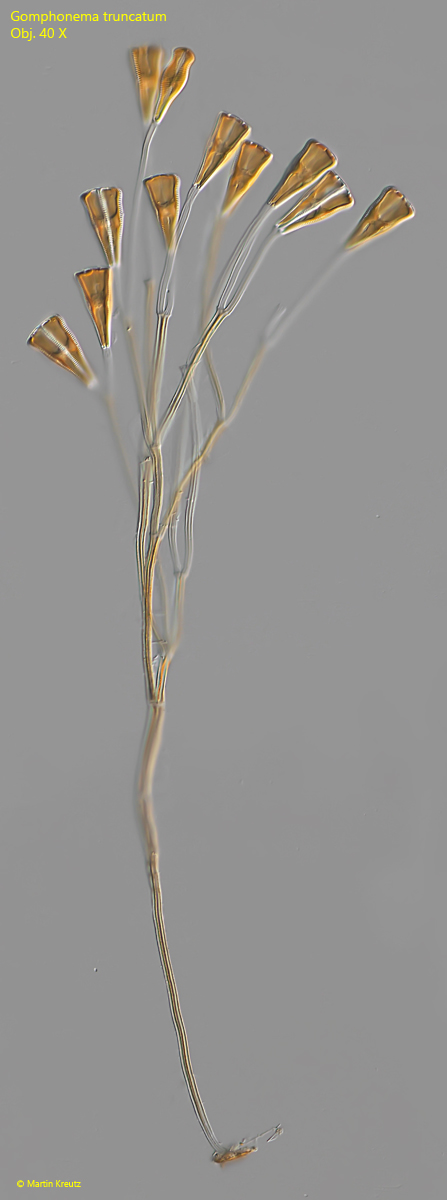
forms colonies on branched gelatinous stalks
striae almost parallel toward headpole
central field surrounded by striae of different length
chloroplast golden-brown
Gomphonema truncatum
I found colonies of Gomphonema truncatum on the stems of the yellow pond lily (Nuphar lutea) in the pond of the waste disposal company Constance. The colonies on branched gelatinous stems (s. fig. 1) were partially visible to the naked eye as brown bushes covering the stems.
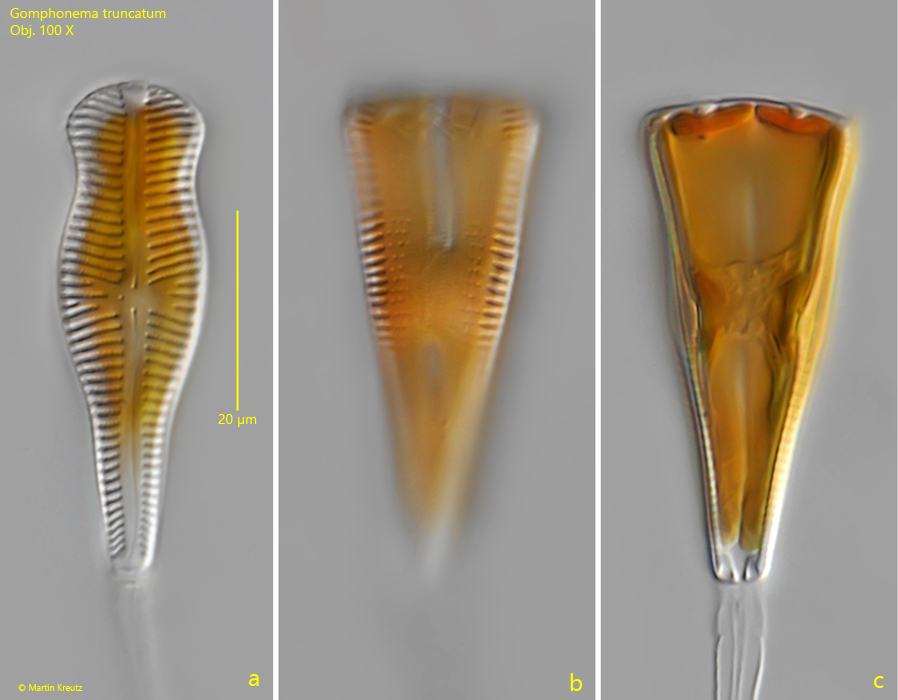
Gomphonema truncatum can be easily recognized by the characteristic shape of its valve. In girdle view, the valves are distinctly wedge-shaped, while in valve view they are club-shaped with a demarcated head region. The constriction below the head region can vary in intensity. The shells show distinct striations composed of individual pores. The individual pores are difficult to resolve in living specimens with water as the surrounding medium. Characteristic of Gomphonema truncatum are the irregularly long striations arranged radially around the central field in the middle (s. fig. 4).
Fig. 1:Gomphonema truncatum. L = 610 µm (of colony). A colony on branched gelatinous stalks. Obj. 40 X.
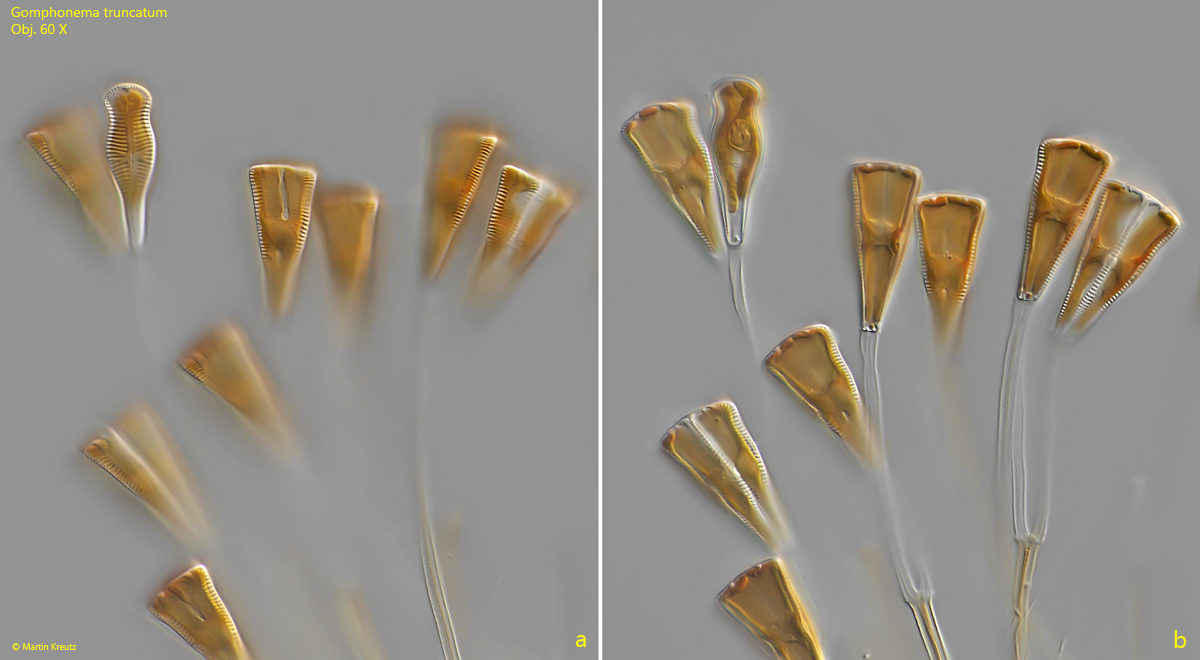
Fig. 2 a-b:Gomphonema truncatum. L = 48–54 µm (of cells). Two focal planes of some cells in the colony. Obj. 60 X.
Fig. 3 a-c:Gomphonema truncatum. L = 48 µm. A specimen in valve view (a) and two focal planes of the wedge-shaped girdle view (b, c). Obj. 100 X.
Fig. 4:Gomphonema truncatum. L = 48 µm. The squashed specimen as shown in fig. 3 a-c. Note the striae (STR) of different length surrounding the central field of the valve. Obj. 100 X.