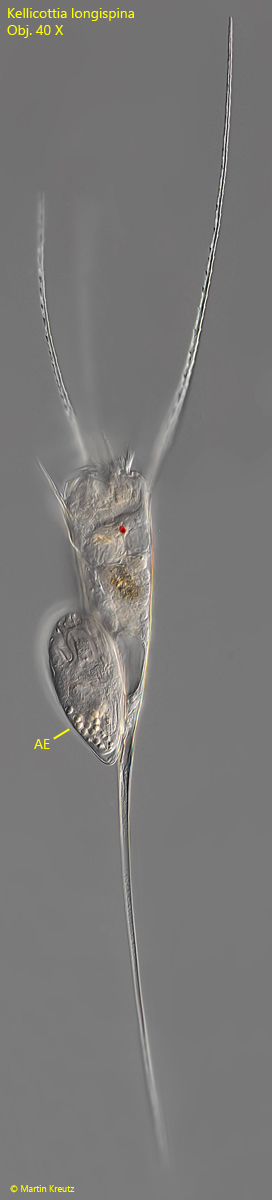
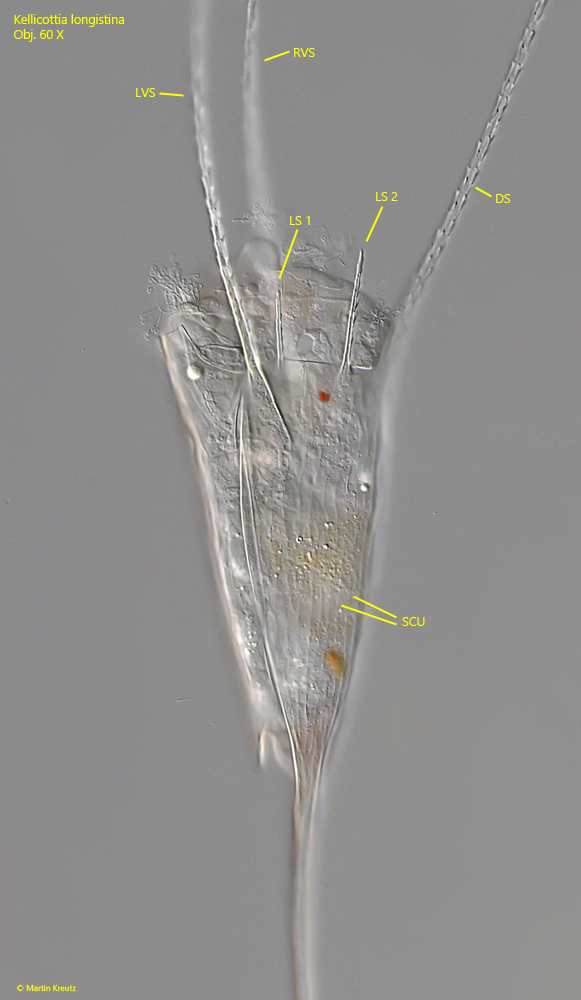
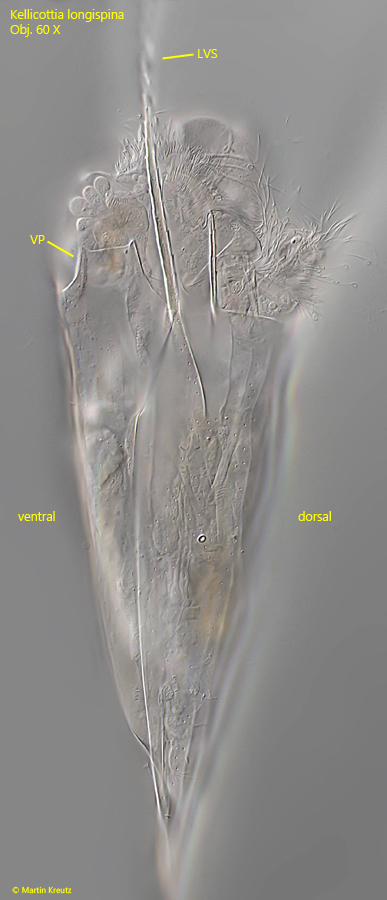
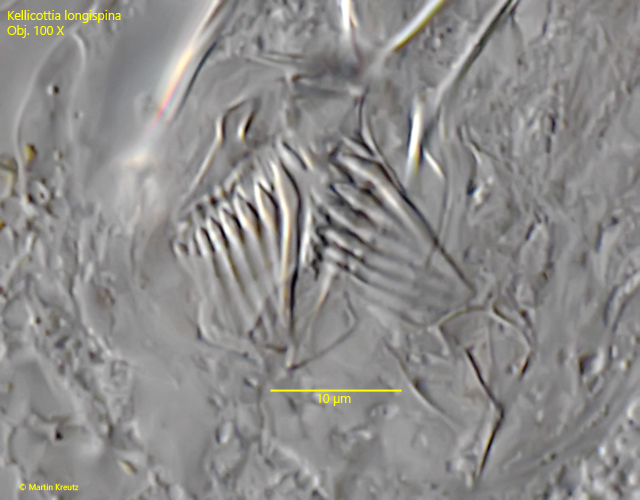
I find Kellicottia longispina exclusively in the plankton of Lake Constance. The species is psychrophilic, meaning it prefers cold temperatures. The optimal temperature for Kellicottia longispina is 15 °C. At higher temperatures, the specimens sink into deeper water layers.
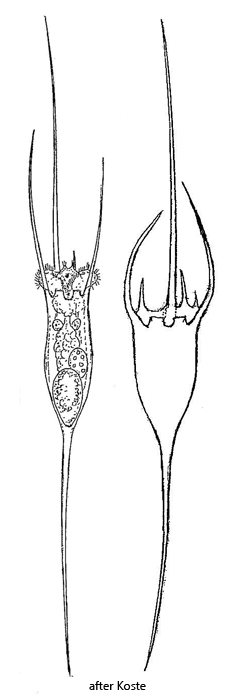
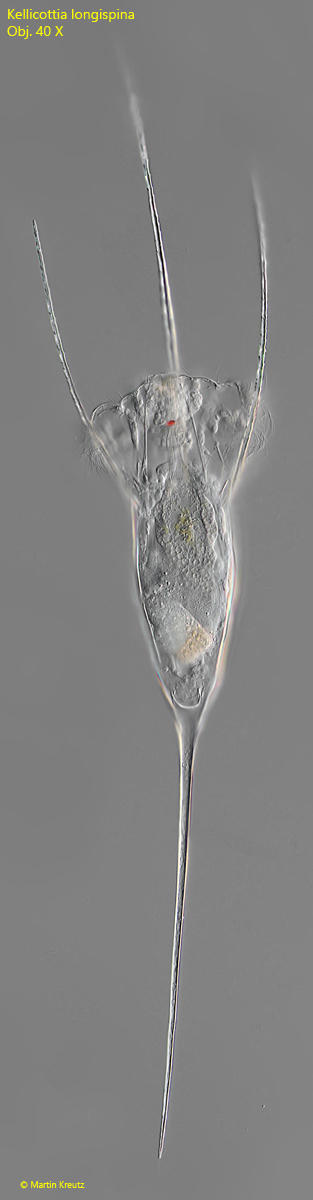
Kellicottia longispina is easy to recognize by its typical body shape with long spines. On the anterior margine of the lorica, there are 6 spines. Of these, 2 on the ventral side and one on the dorsal side are particularly long. Between these long spines are 3 other, significantly smaller spines. All spines on the anterior margin have a serrated structure. At the posterior end, there is another long spine, which, however, is smooth. The body itself is conically shaped and resembles an ice cream cone. The long spines serve as protection against predation. In many rotifers, there is a correlation between the presence of predators (e.g., Asplanchna spec.) and the length of the spines. This correlation has not yet been demonstrated for Kellicottia longispina. Instead, it has been found that the spines lengthen as the water temperature decreases (Edmondson, 1952, unpublished).
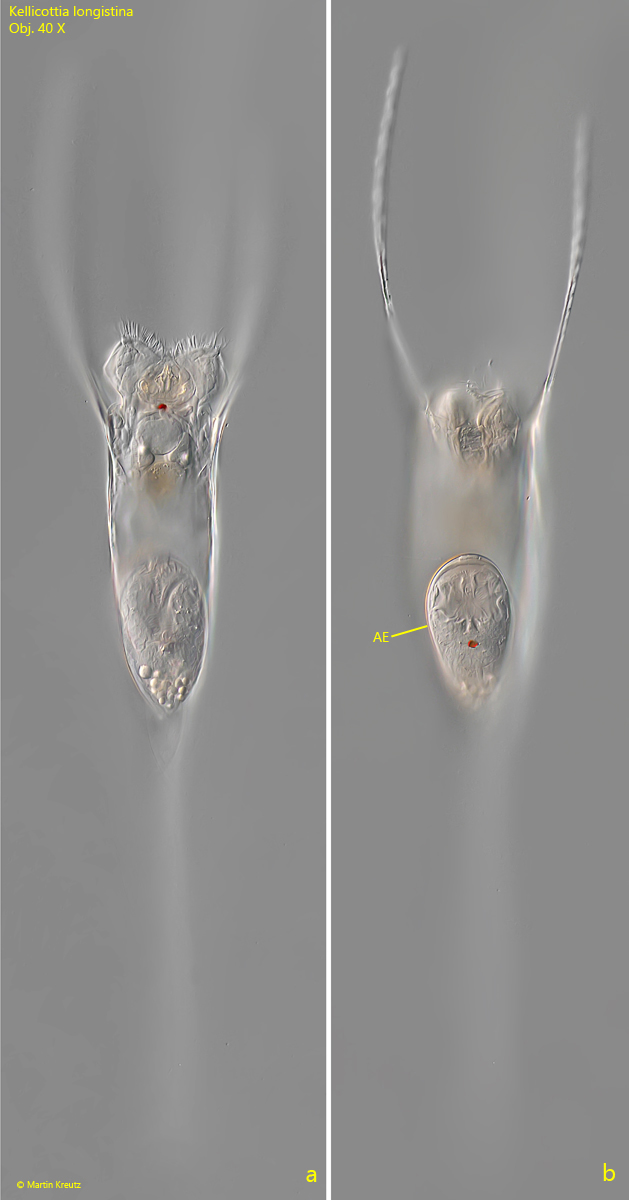
The corona of Kellicottia longispina is trilobed, which, however, is difficult to recognize in free-swimming specimens. According to Koste (1978), the diet consists mainly of small phytoflagellates such as Mallomonas and Dinobryon. In larger bodies of water, the species can be found throughout the year. In smaller bodies of water, mainly in spring.
The lorica of Kellicottia longispina is described by Koste (1978) as smooth and without structure. In my population, however, I was able to observe a delicate longitudinal striation on the dorsal side (s. fig. 4).
Kellicottia longispina can easily be confused with the similar species Kellicottia bostoniensis. However, this species has only 4 spines at the apical margin and, with a total length of about 360-380 µm, is also significantly smaller.
More images and information on Kellicottia longispina: Michael Plewka-Freshwater life-Kellicottia longispina