Keratella quadrata is one of the most common planktonic rotifers. The species can be found in almost all bodies of water. The length and shape of the spines are extremely variable and depend on the type and frequency of predators, but also on the season. Many varieties of the species have been described.
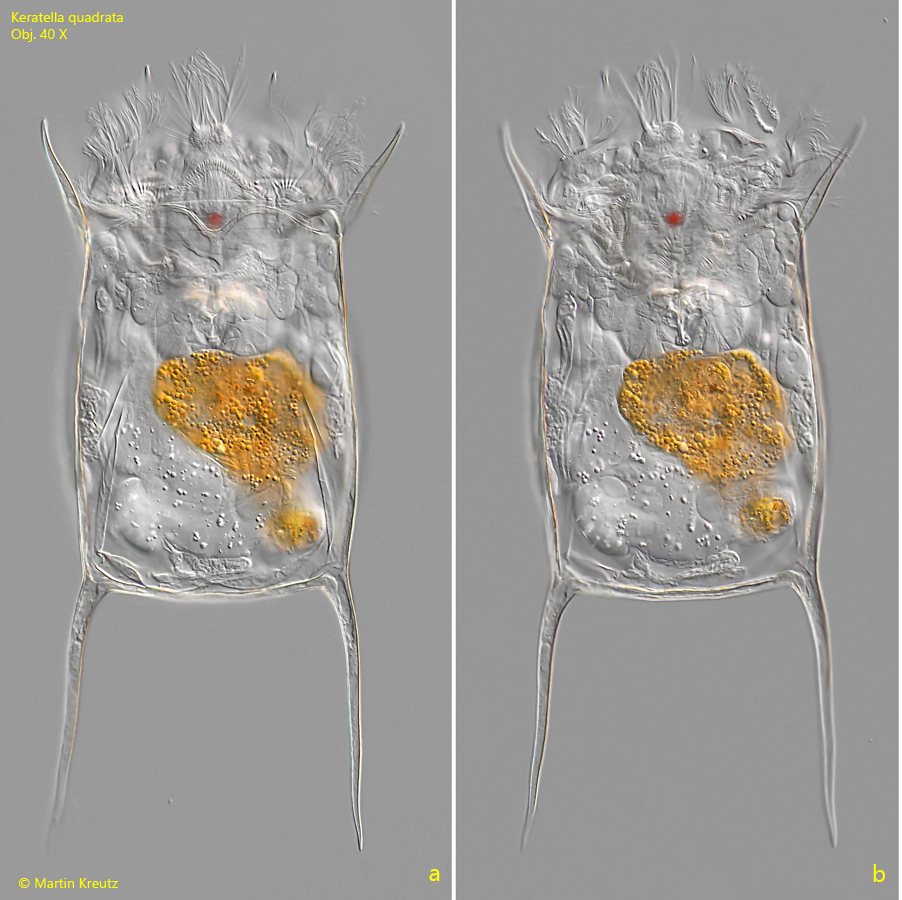
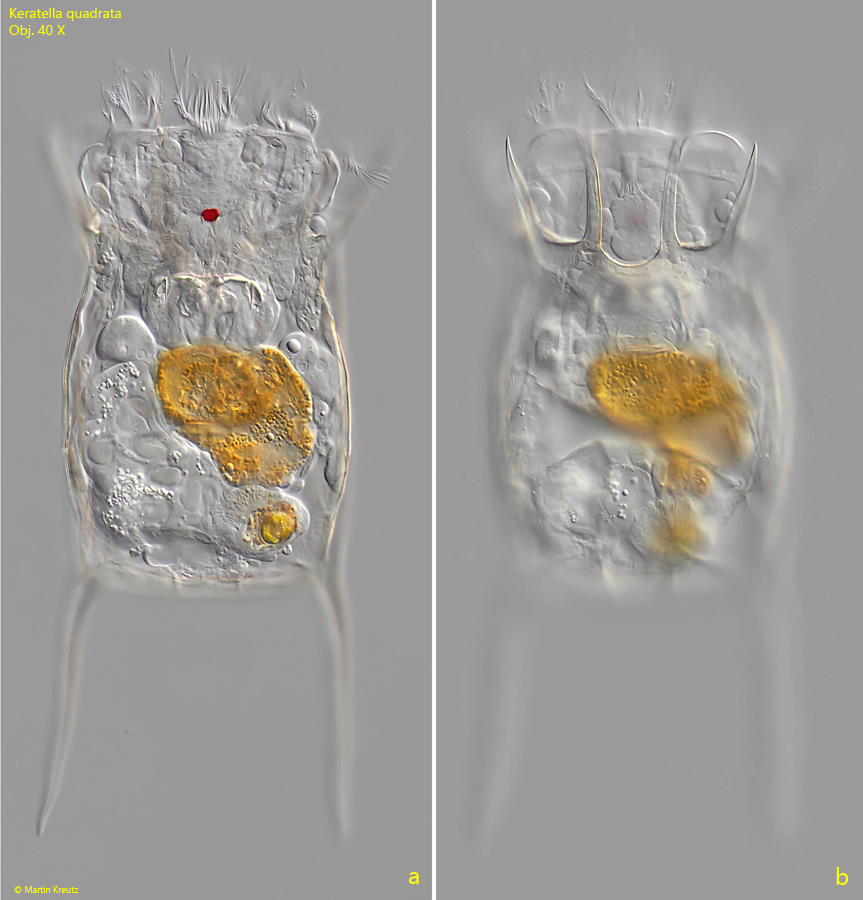
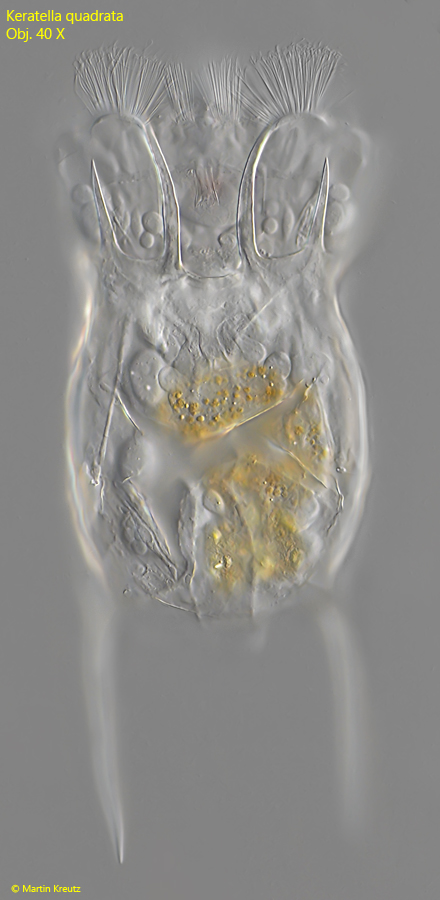
The basis form has an almost rectangular lorica. At the lateral sides of the broadly rounded posterior end, two straight or only slightly curved spines arise, with a length of 40–50 µm. The anterior margin is equipped with 6 spines. Two spines are positioned laterally and are somewhat spread apart, while four additional spines sit on the dorsal, anterior margin (s. fig. 3). These 4 spines are strongly bent ventrally, so that they cover the anterior opening of the lorica, from which the corona is extended.
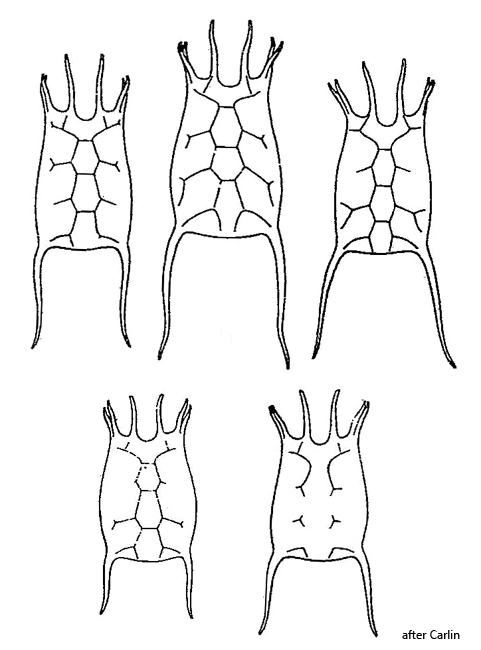
The dorsal side of the lorica is convex and has a polygonal faceting. The pattern of the faceting is variable in its division and clarity except for the anterior polygonal field. This is always hexagonal in Keratella quadrata.
Fig. 1 a-b:Keratella quadrata. L = 270 µm (with spines). Two focal planes of a specimen from ventral. The two lateral spines at the anterior margin are wisible as welln as the two long posterior spines. Obj. 40 X.
Fig. 2 a-b:Keratella quadrata. L = 270 µm (with spines). The same specimen as shown in fig. 1 a-b with focal plane on the eyespot and the 4 dorsal spines of the anterior margin. Obj. 40 X.
Fig. 3:Keratella quadrata. L = 260 µm (with spines). A second specimen from dorsal with focal plane on the 4 dorsal spines of the apical margin. Obj. 40 X.
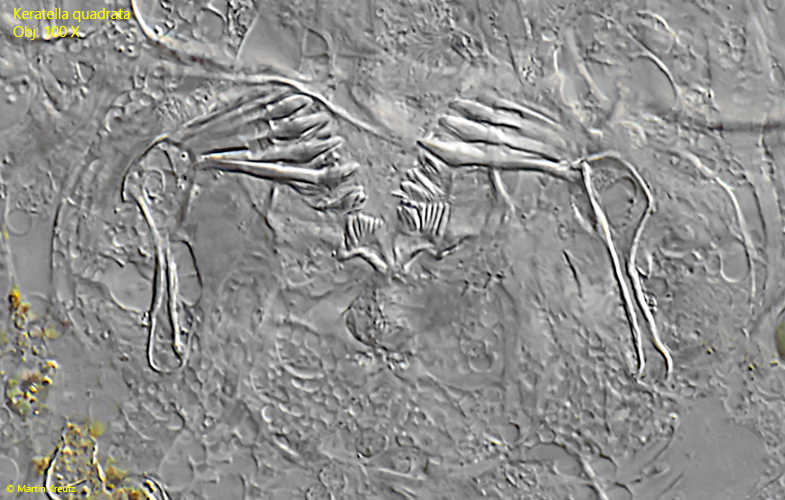
Fig. 4:Keratella quadrata. The trophi in a strongly squashed specimen. Obj. 100 X.