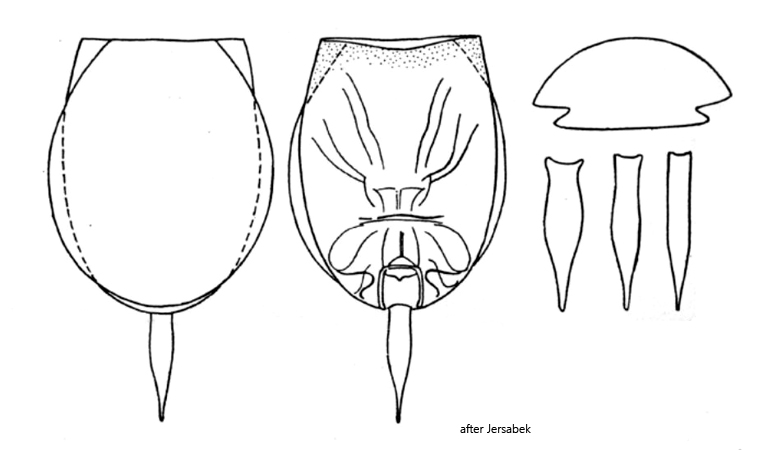
contracted lorica broad elliptical or almost spherical (when contracted)
length 54–85 µm (of lorica)
anterior ventral margin slightly concave
anderior dorsal margin straight
ventral plate with 4 longitudinal folds
2 foot segments
toes fused, 21–38 µm long
Lecane closterocerca
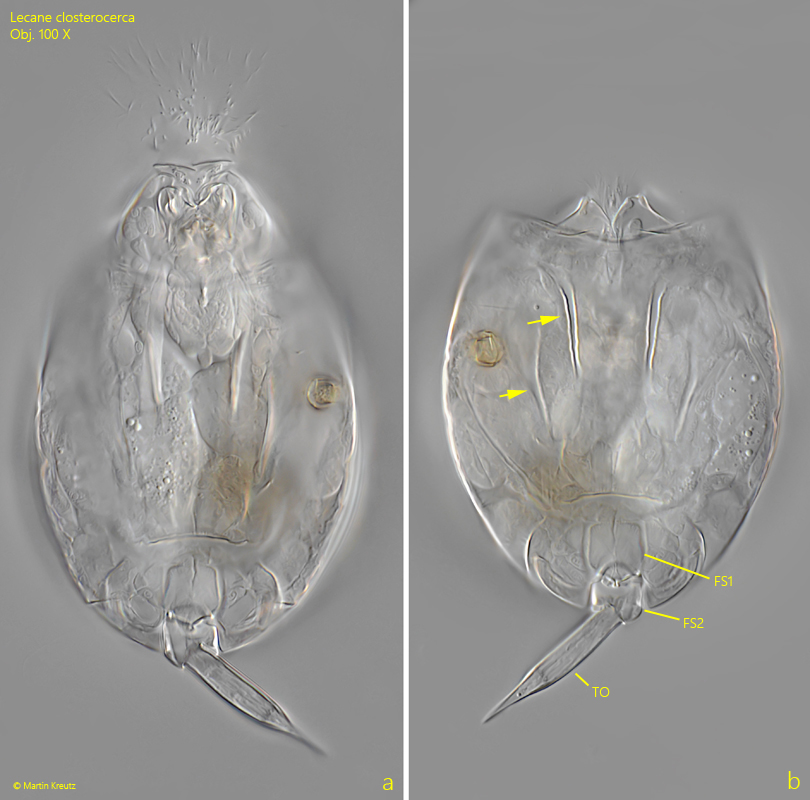
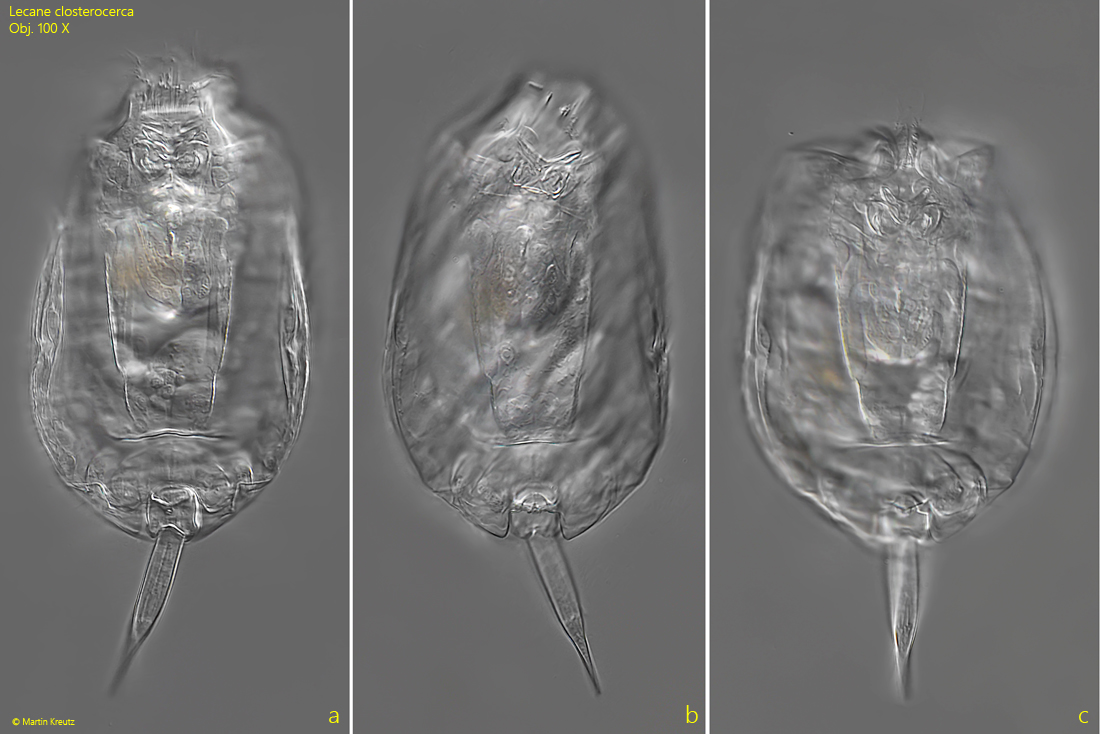
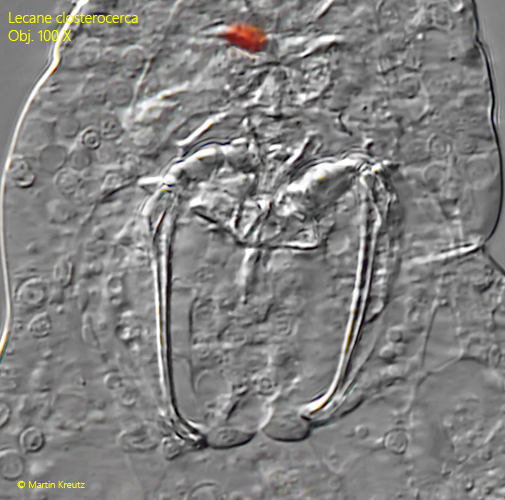
So far, I have found only very few specimens of Lecane closterocerca. I may also have overlooked other specimens, since identifying it requires examining the ventral plate of the lorica at high magnification. In contracted and slightly squashed specimens, the ventral plate shows 4 longitudinal folds, arranged parallel to one another and in a slight V-shape (s. fig. 1 b). In stretched specimens, the folds appear as two converging lines that approach one another in a step-like manner in the lower third (s. fig. 2 a).
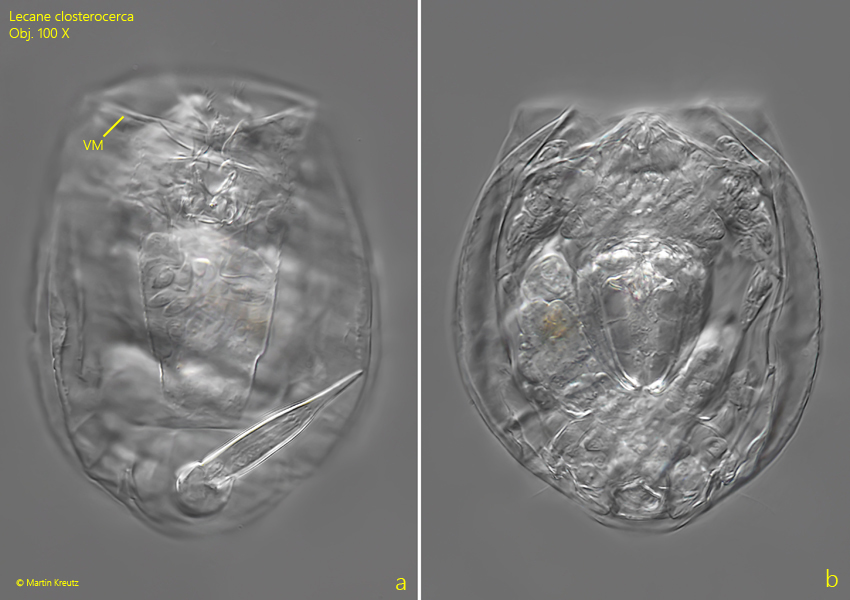
In the contracted state, the lorica is approximately spherical (s. fig. 3 b). The anterior margin is slightly concave or very obtuse-angled in shape (s. fig. 3 a). The foot consists of only two segments, which are approximately rectangular in shape (s. fig. 1 b). The toes are fused into a single one that tapers to a thin point (s. fig. 1 b).
Fig. 1 a-b:Lecane closterocerca. L = 95 µm (of elongated lorica). An almost elongated (a) and slightly retracted specimen (b) from ventral. Note longitudinal folds (arrows) of the ventral plate and the two foot segments (FT1, FT2). The toes are fused to a single toe (TO). Obj. 100 X.
Fig. 2 a-c:Lecane closterocerca. L = 83 µm (of elongated lorica). An elongated (a) and slightly retracted specimen (b) from ventral. Obj. 100 X.
Fig. 3 a-b:Lecane closterocerca. L = 74 µm (of retracted lorica). The same specimen as shon in fig. 1 a-c slightly (a) and fully retracted (b). The anterior ventral margin of lorica (VM) is slightly concave. Obj. 100 X.
Fig. 4:Lecane closterocerca. The trophy in a strongly squashed specimen. Obj. 100 X.