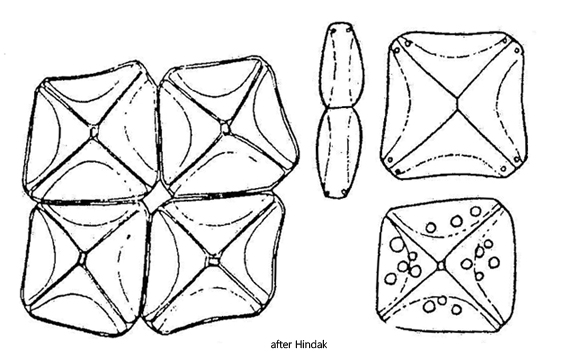
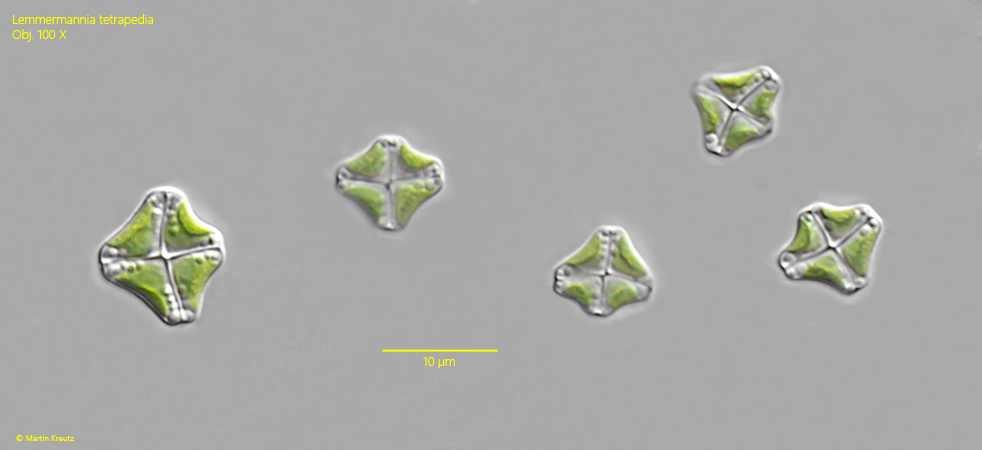
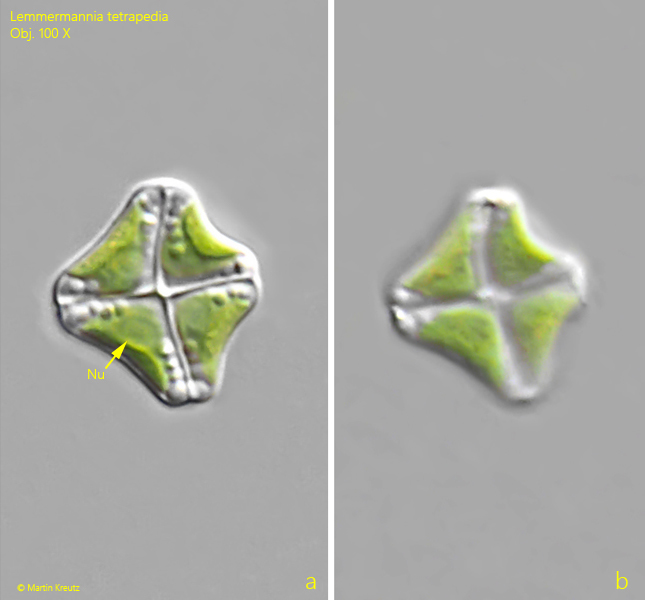
I rarely find Lemmermannia tetrapedia in plankton samples from the pond at the waste disposal company Constance. So far, I have found only coenobia with 4 cells. The cells are triangular, with the side facing outward being concave. In each cell, a chloroplast lies against the cell wall. It bends inward at the concave side of the cell and then forms a kind of pocket. In doing so, it also surrounds the cell nucleus, which lies in the middle of the cell. The cells in my population have always contained colorless oil droplets.
Fig. 1:Lemmermannia tetrapedia. D = 7–12 µm. Some coenobia of each 4 cells. Obj. 100 X.
Fig. 2:Lemmermannia tetrapedia. D = 12 µm. Two focal planes of a specimen as shown in fig. 1. The chloroplast lies against the cell wall and is folded over on the concave side. It surrounds the cell nucleus (Nu). Obj. 100 X.