So far I have only found Macrochaetus subquadratus in the Simmelried and the Paradieswiesen, where the species is rare and I only find specimens sporadically. I found the specimens between floating plant masses.
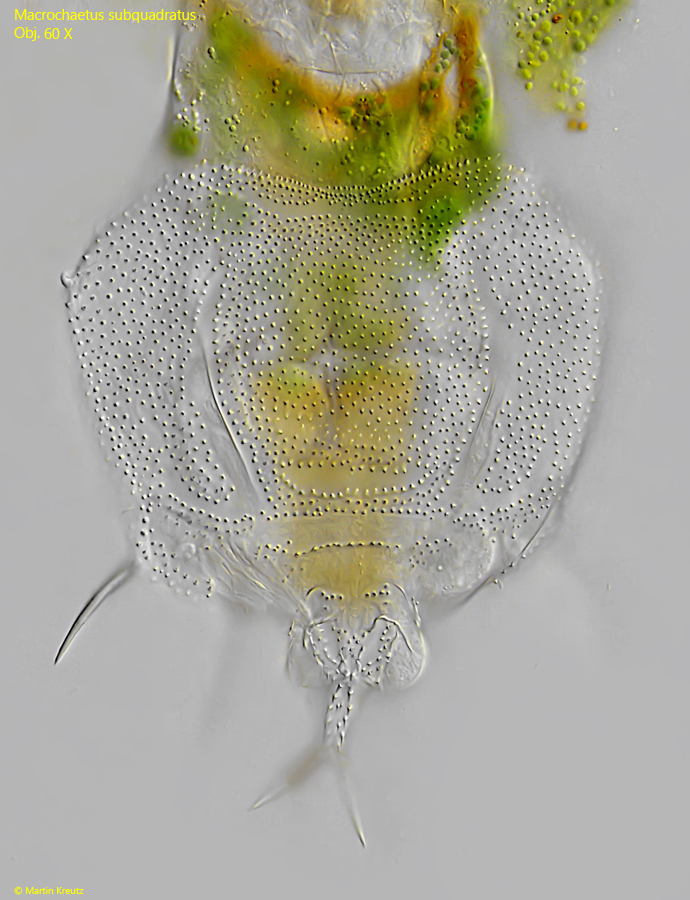
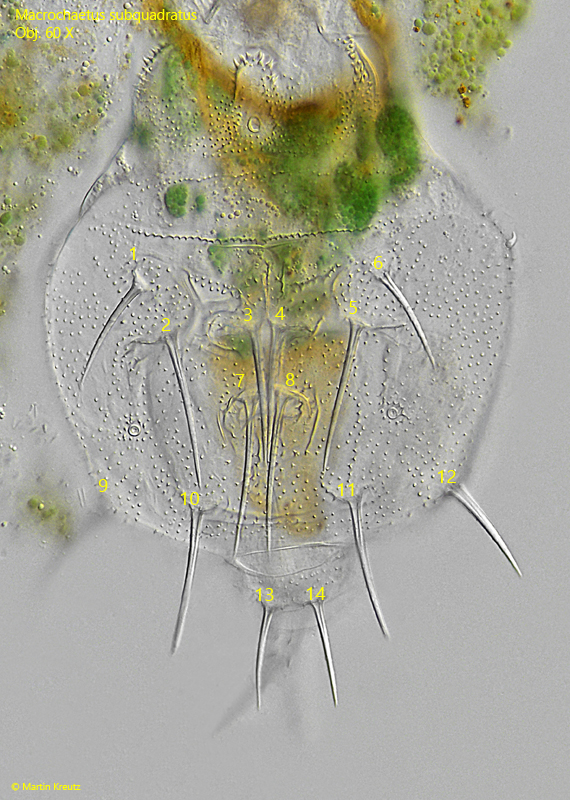
Macrochaetus subquadratus is very strikingly shaped and stands out even at small magnifications due to its 14 long dorsal spines (s. figs. 2 a-b, 3 and 5). The entire lorica is rigid and armed with small teeth in addition to the long spines. The lorica is also clearly granulated. The ventral side is flat with a distinct pattern of granules and small spine at the anterior margin of the lorica (s. fig. 4).
There are about 10 species within the genus Macrochaetus, all of which have loricae with long spines. It is therefore important to examine the number and position of these spines in detail in order to determine the exact species. So far I have found only Macrochaetus subquadratus, which seems to be the most common species in Central Europe.
Fig. 1 a-d:Macrochaetus subquadratus. L = 163 µm. A freely swimming specimen from dorsal (a-c) and ventral (d). Obj. 40 X.
Fig. 2 a-b:Macrochaetus subquadratus. L = 163 µm. Two focal planes of the dorsal side from the slightly squashed specimen as shown in fig. 1 a-d. Note the lateral antennae on the left and right side (LLA, RLA). Obj. 60 X.
Fig. 3:Macrochaetus subquadratus. The 14 dorsal spines (1–14) in a squashed specimen. DA = dorsal antenna, ES = eyespot, LLA = left lateral antenna, RLA = right lateral antenna. Obj. 60 X.
Fig. 4:Macrochaetus subquadratus. The pattern of the ventral side in a squashed specimen. Obj. 60 X.
Fig. 5:Macrochaetus subquadratus. The same squashed specimen as shown in fig. 4 but with the focal plane on the dorsal side (from ventral). The 14 dorsal spines are visible (1–14). Obj. 60 X.
Fig. 6 a-c:Macrochaetus subquadratus. L = 176 µm. A slightyl squashed second specimen from dorsal (a-b) and from lateral (c). Obj. 40 X.
Fig. 7 a-b:Macrochaetus subquadratus. Two focal planes of the trophi in a strongly squashed specimen. Obj. 100 X.