ventral side of lorica with longitudinal striation
dorsal anterior margin with 4 spines
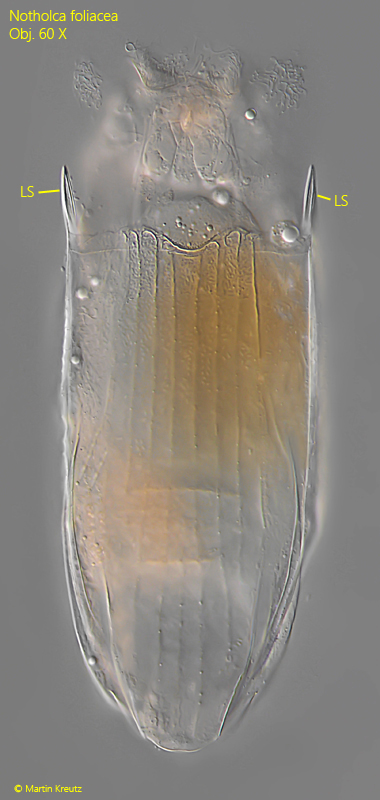
lateral anterior margin with 2 spines
anterior ventral margin with an U-shaped incision
one eyespot
Notholca foliacea
So far I have found Notholca foliacea only once in samples from the Odertal National Park. In the samples, however, the specimens were extremely rare and I was able to examine only three specimens in total.
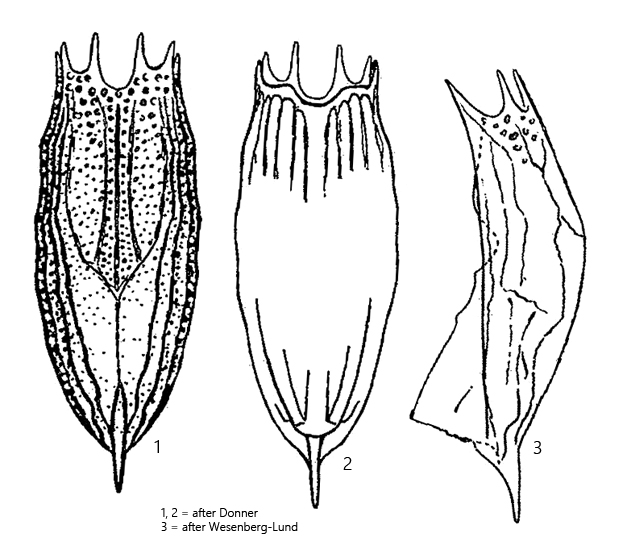
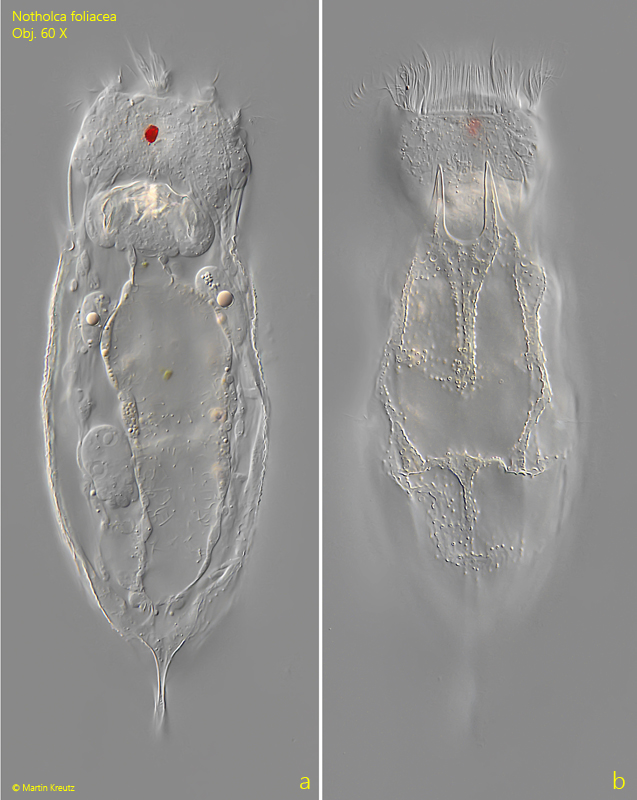
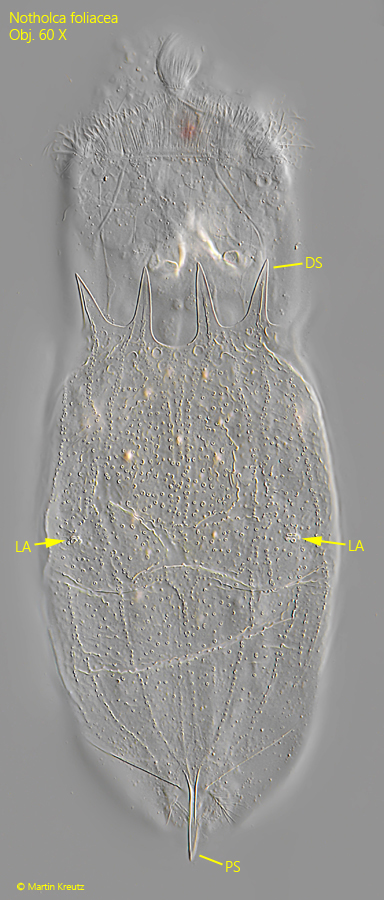
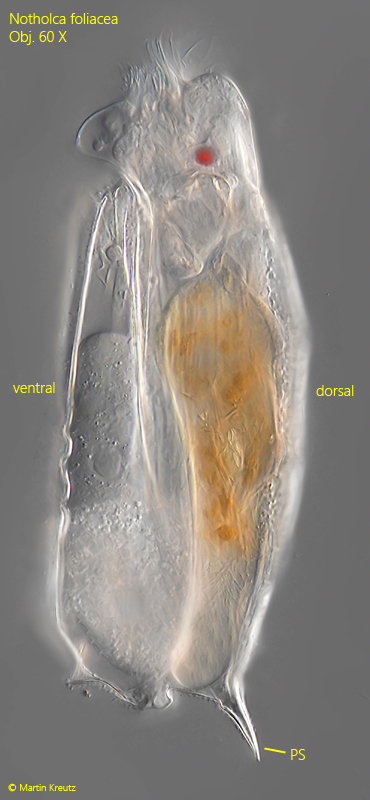
The dorsal side of the lorica is slightly convex and shows a faint field pattern and is distinctly granulated (s. fig. 1 b and 2). Four longer spines stand at the anterior margin (s. fig. 4). Two further spines are positioned laterally at the anterior margin (s. fig. 3). Striking is a slender spine at the posterior end (s. fig. 2). In lateral view one can see that it projects at an angle (s. fig. 4).
The ventral side of the lorica is almost flat and shows a longitudinal, parallel striation that is not very pronounced (s. fig. 3). Towards the anterior margin it seems to become more distinct. The anterior margin has no spines on the ventral side, but has a broad U-shaped indentation.
Fig. 1 a-b:Notholca foliacea. L = 184 µm (of lorica). Two focal planes of a slightly squashed specimen from dorsal. The lorica has a suggested field pattern and is clearly granulated. Obj. 60 X.
Fig. 2:Notholca foliacea. L = 184 µm (of lorica). The squashed specimen as shown in fig. 1 a-b. Note the pores of the lateral antennae (LA) and the posterior spine (PS). Obj. 60 X.
Fig. 3:Notholca foliacea. L = 177 µm (of lorica). A slightly squashed specimen from ventral. The longitudinal striation is visible and the U-shaped incision af the anterior margin. LS = lateral spines. Obj. 60 X.
Fig. 4:Notholca foliacea. L = 187 µm (of lorica). A slightly squashed specimen from left. The posterior spine sticks out at an angle. Obj. 60 X.
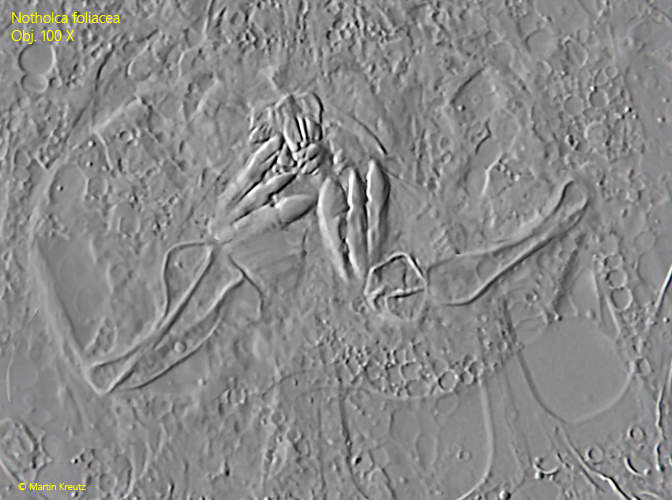
Fig. 5:Notholca foliacea. The trophi in a strongly squashed specimen. Obj. 100 X.