plates of chromatoplasm arranged in spirals from cell to cell
mucous sheath absent
Oscillatoria janus
I found Oscillatoria janus in July 2026 in old samples from the pond of St. Ulrich in Austria. The trichomes grew in thin mats on the mud at the bottom of the containers. Most of the time the trichomes were associated with other cyanobacteria.
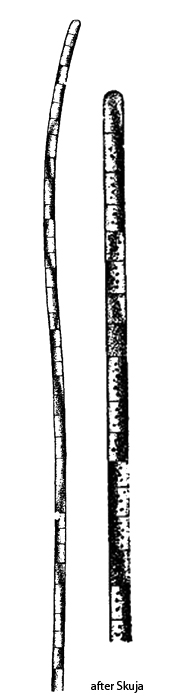
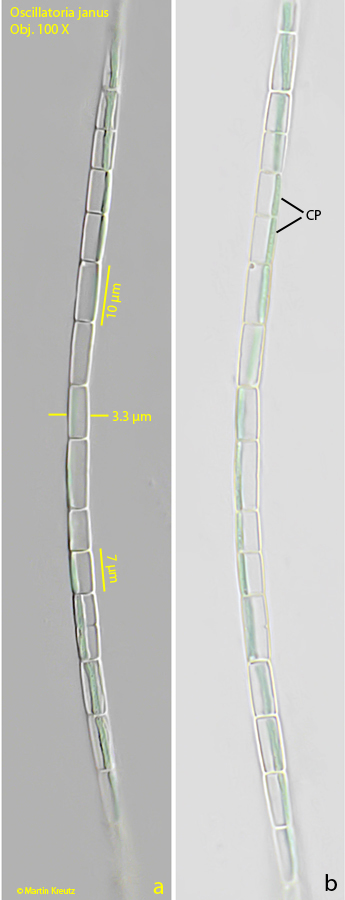
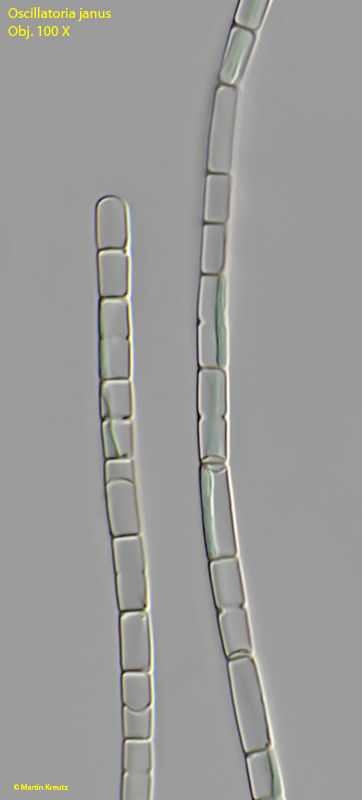
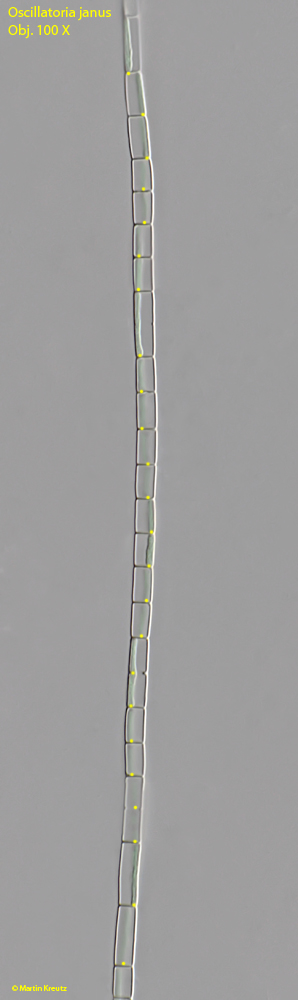
When looking at Oscillatoria janus, one might think one is dealing with a filamentous green alga, since the delicate blue-green chromatoplasm of this cyanobacterium lies in plate-like form against the cell wall (s. fig. 3 a-b). The largest part of the cells is colorless, and even in DIC no structure at all can be discerned in it. It could be a liquid-filled vacuole. This extraordinary arrangement of the chromatoplasm continues when one follows its position in the cells along the entire filament. Then one sees that the chromatoplasm is positioned slightly offset from cell to cell, resulting in a spiral arrangement along the filament (s. fig. 5). Skuja (1955) described this as a “spirally running, continuous band (of chromatoplasm)”.
The cells of my population were 5–12 µm long. Within the filaments many cell divisions occur, which is why the lengths vary greatly. The thickness of the filaments was 3.0–3.3 µm and thus somewhat thicker than the 2–2.5 µm given by Skuja. At the cross walls I was able to discern very slight constrictions, which are not mentioned by Skuja.
For Oscillatoria janus, apparently only Skuja’s description from 1955 exists so far, in which he placed this cyanobacterium in Oscillatoria. In fact, the features of Oscillatoria janus are rather untypical for this genus. Therefore, Anagnostidis and Komarek proposed in 1988 that the species should be assigned to the genus Jaaginema. However, due to the scant data and the lack of redescriptions, this has not yet happened, and the name Oscillatoria janus therefore remains valid.
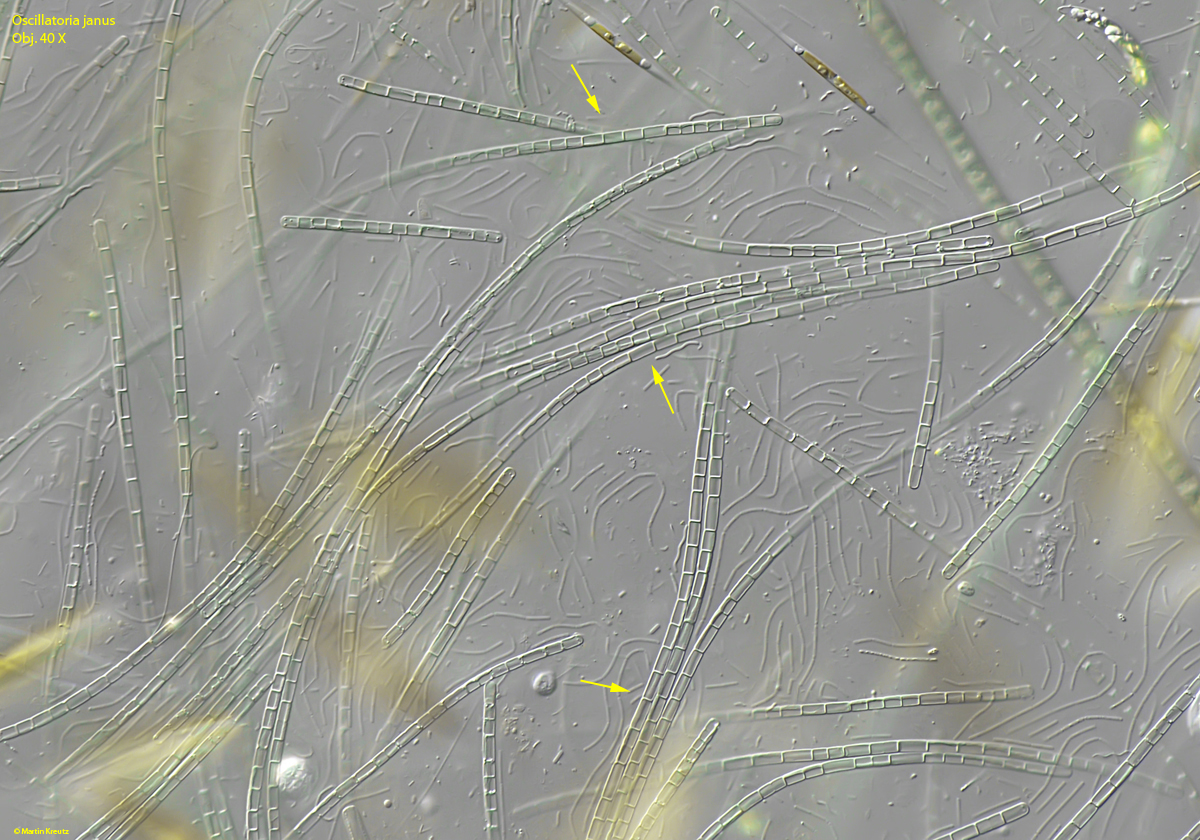
Fig. 1:Oscillatoria janus. A cluster of straight and slightly curved trichomes (arrows). Obj. 40 X.
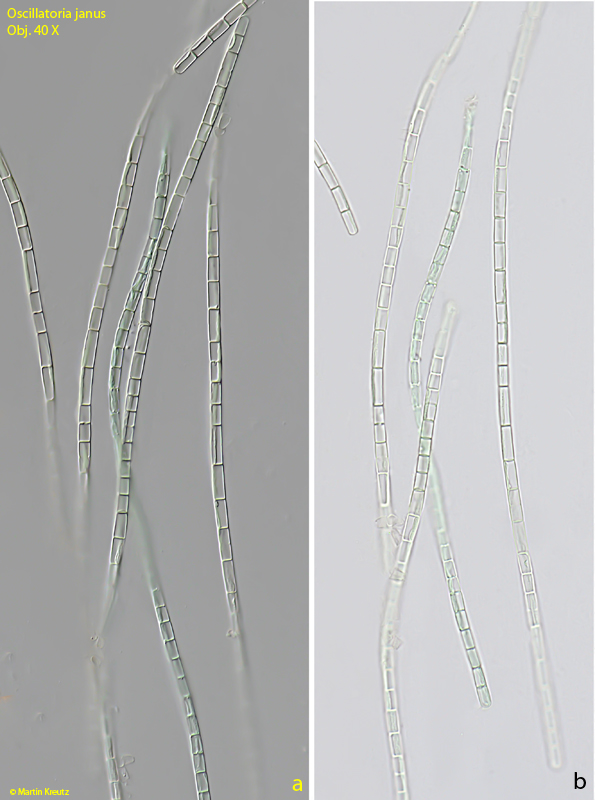
Fig. 2 a-b:Oscillatoria janus. Some trichomes in DIC (a) and brightfield illumination (b). Obj. 40 X.
Fig. 3 a-b:Oscillatoria janus. L = 5–12 µm (of cells). A single trichome in DIC (a) and in brightfield illumination (b). The diameter of the cells is 3.3 µm. Note the plate-shaped chromatoplasm (CP) in the cells, attached to the cell wall. The main part of the cells is colorless. Obj. 100 X.
Fig. 4:Oscillatoria janus. The terminal cells of the trichomes are rounded and not tapered. At the cross walls a slight constriction is visible. Obj. 100 X.
Fig. 5:Oscillatoria janus. The plate-shaped chromatoplasm of the cells is positioned slightly offset from cell to cell, so that along the filament it results in a spiral arrangement. For clarification, the positions of the chromatoplasm in the individual cells are marked with a yellow dot. Obj. 100 X.