In 2007 and 2008, I often found Petalomoas sexlobata in the uppermost layer of mud at Simmelried. After 2008, I was no longer able to detect this curious species.
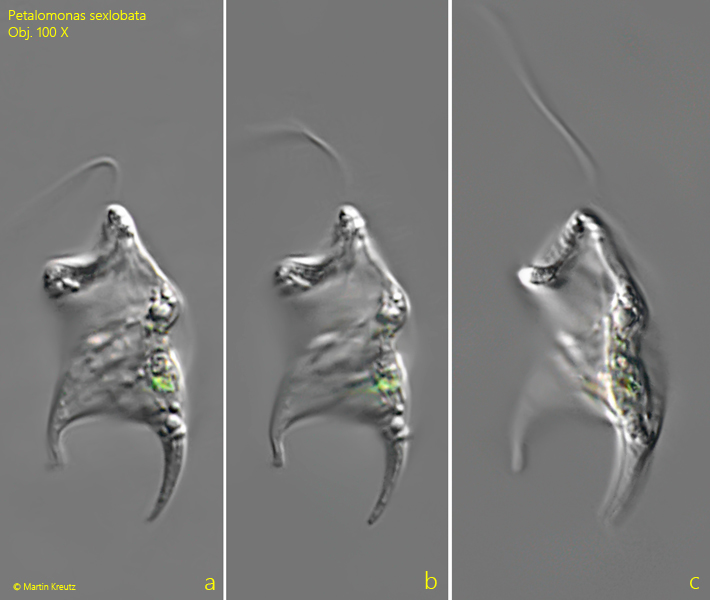
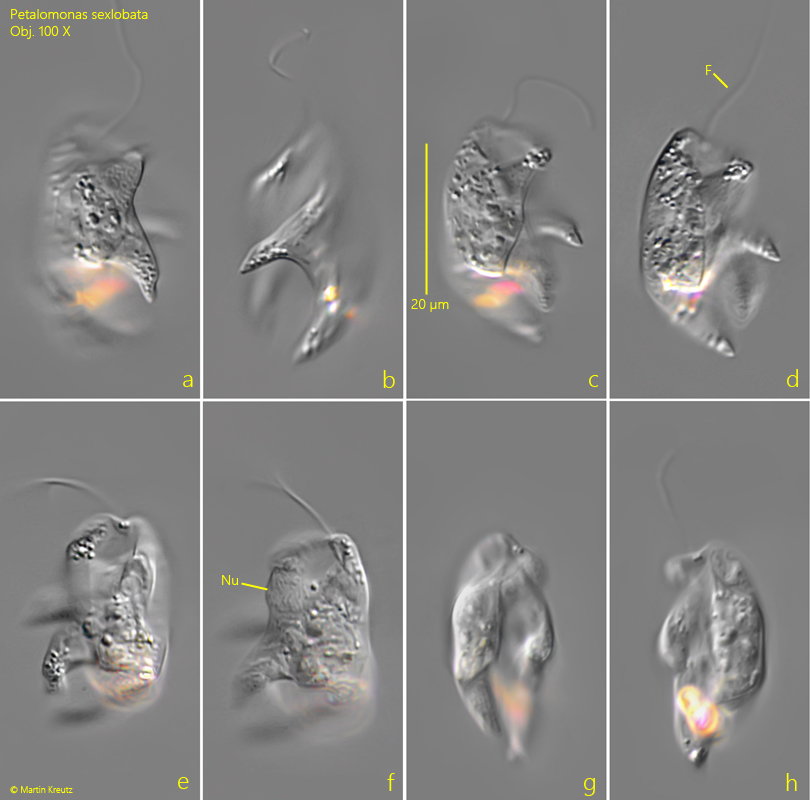
The available descriptions of Petalomonas sexlobata are extremely brief and may all ultimately derive from Klebs (1892). The species is said to have 6 projections that extend backward and curve inward. In my population, I found specimens with projections of varying lengths and shapes. It appeared that two of these projections were always longer than the others. Sometimes these longer projections were finger-shaped (s. fig. 1 a-c). I was also not always able to observe 6 projections. Sometimes there were only 4 or 5. The specimens measured 30–32 µm in length, which is consistent with the reported range of 27–30 µm given by Lemmermann (1913).
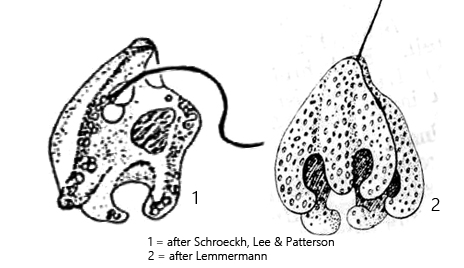
Although the shape of my specimens of Petalomonas sexlobata does not fully match the drawings by Schroeckh et al. and Lemmermann (s. drawings above), I see no other alternative. The species Petalomonas spinifera also has projections, but these are pointed rather than rounded. Petalomonas mira var. appendiculata has finger-shaped projections at the posterior end, but also has distinct ribs, which I was unable to observe in my specimens.
Fig. 1 a-c:Petalomonas sexlobata. L = 32 µm. Dorsal view on a freely swimming specimen with inwardly curved processes. Obj. 100 X.
Fig. 2 a-h:Petalomonas sexlobata. L = 31 µm. A second, freely swimming specimen from right (a, c, d), left (b) and from dorsal (e-f). Obj. 100 X.