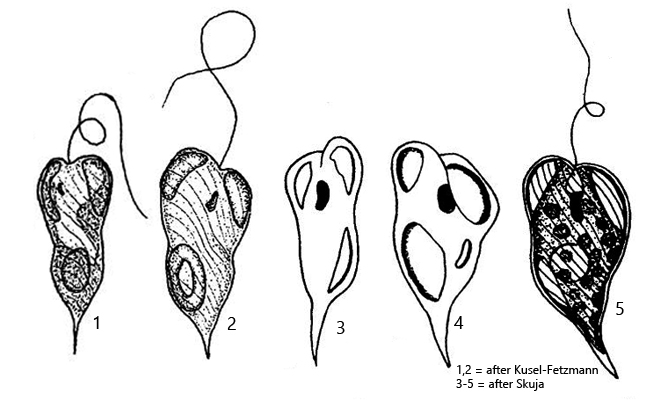
outline quite irregular due to cup-shaped paramylon grains
3–4 large, cup-shaped paramylon grains
cup-shaped paramylon grains located in anterior end and laterally
pellicle with counterclockwise striation
posterior half of cell tapered to a spine
chloroplasts disc-shaped
flagellum of body length
Phacus aenigmaticus
Although Phacus aenigmaticus is described as a common and widespread species, I was only able to detect it once in April 2026 in Simmelried. The population was located among floating, decomposing masses of plants together with other Euglenophyceae.
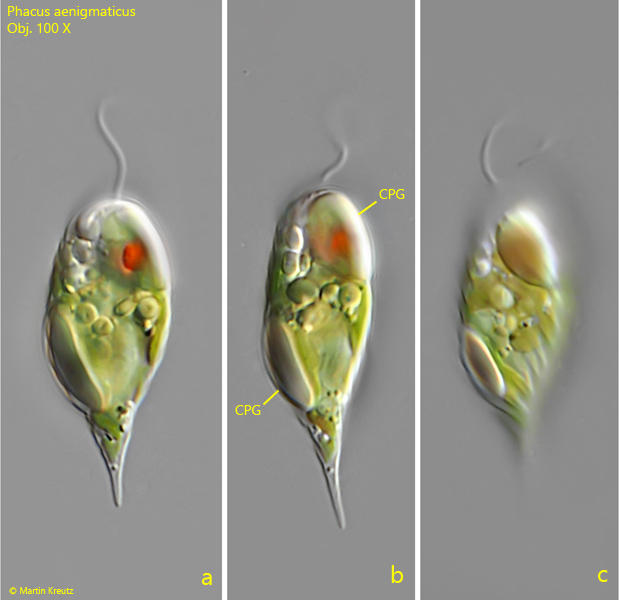
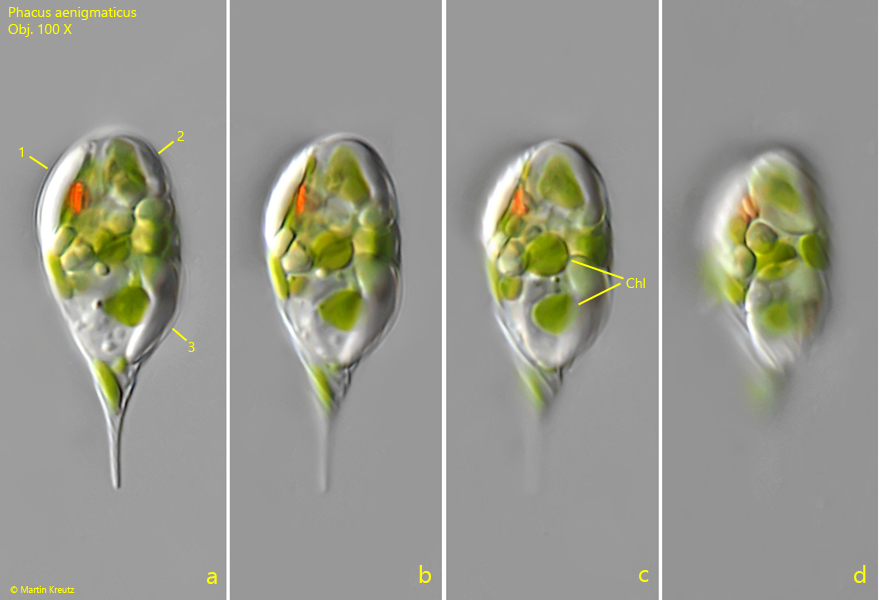
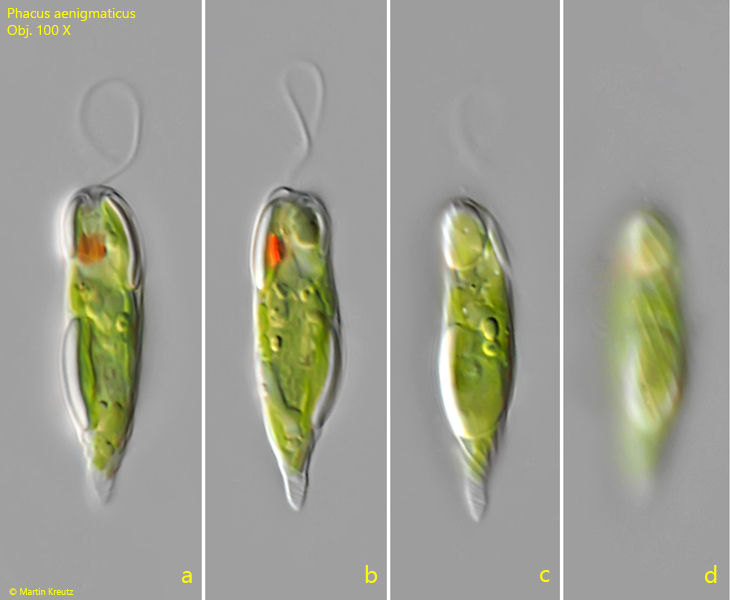
The most striking feature of Phacus aenigmaticus are the large, cup-shaped paramylon grains, which are located at the anterior end and in the middle of the body (s. fig. 1 b). In my population, there were usually 3 of these large paramylon grains present. They are located directly beneath the pellicle and can also deform the body. Usually, two of these paramylon grains are found at the anterior end, which often makes it thickened. In one specimen with a more slender body shape (s. fig. 3 a-d), I had the impression that a slight metabolic movement was possible, as the posterior end, which was drawn out into a blunt tip, changed its length while swimming. This was not observed by earlier authors. I was able to clearly recognize the disc-shaped chloroplasts in all specimens. Between the large paramylon grains, several smaller ones with oval or ellipsoidal shape are visible. These are mainly concentrated in the anterior half of the body. The eyespot is comparatively large and the distinct striation of the pellicle runs counterclockwise. It extends to the end of the caudal spine.
Fig. 1 a-c:Phacus aenigmaticus. L = 34 µm. A freely swimming specimen. Note the large, cup-shaped paramylon grains (CPG) located in the anterior end and laterally in mid-body. Obj. 100 X.
Fig. 2 a-d:Phacus aenigmaticus. L = 32 µm. A second specimen with three cup-shaped paramylon grains (1–3). Chl = disc-shaped chloroplasts. Obj. 100 X.
Fig. 3 a-d:Phacus aenigmaticus. L = 32 µm. A third, freely swimming specimen with a more slender shape and a short spine. Obj. 100 X.