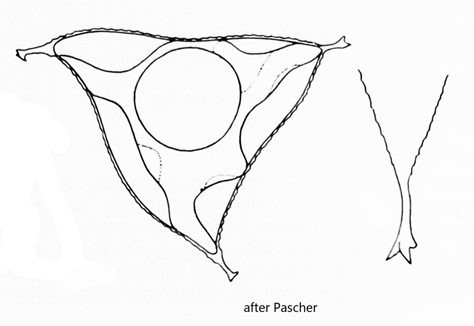
cell flat, triangular in shape, sometimes point-symmetrically rotated
cell form
15–20 µm across
three ends with 2–3 spines or tubercles
cell wall smooth or granulated (hard to see)
sides between the arms are concavely indented
about 12 chloroplasts, disc-shaped
no pyrenoids
Pseudogoniochloris tripus
I have found Pseudogoniochloris tripus so far only very sporadically in the Simmelried, often between decomposing plant masses or between accumulations of filamentous algae. The cells of my population were larger with a diameter of about 35 µm than the range of 15–20 µm given by Pascher. Nevertheless, all other characteristics match Pascher’s description, so I assume that the larger cells are within the natural variance. This alga belongs to the yellow-green algae (Xanthophyceae). These differ from the green algae (Chlorococcales) in that they produce the reserve substance chrysolaminarin rather than starch. Under the light microscope, the chloroplasts of the yellow-green algae appear lighter and more yellowish than those of the green algae.
Fig. 1 a-b: Pseudogoniochloris tripus. d = 35 µm. Two focal planes of a slighty squashed specimen. Note the tiny spines at the distal ends of the arms (arrow). Chl = disc shaped chloroplasts. Obj. 100 X.