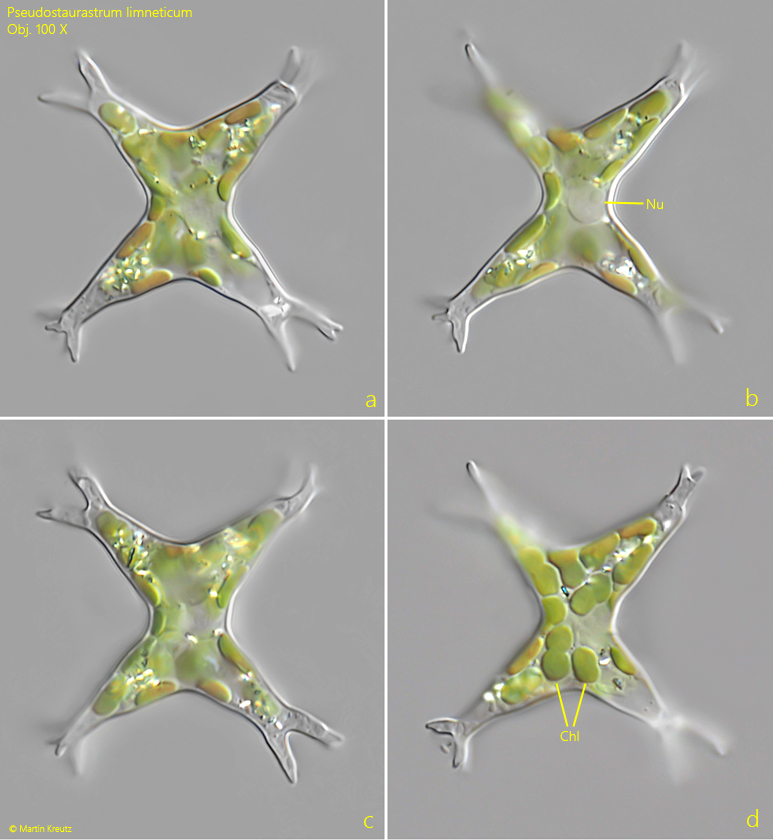
I have found Pseudostaurastrum limneticum only once so far, in a few specimens in a plankton sample from the pond at the Fliesshorn campsite in October 2026. The specimens stand out immediately in the samples because of their star shape. The 4 arms point toward the corners of a tetrahedron, although I have found that there are also flatter specimens shaped like a deformed tetrahedron. The ends of the arms are dichotomously forked. Each of the two ends bears two blunt spines.
I found the round nucleus in the central part of the cell, shifted slightly toward the margin (s. fig. 1 b). Numerous disc-shaped chloroplasts, which are yellow-green in color, lie against the cell wall (s. fig. 1 d).
Pseudostaurastrum limneticum was formerly classified among the yellow-green algae (Xanthophytes). Later, it was placed among the Eustigmatophytes, since it has only chlorophyll a, but not chlorophylls b and c.
Fig. 1 a-d:Pseudostaurastrum limneticum. L = 42 µm. Different focal planes of a specimen found in October 2026. Note the nucleus (Nu) and the disc-shaped chloroplasts (Chl). Obj. 100 X.