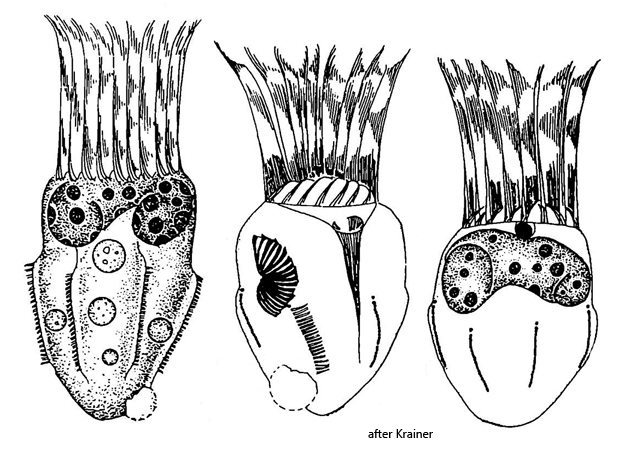
oral apparatus anterior with 18–19 adoral membranelles
six slightly spiral rows of short bristles limited to mid-body
macronucleus semicircular near anterior end
one spherical micronucleus
contractile vacuole subterminal
Rimostrombidium brachykinetum
I found a few specimens of Rimostrombidium brachykinetum in the pond of the convent Hegne. In the samples, the specimens gathered at the surface after some time.
Rimostrombidium brachykinetum is not easy to photograph at high magnifications, as the specimens swim very quickly and also swell and burst very quickly under the coverslip. However, an examination at high magnification is necessary to recognize the features for identification. This particularly concerns the 6 rows of short bristles, which run slightly spirally in the middle of the body or just below it. They have the same distance from each other and run on slightly raised ribs, which is best seen in an apical view.
The light microscopic images, which I show here in fig. 1 a-f, seem to differ significantly from Krainer’s drawings (s. above). However, it should be considered that the drawings are also based on electron microscopic images of fixed individuals. The essential characteristic of the genus Rimostrombidium, the spiral rows of short bristles, can also be seen under the light microscope (s. figs. 1 a and 1 b). In my specimens, these rows of bristles extended at most to the anterior third and ended there (s. fig. 1 e and 1 f). In the similar species Rimostrombidium humile, these 6 rows run from the anterior end and meet at the terminal end. I could not recognize this arrangement of long rows of bristles, which is why I believe that this is Rimostrombidium brachykinetum.
I could not precisely identify the macronucleus, which lies transversely and semicircularly directly under the adoral zone. The contractile vacuole was also not clearly visible. My specimens were between 24–27 µm long, which is at the upper end of the range given by Krainer.
Fig. 1 a-f:Rimostrombidium brachykinetum. L = 27 µm. Different focal planes of a freely swimming specimen. Note the ciliary rows of bristles (CRB). These rows of bristles end in the anterior third of the body or near mid-body (arrows). AZM = adoral zone of membranelles, CV ? = probably the contractile vacuole. Obj. 100 X.