Phylogenetic tree: Staurastrum avicula var. exornatum
Diagnosis:
cells 3-radiate
semi-cells oval
length 28–40 µm, width 27–40 µm
apices slightly convex
distal ends of arms with one pair of spines
isthmus narrow
sinus acutely angled, greatly expaned outward
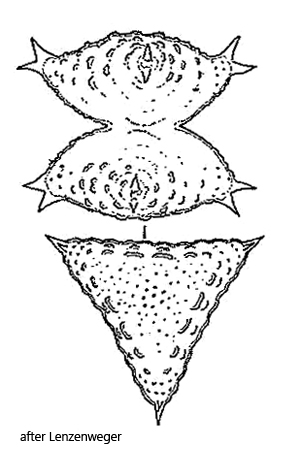
cell wall ornamented with elongated warts
some warts with small teeth
Staurastrum avicula var. exornatum
I find Staurastrum avicula var. exornatum in the Simmelried at intervals of several years. The species seems to be more frequent especially in the summer months.
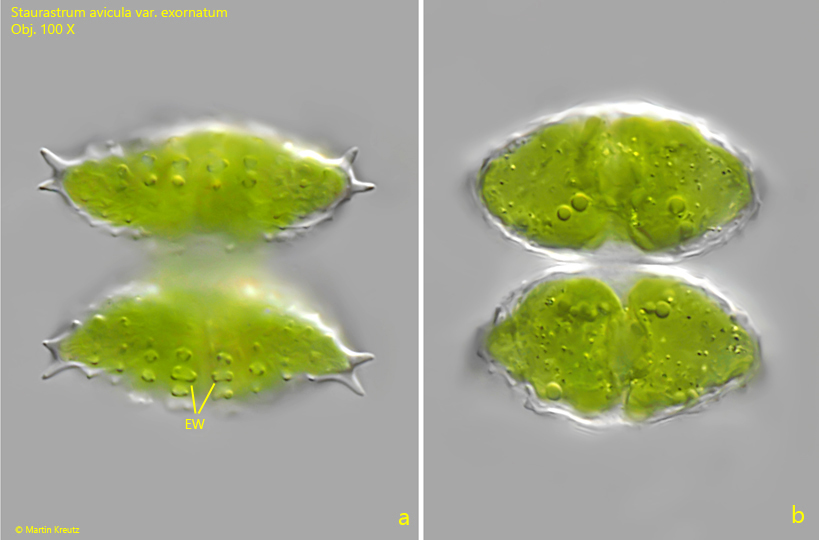
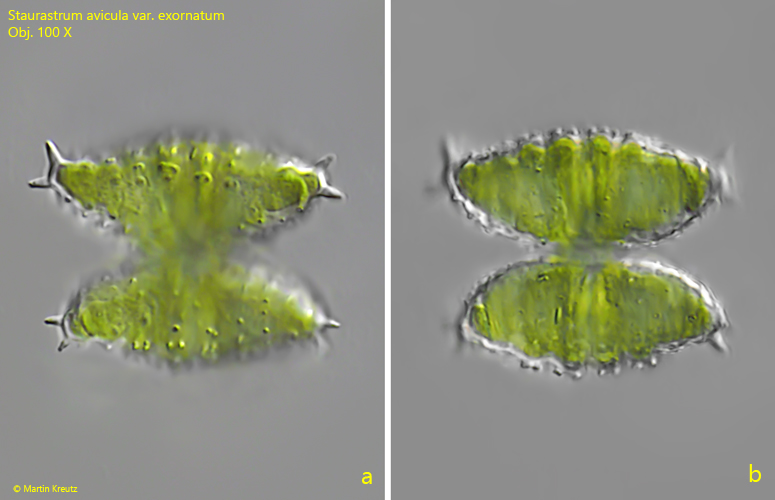
The species is easily recognizable by the typical pair of short spines at the end of the arms. These are oriented parallel to the longitudinal axis of the cell. As a result they are always clearly visible in a single focal plane (s. figs. 1 a and 2 a). The sinus of Staurastrum avicula var. exornatum is widely open. In contrast to the typical form, Staurastrum avicula var. exornatum has elongated, elliptically shaped warts that cover the cell wall. The two ends of the warts rise to very short spines, which can be clearly seen when focusing through the cell.
Lenzenweger (1997) suspects that these elongated warts, as a distinguishing feature from the typical form Staurastrum avicula, possess a dubious taxonomic value. Nevertheless, this variety has been taxonomically recognized.
Fig. 1 a-b:Staurastrum avicula var. exornatum. L = 37 µm. Two focal planes of a specimen found in July 2025. Note the elongated warts (EW) covering the cell wall. Obj. 100 X.
Fig. 2 a-b:Staurastrum avicula var. exornatum. L = 28 µm. A second specimen found in July 2016. Obj. 100 X.