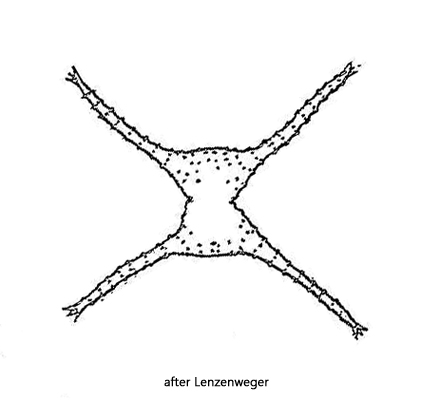
length of processes very variable, depending on habitat
planktonic lifestyle
Staurastrum chaetoceras
So far, I have found Staurastrum chaetoceras exclusively in the pond of the convent Hegne. Most specimens were biradiate and only a few specimens were triradiate. The specimens of my population were between 22–28 µm long (including projections), which fits well with the length data from Lenzenweger (1997). The length of the processes in this species is very variable and, according to Lenzenweger, depends on the flow velocity in the water body. In waters without current, the processes are supposed to be the shortest.
John et al. (2002) describe Staurastrum chaetoceras as significantly larger. According to them, specimens with processes can reach 46–94 µm in length and 50–77 µm in width. Which population was studied remains unclear. Bettighofer also found Staurastrum chaetoceras on the island of Fehmarn in 2014 with very similar dimensions to those in my population. Therefore, I base my description of this species on Lenzenweger’s account.
Fig. 1 a-b:Staurastrum chaetoceras. L = 28 (with processes). Two focal planes of a biradiate specimen. Obj. 100 X.
Fig. 2 a-b:Staurastrum chaetoceras. L = 23 (with processes). Two focal planes of a second, biradiate specimen. Obj. 100 X.
Fig. 3 a-b:Staurastrum chaetoceras. L = 26 (with processes). A triradiate specimen from the same sampling site as the biradiates specimen shown above. Obj. 100 X.